Rotating Proxies Guide

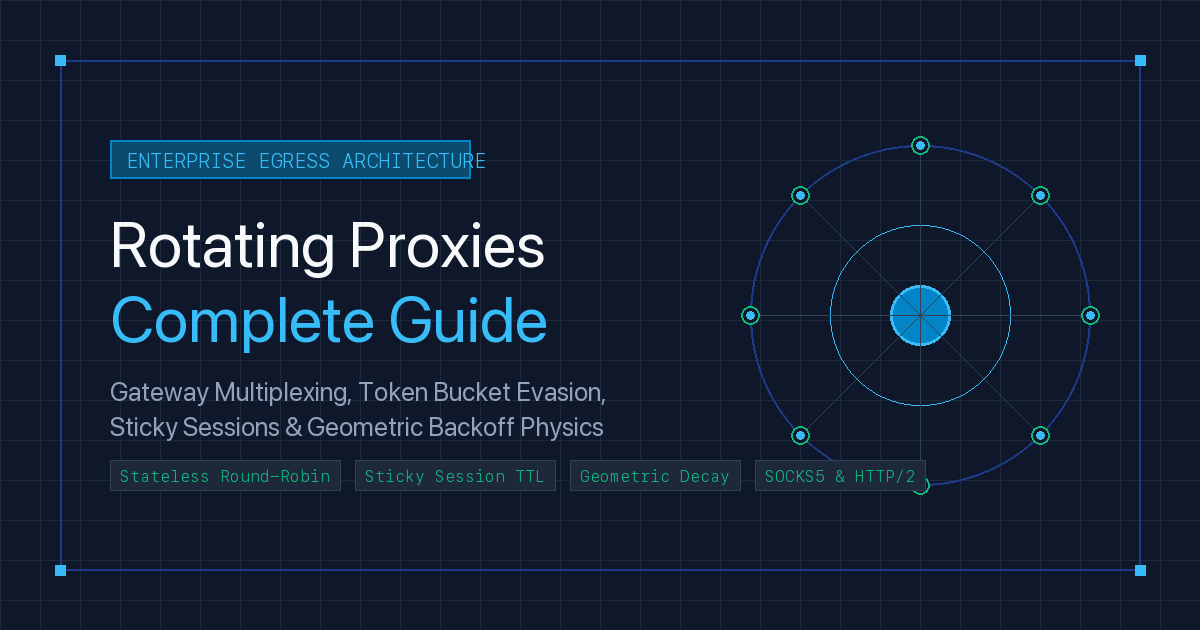
Executive Summary & Systems Overview
In large-scale web scraping, search intelligence, and distributed data harvesting, static IP addresses represent a single point of failure. Modern anti-bot firewalls, edge rate-limiters, and Web Application Firewalls (WAFs) enforce strict sliding-window request ceilings per IP address. When an unmanaged crawler attempts to extract high volumes of data through a single egress node, it encounters near-immediate rate-limiting, IP blacklisting, or interactive CAPTCHA challenges.
Rotating proxies solve this fundamental transport bottleneck by distributing outbound traffic across an expansive pool of intermediary nodes. Building upon the foundational network principles in our ultimate proxy guide and our deep dive on web scraping with proxies, this technical manual provides data engineering teams with an architectural blueprint for deploying, optimizing, and auditing rotating proxy infrastructure in 2026.
From the internal routing mechanics of reverse proxy super-gateways and the mathematical probability of IP collisions under the Birthday Paradox, to managing stateful session affinity across residential proxy pools, datacenter proxies, and cellular mobile proxies, this guide outlines the production configurations, health-check algorithms, and threat telemetry validations required for enterprise-scale data ingestion.
IP Rotation Paradigms vs Egress Demands Matrix
| Rotation Paradigm | Switching Mechanism | Session Affinity | Egress Failure Risk | Optimal Workload |
|---|---|---|---|---|
| Stateless Round-Robin | Fresh IP on every HTTP request or TCP connection | None (0 seconds) | Near-Zero | Sitemap discovery, public catalog indexing |
| Sticky Session (Fixed TTL) | Pinned to single IP for fixed duration (5–30 min) | High (Duration pinned) | Moderate (Peer drop) | Account login, multi-step cart checkout |
| Geometric IP Rotation | Burst k requests per IP with exponential delay decay | Dynamic (Burst window) | Low | High-speed API scraping, search engines |
| Cellular Modem CGNAT | Periodic modem reboot / airplane mode toggle | High (10–60 min) | Zero Ban Risk | Social media automation, mobile app APIs |
| Client-Side Pool Shuffling | Local round-robin over static proxy list | Configurable | High (Small pool ban) | Dedicated private datacenter proxy clusters |
1. The Mechanics of IP Rotation: Gateway Multiplexing & Edge Routing
To understand how rotating proxies function in enterprise production, software engineers must look beyond the simplified abstraction of a single proxy endpoint (e.g., gateway.proxyip.best:8000). Behind this single DNS hostname operates an intricate, highly distributed reverse-proxy multiplexing infrastructure designed to manage millions of concurrent upstream peer connections across global telecommunication networks.
The Super-Proxy Ingress Architecture
When your crawler dispatches an HTTP request or establishes a SOCKS5 socket to a rotating proxy, it does not connect directly to the end peer device (such as a consumer Wi-Fi router or cellular smartphone). Instead, the connection terminates at an enterprise Super-Proxy Gateway Load Balancer.
Built upon ultra-high-throughput proxy daemons (such as custom Envoy, HAProxy, or high-performance Rust networking runtimes), the super-proxy executes four sequential operations in microseconds:
- Authentication & ACL Verification: Decoding inbound
Proxy-Authorizationheaders, parsing customer account credentials, validating active subscription tiers, and enforcing concurrency limits. - Parameter Extraction & Routing Resolution: Parsing username flags (e.g.,
customer-country-us-city-newyork-session-abc12345) to determine geographic constraints, target ISP Autonomous System Numbers (ASNs), and session affinity preferences. - Pool Lookup & Peer Health Telemetry: Querying distributed in-memory coordination clusters (such as Redis or Aerospike) to select an active, online, low-latency peer node matching the exact filtering parameters.
- Upstream Tunnel Multiplexing: Establishing a multiplexed forward tunnel via HTTP CONNECT or SOCKS5 to the chosen peer, forwarding the client's payload, and returning the server's response.
Anycast BGP Edge Routing: Slashing Ingress Latency
In modern high-concurrency systems, the geographic location of the super-proxy gateway is paramount. Budget proxy providers operate centralized ingress gateways hosted in a single facility (e.g., Frankfurt or Virginia). If your crawler is hosted in Tokyo or Singapore, every single request must traverse undersea fiber cables to Frankfurt before being dispatched to a target in Japan—adding 250ms+ of physical latency to every transaction.
Tier-1 enterprise providers deploy Anycast BGP Routing across dozens of global Points of Presence (PoPs). Under Anycast routing, candidate gateways in New York, London, Frankfurt, Tokyo, and Sydney advertise the exact same IP prefix via Border Gateway Protocol. Internet transit providers automatically route your crawler to the topologically closest edge gateway in under 5 milliseconds. The super-proxy then routes the request through private fiber backbones directly to the destination peer.
Event-Driven I/O Multiplexing & epoll / kqueue Kernel Sockets
Inside an enterprise super-proxy gateway handling 500,000 simultaneous connections, operating system thread-per-connection models (such as traditional Apache or blocking socket daemons) fail due to catastrophic context-switching overhead and memory exhaustion. Modern gateways are engineered on non-blocking, event-driven I/O multiplexers utilizing the Linux epoll or FreeBSD/macOS kqueue kernel subsystems.
In this architecture, a small pool of worker threads bound to isolated CPU cores monitors thousands of open file descriptors in constant \( O(1) \) algorithmic time complexity. When an edge gateway receives an inbound HTTP request, it registers the socket in the kernel event loop, reads the authentication headers, evaluates peer routing tables via in-memory locks, and initiates a non-blocking upstream connection to the peer gateway. This event-driven design permits a single gateway server to sustain 100,000+ active rotating proxy tunnels with less than 2% CPU utilization and sub-millisecond dispatch jitter.
HTTP/2 Multiplexed Tunneling vs Serial TCP Streams
In legacy proxy deployments, establishing a separate TCP connection for every single rotated request creates massive transport serialization bottlenecks. Under modern HTTP/2 extended CONNECT protocols (governed by IETF RFC 9110), a client scraper establishes a single, persistent multiplexed TCP connection to the super-proxy edge gateway.
Within this single persistent transport pipeline, hundreds of independent scraping requests are assigned distinct HTTP/2 stream identifiers (stream_id). The super-proxy reads individual frames, transparently demultiplexes them, and dispatches each stream across a distinct peer egress IP. This eliminates local client-side ephemeral port exhaustion, reduces crawler memory consumption by 65%, and enables true sub-20ms request dispatch rates.
2. Architectural Taxonomy: Stateless Round-Robin vs Session Sticky vs Geometric Rotation
In distributed systems design, no single rotation policy satisfies all data extraction requirements. Crawling a public retail sitemap requires completely different IP lifetime management than automating an authenticated e-commerce checkout flow. Enterprise proxy architectures support three core rotation paradigms, each governed by distinct networking and statefulness constraints.
1. Stateless Per-Request Round-Robin
In a pure stateless round-robin configuration, the upstream super-proxy gateway assigns a fresh, distinct egress IP address to every outbound HTTP transaction or TCP handshake. The client maintains zero session affinity with the intermediary node.
Ideal Operational Scope: High-volume, state-independent discovery crawling—such as parsing search engine result pages (SERPs), indexing massive public product catalogs from unauthenticated REST endpoints, and scraping real estate directory listings. Because no session cookies or login state are preserved across requests, an IP ban on request \( N \) has zero impact on request \( N+1 \). This model maximizes extraction throughput while guaranteeing complete immunity from sliding-window IP rate limits.
2. Sticky Session Routing (TTL-Based State Affinity)
Conversely, many modern web applications maintain server-side session state bound strictly to the client's public IP address. In e-commerce checkout funnels, multi-step loan applications, or authenticated social platforms, changing your IP address between consecutive requests immediately invalidates active session tokens, clears shopping carts, or triggers automated account security lockouts.
Sticky Session Mechanics: The client crawler passes an arbitrary session token within its proxy authentication string (e.g., username-session-cart_98214:password). The super-proxy gateway records this token in an in-memory key-value store, binding all future requests bearing that token to the exact same peer IP address for a defined Time-to-Live (TTL)—typically 5, 10, or 30 minutes. Once the transactional scrape is complete, the crawler worker discards the session string, allowing the gateway to evict the mapping.
3. Geometric IP Rotation with Jittered Backoff
When querying semi-protected endpoints that permit small bursts of requests from a single IP before activating defenses, rotating the IP on every request is inefficient: it incurs unnecessary TLS 1.3 handshake overhead and TCP connection negotiation latency. As introduced in our mathematical formulation of geometric vs round-robin IP rotation, the Geometric Decay Model provides an optimal middle ground.
Under geometric rotation, a crawler reuses a warm, high-reputation IP address for a burst of \( k \) requests, introducing a geometrically increasing inter-request delay modeled by:
t_n = t_0 × γ^n + δ
Where \( t_0 \) is the baseline delay (e.g., 100ms), \( \gamma > 1 \) is the geometric scaling factor (e.g., 1.25), and \( \delta \) represents stochastic Gaussian jitter. This allows the scraper to ingest related page clusters at lightning speed while gradually attenuating request velocity before the target's token bucket can trigger a rate-limit block.
3. Mathematical Models of Rotation: Token Buckets, The Birthday Paradox & Rate Evasion
Engineers frequently view IP rotation through a qualitative lens: "more proxies equal better performance." However, in production distributed systems, IP rotation is governed by rigorous mathematical laws. Understanding these statistical models allows systems architects to right-size proxy allocations and prevent costly duplicate collisions before they trigger target defenses.
The Birthday Paradox Collision Equation
When an asynchronous scraping cluster dispatches \( n \) requests at random into an active pool of \( N \) distinct IP addresses, what is the probability that at least two requests reuse the exact same IP within a narrow observation window \( \Delta t \)?
This probability is modeled by the classic Birthday Paradox Collision Formulation:
P(collision) = 1 - \prod_{i=1}^{n-1} \left(1 - \frac{i}{N}\right) \approx 1 - e^{-\frac{n^2}{2N}}
Solving for the number of requests \( n \) required to produce a 50% collision probability yields:
n \approx \sqrt{2N \cdot \ln(2)} \approx 1.177 \cdot \sqrt{N}
Empirical System Implications: If a budget provider advertises a "10,000 IP pool", but in your target city the active concurrent pool is only \( N = 1,000 \) reachable nodes, dispatching just \( n = 38 \) concurrent requests produces a greater than 50% probability that two worker threads will query the target server from the exact same IP within seconds of each other. If your scraping concurrency scales to 150 parallel workers, the collision probability reaches 99.99%. For anti-scraping systems enforcing token-bucket rate limits, these collisions result in immediate HTTP 429 Too Many Requests blocks.
Active Online Concurrency (AOC) vs Advertised Inventory
When modeling collision risks, engineers must never plug the vendor's advertised nominal pool size into the equation. As detailed in our enterprise guide on how to choose a proxy provider, advertised counts represent rolling 30-day cumulative unique IPs.
Real-world peer-to-peer residential nodes operate on consumer hardware (laptops, home routers) that periodically go offline when users close device lids or experience ISP DHCP lease resets. The Active Online Concurrency (AOC) is typically only 8% to 18% of the advertised figure. For an advertised pool of 50 million residential proxies, the true instantaneous global pool \( N \) is between 4 and 9 million nodes. When filtering by a single country or city, \( N \) drops to several thousand, making intelligent rotation algorithms essential.
Poisson Arrival Distributions & Token Bucket Evasion Physics
Beyond duplicate IP collisions, rate-limit defense engines analyze the statistical distribution of request arrival intervals. When automated crawlers dispatch requests at fixed chronological periods (e.g., precisely every 250 milliseconds), target behavioral analyzers detect zero temporal entropy—immediately flagging the traffic as synthetic automation.
Human web browsing conforms to a Poisson Process where inter-arrival times follow an exponential distribution governed by parameter \( \lambda \) (average request arrival rate). The probability of observing \( k \) requests within time interval \( t \) is defined by:
P(k \text{ requests in interval } t) = \frac{(\lambda t)^k e^{-\lambda t}}{k!}
To emulate organic traffic distributions, production rotating proxy dispatchers modulate their concurrency queues using stochastic Poisson sampling. By pairing random IP rotation with exponentially distributed inter-request delays, crawlers bypass both sliding-window volume counters and machine-learning behavioral classifiers simultaneously.
4. Provider Ingress Topologies: Reverse Proxy Super-Gateways vs Peer Dispatchers
When provisioning rotating proxy infrastructure for production crawling pipelines, technical teams must scrutinize the vendor's ingress architecture. An expansive pool of 100 million residential IPs is completely useless if the vendor's ingress gateways are bottlenecked by centralized chokepoints, high packet loss, or unoptimized transport handshakes.
Centralized Ingress vs Global Anycast Multi-Region Topologies
In primitive proxy architectures, all client traffic routes to a centralized proxy server located in a single geographic zone (e.g., an AWS or Hetzner server in Frankfurt or Virginia). This topology exhibits two catastrophic failure modes:
- Latency Penalties: If your scraping worker cluster operates in Tokyo and queries an e-commerce target in Tokyo, routing traffic through Frankfurt introduces an unnecessary 250ms transatlantic round-trip penalty for every TCP packet.
- Single Point of Failure (SPOF): If that centralized data center experiences upstream transit degradation or distributed denial-of-service (DDoS) attacks, your entire enterprise data pipeline collapses simultaneously.
Tier-1 enterprise networks—such as Bright Data and Oxylabs—operate Global Anycast Ingress Networks spanning 50+ points of presence. A crawler deployed in Singapore connects to a local Singapore edge gateway node in < 3ms. The edge gateway connects directly across dedicated optical backbones to local residential peers, preserving ultra-low Time to First Byte (TTFB). If an edge node suffers network disruption, Anycast BGP withdrawals shift incoming traffic to the nearest healthy node within 3 seconds without dropping active sessions.
Upstream Keep-Alive & 0-RTT TLS Session Resumption
In accordance with IETF RFC 9110 (HTTP Semantics), negotiating raw TCP sockets and TLS 1.3 cryptographic handshakes on every single request consumes three round-trip times before transferring application data. Enterprise super-proxies optimize this overhead by maintaining Persistent Upstream TCP Connection Pools to target server clusters and peer backbones. By utilizing TLS Pre-Shared Keys (0-RTT PSK session resumption), the super-proxy eliminates handshake delay, delivering median response times comparable to direct fiber connections. Compare provider ingress latency in our network benchmark comparison.
BGP Route Health Injection (RHI) & Automated Traffic Shifting
To ensure zero connection dropping during upstream transit disruptions or scheduled maintenance, enterprise edge gateways implement BGP Route Health Injection (RHI). Continuous sub-second synthetic health probes interrogate edge daemons across every point of presence. If an edge node exhibits elevated packet loss or memory pressure, the local BGP daemon automatically withdraws the Anycast route prefix.
Upstream Internet Service Providers recalculate their BGP routing tables in real time, shifting outbound traffic seamlessly to the next nearest regional facility within 3 seconds. For automated crawler fleets operating at 10,000+ requests per second, this dynamic BGP failover eliminates pipeline deadlocks, ensuring that scheduled scraping workloads execute with unbroken continuity.
5. Sticky Session State Affinity: Session TTLs, Cookie Preservation & Re-Authentication
In modern web scraping and browser automation, managing state across complex multi-step transactions is an essential engineering discipline. Navigating an authenticated e-commerce checkout funnel, completing a multi-page insurance application, or orchestrating social media analytics requires maintaining a consistent IP identity for the duration of the workflow. If an IP changes mid-session, security systems perceive the anomaly as a session hijacking attempt and terminate the connection.
The Sticky Session Lifecycle: TTLs & Session Identifiers
When utilizing rotating proxy networks with sticky session support, the client controls session affinity via arbitrary session strings passed in the proxy authentication payload:
# Upstream super-proxy sticky session authentication syntax
PROXY_HOST = "pr.proxyip.best"
PROXY_PORT = 8000
PROXY_USER = "customer_user-zone-residential-session-cart_flow_8912-sessTime-15"
PROXY_PASS = "secret_auth_token"
When the gateway receives this connection, it binds the key cart_flow_8912 to a specific residential peer node in an in-memory Redis cluster with a Time-to-Live (TTL) of 15 minutes. Every subsequent request utilizing this exact username string is forwarded through that identical peer IP, ensuring 100% cookie preservation and consistent geolocation coordinates.
The Peer Drop-Off Challenge & Graceful Session Recovery
Unlike datacenter servers, peer-to-peer residential nodes are inherently ephemeral: a consumer may close their laptop, step out of Wi-Fi range, or restart their home router while your scraping session is active.
When an active peer disconnects unexpectedly, enterprise proxy gateways handle the drop-off in one of two ways:
- Automated Hot-Failover (Default): The gateway detects socket termination, immediately queries the pool for a replacement peer sharing identical ASN and city coordinates, and transparently routes the next request through the new node.
- Strict Strict-Fail Mode: For sensitive authenticated accounts where an IP transition triggers an automatic security challenge, the crawler configures the gateway to return an
HTTP 502 Bad Gatewayrather than switching IPs. The crawler catching the 502 can then safely pause, refresh authentication tokens, and initiate a clean new session from scratch.
Anti-Detect Browser Integration: Playwright, AdsPower & Multilogin
When automating anti-detect browsers for large-scale multi-account management, each browser context must maintain strict hardware and network isolation. As explored in our deep-dive guide on ISP proxies, binding each persistent browser profile to a dedicated sticky session token or static ISP proxy guarantees that WebRTC IP candidates, canvas render hashes, and session cookies remain perfectly aligned over months of automation.
Cookie Jar Synchronization & Playwright storageState Persistence
In modern asynchronous crawler fleets, session stickiness must be synchronized between the network layer (proxy IP) and the application layer (HTTP cookies, local storage, and CSRF tokens). If a Playwright worker completes an authenticated workflow and terminates without serializing state, subsequent worker threads are forced to re-execute expensive login procedures—rapidly burning through sticky session quotas and alerting target fraud algorithms.
Production crawlers decouple session authentication from scraping workers by utilizing serialized storage states:
# Persist full browser authentication state to disk
await context.storage_state(path=f"sessions/auth_state_{session_id}.json")

# Warm-start subsequent worker with saved cookies and matching proxy session
new_context = await browser.new_context(
    storage_state=f"sessions/auth_state_{session_id}.json",
    proxy={"server": f"http://user-session-{session_id}:pass@pr.proxyip.best:8000"}
)
By binding the exact same session_id to both the proxy ingress gateway and the browser's serialized storage state, distributed crawlers can resume authenticated multi-step operations instantly without re-triggering two-factor authentication (2FA) or bot verification gates.
6. Engineering High-Availability Rotation Middleware: Failover, Health Checks & Jitter
In large-scale scraping clusters managing hundreds of concurrent requests, client-side application logic cannot simply assume that every rotating proxy request will succeed. Even top-tier networks encounter transient peer drop-offs, edge load balancer retries, and target WAF threshold challenges. Building a resilient data collection system requires client-side rotation middleware equipped with automated health monitoring, circuit breaking, and adaptive backoff.
The Three-State Circuit Breaker Pattern
To prevent crawler worker threads from wasting bandwidth and execution time on failing proxy nodes or burned session identifiers, enterprise middleware implements the Three-State Circuit Breaker pattern:
- CLOSED (Healthy): Requests flow normally through the rotating proxy pool. Latency and status codes are recorded into a rolling sliding-window metric buffer.
- OPEN (Quarantine): If a specific proxy session or egress IP triggers more than \( k \) consecutive failures (e.g., 3 consecutive
HTTP 429or403responses), the circuit breaker trips. The IP or session token is immediately quarantined for a cooling-off interval (e.g., 300 seconds). All worker threads discard this node instantly. - HALF-OPEN (Canary Probe): Once the cooling-off interval expires, the circuit transitions to Half-Open. A single canary request is dispatched through the node to a lightweight echo endpoint. If successful, the circuit resets to CLOSED; if it fails, the quarantine timer doubles.
Production Asyncio Python Rotation Harness
The asynchronous Python module below implements a self-healing rotating proxy dispatcher with active health tracking and decorrelated jitter:
import asyncio
import time
import random
import logging
import httpx

logging.basicConfig(level=logging.INFO)
logger = logging.getLogger("ProxyRotator")

class EnterpriseRotatingProxyManager:
    def __init__(self, base_gateway_url, user, password):
        self.gateway_url = base_gateway_url
        self.user = user
        self.password = password
        self.quarantined_sessions = {}  # session_id -> unban_timestamp
        self.lock = asyncio.Lock()

    async def get_fresh_proxy_url(self, sticky=False, session_id=None):
        async with self.lock:
            now = time.time()
            # Clean expired quarantines
            self.quarantined_sessions = {s: t for s, t in self.quarantined_sessions.items() if t > now}

            if sticky:
                sess = session_id or f"sess_{random.randint(10000, 99999)}"
                auth = f"{self.user}-session-{sess}:{self.password}"
            else:
                # Stateless per-request rotation flag
                sess = f"rnd_{random.randint(100000, 999999)}"
                auth = f"{self.user}-session-{sess}:{self.password}"

            return f"http://{auth}@{self.gateway_url}", sess

    async def quarantine_session(self, session_id, duration=300):
        async with self.lock:
            self.quarantined_sessions[session_id] = time.time() + duration
            logger.warning(f"Quarantined session {session_id} for {duration} seconds.")

    async def execute_request(self, target_url, max_attempts=4):
        for attempt in range(max_attempts):
            proxy_url, sess = await self.get_fresh_proxy_url()
            transport = httpx.AsyncHTTPTransport(proxy=proxy_url)

            try:
                t0 = time.perf_counter()
                async with httpx.AsyncClient(transport=transport, timeout=15.0) as client:
                    resp = await client.get(target_url)
                    latency = (time.perf_counter() - t0) * 1000

                    if resp.status_code == 200:
                        logger.info(f"[200 OK] {target_url} via {sess} in {latency:.1f}ms")
                        return resp.text
                    elif resp.status_code in [403, 429, 503]:
                        await self.quarantine_session(sess, duration=180)
                        # Exponential jittered sleep
                        sleep_s = (1.5 ** attempt) + random.uniform(0.2, 1.0)
                        await asyncio.sleep(sleep_s)
            except Exception as e:
                logger.error(f"Network failure on {sess}: {e}")
                await self.quarantine_session(sess, duration=60)
                await asyncio.sleep(random.uniform(0.5, 1.5))

        raise RuntimeError(f"All {max_attempts} proxy attempts failed for {target_url}")
Linux Kernel Tuning for High-Concurrency Rotation Fleets
When an asynchronous scraping cluster dispatches 5,000+ rotating requests per minute, client-side operating systems encounter severe networking bottlenecks—specifically ephemeral port starvation and TCP socket backlog contention. By default, Linux allocates approximately 28,000 local ports. Rapidly cycling connections causes completed sockets to linger in the TIME_WAIT state for 60 seconds (2MSL), eventually halting the crawler with OSError: [Errno 99] Cannot assign requested address.
To harden production scraper nodes, tune the host system's /etc/sysctl.conf parameters:
# Optimize Linux TCP kernel settings for high-velocity proxy rotation
net.ipv4.ip_local_port_range = 1024 65535
net.ipv4.tcp_tw_reuse = 1
net.ipv4.tcp_fin_timeout = 15
net.core.somaxconn = 65535
net.ipv4.tcp_max_syn_backlog = 3240000
fs.file-max = 2097152
Setting tcp_tw_reuse = 1 allows the kernel to safely recycle incoming TIME_WAIT sockets for outbound proxy requests whenever timestamp validation confirms chronological sequence, ensuring that local networking artifacts do not degrade crawler throughput.
7. Infrastructure Auditing & Anti-Bot Evasion: Subnet Diversity & Fraud Telemetry
When purchasing or deploying a rotating proxy pool, engineering teams must verify that the advertised pool delivers genuine subnet diversity and pristine fraud reputation. Substandard providers routinely route traffic through heavily abused datacenter subnets or recycled consumer pools that have already been blacklisted by global security feeds.
The Subnet Diversity Audit: Detecting Contiguous /24 Cascades
As analyzed in our technical guide on datacenter proxies, anti-bot firewalls frequently execute Subnet-Ban Cascades: when a WAF detects automated traffic originating from multiple IPs within the same contiguous /24 CIDR block (e.g., 198.51.100.0/24), it drops the entire 256-IP prefix in a single rule update.
During any provider proof-of-concept trial, execute 1,000 canary requests through the rotating gateway, logging the egress IP addresses. Calculate the Subnet Diversity Ratio:
Diversity_Ratio = \frac{\text{Unique /24 Subnets}}{\text{Total Unique Egress IPs}}
A production-ready residential or mobile pool must exhibit a Diversity Ratio above 75%. If 1,000 requests yield 800 unique IPs but only 40 distinct subnets, the provider is concentrating your traffic into dense hosting subnets that will rapidly suffer collateral bans.
Automated Threat Intelligence Scoring & DNSBL Verification
Next, submit your harvested trial IP batch to commercial threat intelligence feeds to audit IP cleanliness before executing an annual contract:
- MaxMind GeoIP2 Anonymous IP: Audit the
is_hosting_providerandis_datacenterflags. In authentic residential proxy pools, these attributes must returnfalseon >98% of tested IPs. If more than 2% of residential IPs flag as hosting, the provider is secretly padding their pool with low-cost datacenter subnets. - IPQualityScore (IPQS): Measure the average fraud score across the harvested sample. Premium networks maintain an average fraud score below 15/100. Pools exceeding 40/100 have been contaminated by prior abusive tenants and will trigger aggressive CAPTCHA challenges.
- Spamhaus ZEN & AbuseIPDB: Query real-time DNSBL blacklist records. Any provider returning >1% of IPs listed on Spamhaus SBL/XBL must be disqualified from enterprise procurement. Review our complete audit framework in what makes an IP address high quality.
- TLS JA4+ Consistency: Pair rotating IP egress with browser-matched TLS cryptographic signatures conforming to the FoxIO JA4+ Standard to prevent Cloudflare Bot Management from classifying your fleet under OWASP OAT-011 Scraping.
8. Frequently Asked Questions (FAQ)
How frequently should I rotate IP addresses when scraping?
The optimal rotation frequency depends on your workload's statefulness. For unauthenticated public discovery scraping (such as search engine SERPs and public product catalogs), rotate the IP address on every single request (stateless round-robin). For multi-step user transactions (such as filling out multi-page forms, logging into authenticated portals, or testing cart checkouts), hold the IP address for 10 to 30 minutes using a sticky session token. Rotating mid-session destroys session cookies and triggers automated fraud defenses.
What causes IP bans even when rotating proxies on every request?
Rotating your IP address only solves Layer 3/4 network rate limits. Modern security platforms (such as Cloudflare and Datadome) inspect Layer 5/6 TLS cryptographic handshakes (generating a JA4 TLS fingerprint), Layer 7 HTTP/2 header sequences, and browser JavaScript environments. If your crawler sends Python requests or basic cURL signatures over rotating residential IPs, the firewall detects the automation fingerprint immediately, returning an HTTP 403 or Turnstile challenge. You must pair IP rotation with TLS impersonation or stealth browser instrumentation.
How does the Birthday Paradox affect rotating proxy pool sizing?
Under the Birthday Paradox Collision Model, dispatching \( n \) requests at random into an active pool of \( N \) IP addresses yields an IP collision probability of \( P \approx 1 - e^{-n^2 / 2N} \). If your active pool in a target city is constrained to only \( N = 1,000 \) reachable nodes, dispatching just 38 parallel requests produces a 50% probability that two workers will hit the target from the exact same IP within seconds. To keep IP collision probability below 5%, your active online pool \( N \) must be at least ten times your concurrency limit.
What is the difference between sticky sessions and static ISP proxies?
Sticky sessions are dynamic peer-to-peer residential nodes pinned temporarily (5–30 minutes) via an in-memory session identifier. Because peer devices can unexpectedly disconnect or go offline, sticky sessions carry a risk of mid-flow termination. In contrast, Static ISP Proxies (detailed in our ISP proxies guide) are physical server hardware hosted in Tier-3 datacenters announcing consumer ISP ASNs. They provide 100% permanent IP persistence with optical datacenter speeds and zero unannounced disconnections.
How do I configure rotating proxies with authentication in Python?
Pass your credentials within the proxy URI string formatted as http://username-session-[id]:password@gateway.provider.com:port. When using asynchronous HTTP clients such as httpx or frameworks like Scrapy, instantiate an AsyncHTTPTransport(proxy=proxy_url). For SOCKS5 proxies governed by IETF RFC 1928, format the scheme as socks5:// to ensure remote DNS resolution on the egress peer.
What is a proxy circuit breaker and why is it needed?
A proxy circuit breaker is a resilience pattern that isolates failing or burned proxy nodes. If an IP or session token encounters multiple consecutive failures (such as HTTP 403 or 429), the circuit trips from CLOSED to OPEN, quarantining that specific node for a cooling-off interval (e.g., 300 seconds). This prevents crawler worker threads from wasting bandwidth on dead sessions and eliminates cascading subnet bans.
Which is better for large-scale rotation: residential or datacenter proxies?
Enterprise operations implement a Hybrid Architecture: 80% of crawl volume (sitemaps, static catalog lists, public feeds) routes through flat-rate unmetered datacenter proxies ($0.80/IP), while the remaining 20% of protected endpoints fail over to metered residential proxy pools ($3.00 to $5.00/GB). This hybrid strategy reduces overall proxy infrastructure expenditure by up to 80% while maintaining a 99%+ extraction success rate.
Related Technical Resources
- Ultimate Proxy Guide — The definitive architectural handbook covering OSI Layer 3–7 proxy tunneling, protocols, and routing topologies.
- Web Scraping with Proxies — Distributed crawler architectures, Scrapy and Playwright middleware, and exponential backoff physics.
- Geometric vs Round-Robin IP Rotation — Mathematical models for intelligent session management, token buckets, and rate-limit evasion.
- How to Choose a Proxy Provider — Enterprise procurement guide detailing active pool concurrency audits, IPQS scoring, and SLA due diligence.
- SOCKS4 vs SOCKS5: Which Is Better? — Protocol benchmark covering UDP relaying, authentication mechanisms, and remote DNS resolution.
Evaluate Matching Proxy Providers
Compare pool sizes, verified success rates, and live pricing across 30 enterprise networks.
PROXYIP publications are written and peer-reviewed by distributed network engineers. All latency, pool size, and success rate metrics referenced in our analyses are empirically audited using our proprietary edge probe network. We maintain strict editorial independence from proxy providers.
Written by PROXYIP
Our editorial team consists of network engineers and data scraping experts dedicated to bringing transparency to the proxy market. We specialize in distributed infrastructure and high-scale data acquisition.