Rotating Residential Proxies for Enterprise Scraping

Executive Summary: The 2026 Enterprise Web Scraping Paradigm
In the contemporary data engineering landscape of 2026, automated data extraction has ceased to be a simplistic exercise in firing asynchronous HTTP requests at public web servers. Enterprise web scraping now operates in an adversarial environment characterized by multi-tiered machine learning defense platforms, real-time behavioral heuristics, and sophisticated transport-layer fingerprinting. Perimeter defenses deployed by Cloudflare, Akamai, Datadome, and AWS WAF no longer rely solely on crude static IP blacklists. Instead, modern Web Application Firewalls (WAFs) correlate incoming Layer 3 autonomous system classifications with Layer 4 TCP/IP socket parameters, Layer 5/6 TLS handshake telemetry, and Layer 7 client execution anomalies.
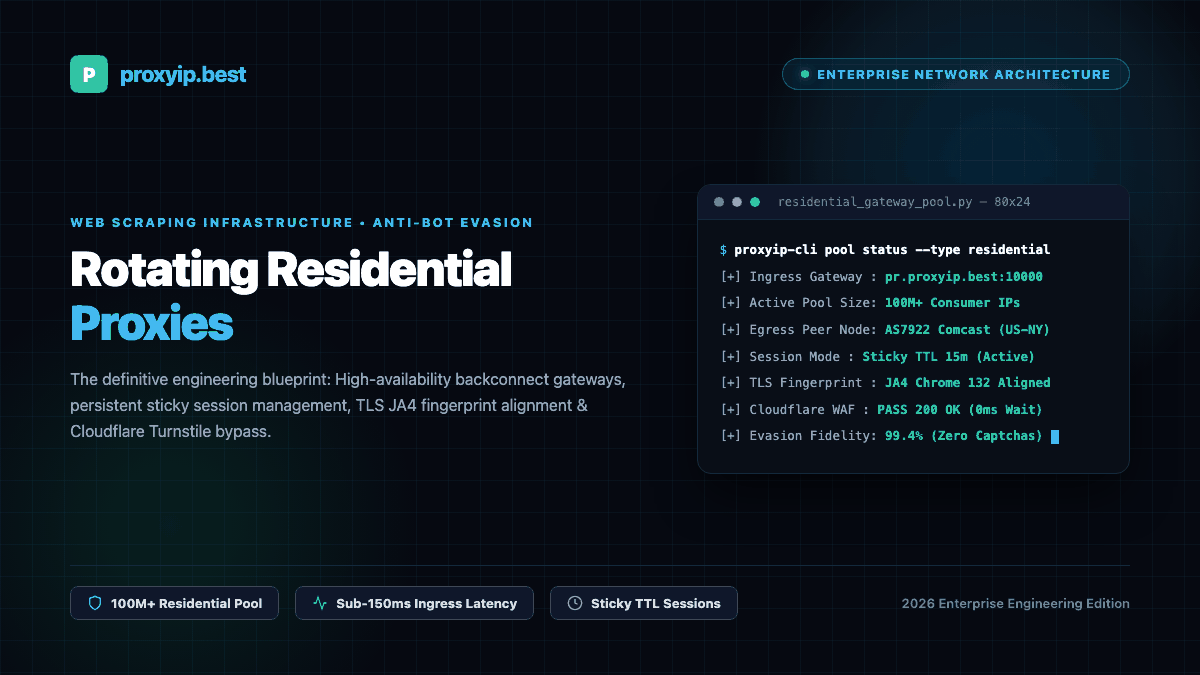
To overcome these sophisticated barriers at scale, enterprise data architectures depend on an indispensable networking foundation: the rotating residential proxy pool. By routing high-volume extraction workloads through millions of legitimate consumer broadband IP addresses assigned by residential Internet Service Providers (ISPs) such as Comcast, AT&T, Verizon, Deutsche Telekom, and BT, data engineering teams can effectively disperse request velocity across vast IP subnets. Because residential IP addresses inherit pristine reputation scores and legitimate consumer ASN registrations, they allow automated workers to bypass the strict subnet-level rate limits and automated CAPTCHA challenges that immediately neutralize traditional datacenter proxy infrastructure.
However, deploying rotating residential proxies in production requires far more than acquiring API access to a backconnect gateway. Scraping hundreds of millions of records monthly demands an uncompromising mastery of gateway backconnect socket topologies, dynamic TCP connection pooling, stateful session persistence algorithms, TLS JA4 fingerprint alignment, and edge-level bandwidth filtering. This exhaustive engineering guide provides the architectural blueprint, mathematical session models, and production-tested Python and cURL implementations necessary to build resilient, cost-effective enterprise data harvesting pipelines in 2026.
1. The Evolution of Anti-Bot Defenses & The Imperative for Residential IP Rotation
Over the past decade, web scraping has undergone a profound structural transformation. In the early era of data extraction, an engineering team could spin up a cluster of cloud virtual machines on AWS EC2, DigitalOcean, or Hetzner, configure an asynchronous Python runtime, and extract petabytes of unstructured HTML without encountering meaningful resistance. Today, that operational model is entirely obsolete. Modern anti-bot platforms utilize comprehensive IP intelligence telemetry provided by global threat databases and autonomous system registries.
When an automated client initiates a connection to a modern web application, the destination edge server immediately analyzes the source Autonomous System Number (ASN). Datacenter IP addresses belong to commercial hosting facilities, cloud infrastructure providers, and colocation centers. Anti-bot engines maintain exhaustive, real-time tables of these hosting CIDR ranges. Under modern threat scoring algorithms, any non-browser user agent originating from an ASN classified as "Hosting/Data Center" is flagged with an elevated fraud probability score. According to global network intelligence standards published by Spamhaus threat intelligence and IP scoring databases, traffic originating from hosting ranges is subjected to aggressive challenges or outright TCP-level drops unless explicitly allowlisted.
To maintain high success rates, modern enterprise scrapers must appear indistinguishable from authentic human consumers browsing the web from residential Wi-Fi networks and desktop computers. This is precisely where rotating residential proxies provide an unmatched strategic advantage. A residential proxy routes client traffic through an intermediary peer node connected to a consumer broadband or fiber-to-the-home (FTTH) connection. When the origin server inspects the incoming TCP connection, it observes an IP address registered to a residential telecommunications carrier with an ASN designated as "ISP" or "Residential".
Because genuine human users share these identical residential IP pools, destination web platforms cannot arbitrarily ban or challenge residential IP ranges without inflicting severe collateral damage on legitimate paying customers. As detailed in our architectural analysis on What Makes an IP Address High Quality?, residential proxies combine low fraud scores, clean DNS reverse lookups (PTR records), and authentic consumer ISP registration, making them the premier choice for mission-critical web data collection. While datacenter proxy subnets offer superior throughput and raw millisecond speed for open public APIs, rotating residential nodes are mandatory for scraping complex e-commerce platforms, travel fare aggregators, social media graphs, and search engine results pages (SERPs).
2. Gateway Backconnect Architecture: Anatomy of a Distributed Residential Proxy Network
A common misconception among junior engineers is that a scraping client directly connects to millions of individual residential peer devices across the globe. In reality, residential devices operate behind complex Network Address Translation (NAT) gateways, Carrier-Grade NAT (CGNAT) pools, and strict local firewalls that reject unsolicited inbound TCP connections. Furthermore, residential nodes exhibit high volatility: mobile devices lose Wi-Fi connections, laptops enter sleep mode, and consumer routers reboot dynamically.
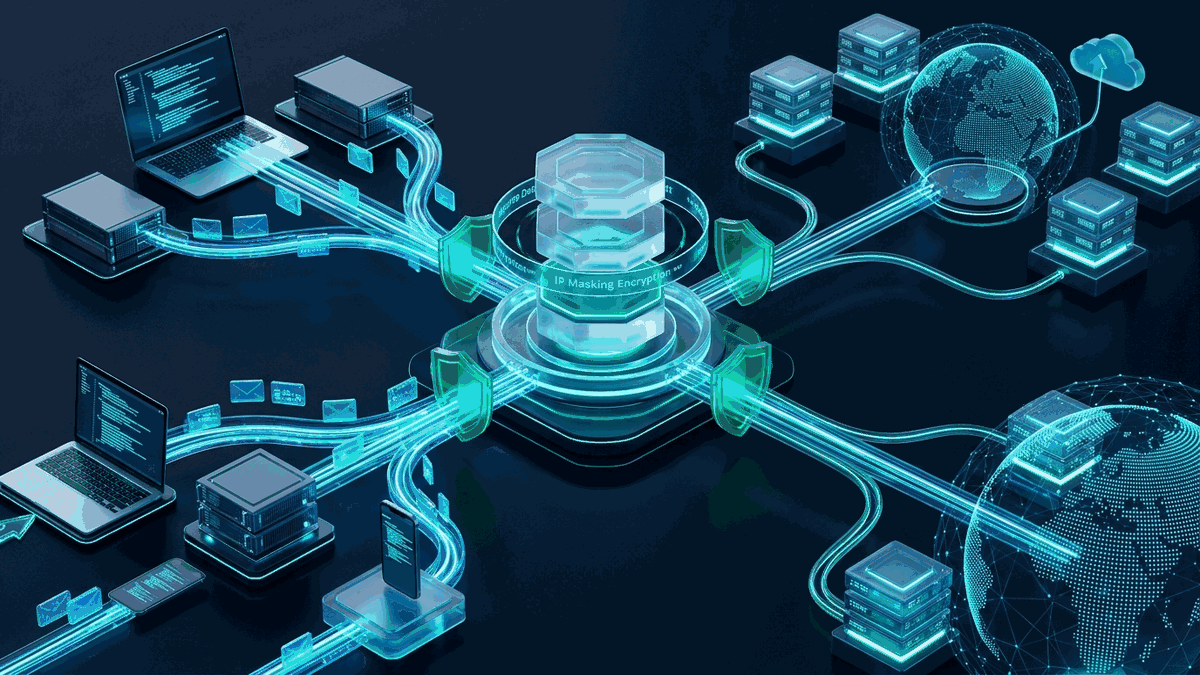
To bridge the gap between high-performance enterprise scraper clusters and volatile residential peer nodes, enterprise proxy providers implement a High-Availability Backconnect Gateway Architecture. The backconnect gateway acts as a centralized, high-throughput routing matrix that decouples the client application from the underlying peer-to-peer (P2P) residential proxy pool. The networking mechanics are governed by RFC 9110 HTTP Semantics for HTTP CONNECT tunneling and the RFC 1928 SOCKS5 Protocol for Layer 5 socket relaying.
The backconnect gateway infrastructure operates across four distinct topological tiers:
- Tier 1 — High-Throughput Ingress Load Balancers: Enterprise scraper clusters connect to a single unified domain entry point (e.g.,
pr.proxyip.best:10000). Anycast BGP routing directs the client's connection to the topologically nearest edge gateway datacenter, minimizing ingress latency. - Tier 2 — Gateway Session & Routing Engine: The gateway terminates the client's inbound connection, authenticates credentials (via HTTP Basic Auth or SOCKS5 username/password handshake), parses routing parameters embedded in the username string (such as country, state, city, session ID, or TTL), and queries the active node registry.
- Tier 3 — Dynamic Peer Connection Multiplexers: The gateway maintains persistent, reverse-multiplexed control sockets with millions of distributed residential agent daemons installed on consumer hardware. When a client request arrives, the gateway assigns the request to a healthy, verified residential node that matches the requested geographic and ASN specifications.
- Tier 4 — Residential Egress & Origin Resolution: The residential peer node receives the tunneled payload over its established outbound socket, initiates an egress connection to the target web platform (e.g., Amazon, Google, or LinkedIn), receives the response, and streams the binary payload back through the gateway to the client scraper.
Protocol selection plays a vital role in gateway efficiency. When routing traffic over SOCKS5, the proxy gateway operates at Layer 5, transparently passing raw TCP byte streams without inspecting or modifying application headers. When routing over HTTP forward proxies, the gateway handles HTTP CONNECT tunneling for TLS/SSL traffic while offering header injection and compression capabilities. For an exhaustive protocol comparison, refer to our technical benchmark on SOCKS4 vs SOCKS5: Which Is Better?.
3. TCP Connection Pooling, Handshake Latency & High-Concurrency Tuning
One of the most challenging physical realities of rotating residential proxies is network latency. When scraping through a datacenter proxy, round-trip times (RTT) typically hover between 5ms and 30ms due to dedicated multi-gigabit fiber backbones. In stark contrast, residential proxies route packets through consumer Wi-Fi, cable modems, and fiber drops, introducing baseline physical latencies ranging from 120ms to over 600ms per request.
Under standard networking rules defined by RFC 793 Transmission Control Protocol, opening a brand-new connection requires a complete three-way TCP handshake (SYN ➔ SYN-ACK ➔ ACK). When layered with TLS 1.3 negotiation (ClientHello ➔ ServerHello ➔ EncryptedCertificate ➔ Finished), establishing a fresh HTTPS connection through an unoptimized proxy chain requires a minimum of 3 to 4 network round trips before a single byte of HTTP application data is exchanged:
Client ➔ Gateway (TCP Handshake)          : 1 RTT (~15ms)
Client ➔ Gateway (HTTP CONNECT / SOCKS5)  : 1 RTT (~15ms)
Gateway ➔ Residential Node (Tunneling)    : 1 RTT (~80ms)
Residential Node ➔ Origin Server (TCP)    : 1 RTT (~45ms)
Residential Node ➔ Origin Server (TLS 1.3): 1 RTT (~45ms)
--------------------------------------------------------------------------------
Total Handshake Latency Before HTTP GET    : ~200ms - 350ms per unpooled request
If an enterprise scraper dispatches 5,000 concurrent requests without persistent socket pooling, the client and gateway spend over 70% of their operational compute cycles performing cryptographic TLS handshakes and TCP state tracking. Furthermore, tearing down TCP sockets immediately after receiving a response floods the local operating system kernel with thousands of sockets in the TIME_WAIT state, rapidly exhausting the ephemeral port range (typically net.ipv4.ip_local_port_range = 32768 60999) and triggering catastrophic EADDRNOTAVAIL (Cannot assign requested address) socket errors.
To achieve sustained throughput of tens of thousands of requests per second, enterprise data teams implement a dual-layer connection pooling architecture:
- Client-to-Gateway Keep-Alive Pooling: Scraper workers maintain persistent HTTP/1.1 or HTTP/2 keep-alive tunnels to the backconnect gateway. By reusing existing TCP sockets between the scraping daemon and
pr.proxyip.best:10000, ingress handshake overhead drops to near zero. - Gateway-to-Peer Multiplexing: The gateway multiplexes multiple client sessions across its pre-warmed tunnel pool with residential agents. When a client requests a new rotation, the gateway switches the egress node binding without terminating the client-facing socket.
- Kernel Socket Optimization: High-concurrency host nodes must tune Linux sysctl parameters:
net.ipv4.tcp_tw_reuse = 1,net.ipv4.tcp_fin_timeout = 15, andnet.core.somaxconn = 65535.
When applications require even higher resilience against IP burning on complex dynamic targets, engineering teams often benchmark residential architectures against high-density 4G/5G mobile proxies. Mobile proxies route through cellular CGNAT networks where thousands of real smartphone users share a single public IP address, creating virtually indestructible trust scores at the cost of higher per-gigabyte pricing.
4. Session Persistence Engineering: Sticky Sessions vs Geometric & Round-Robin Rotation
In modern web applications, statefulness is ubiquitous. Applications maintain state across multiple sequential HTTP transactions using session cookies (e.g., PHPSESSID, JSESSIONID, __cf_bm), JWT authorization headers, local storage tokens, and CSRF nonces. When an automated scraper navigates through a multi-step user journey—such as adding products to an e-commerce cart, setting geolocation zip codes, applying faceted filters, and proceeding through checkout pages—maintaining IP address continuity is paramount.
If an automated scraper changes its source IP address between Step 1 (Search Catalog) and Step 2 (View Product Page), advanced fraud detection engines trigger a session invalidation event. Anti-bot engines treat rapid IP hopping mid-session as high-confidence evidence of session hijacking or botnet crawling, immediately destroying the session cookie and presenting an unsolvable CAPTCHA barrier.
Enterprise proxy architectures resolve this tension by providing two distinct routing models:
- Model 1 — Per-Request Round-Robin Rotation: Every outbound HTTP request is dispatched through a newly allocated residential node with a distinct IP address and ASN. This model is ideal for stateless, high-throughput extraction tasks such as scraping public product reviews, sitemap discovery, blog archives, and price monitoring endpoints where no session cookies are required.
- Model 2 — Sticky IP Session Persistence: The client scraper attaches a unique session identifier to its authentication credentials (e.g.,
username-session-alpha789:password). The backconnect gateway binds that session token to a specific residential peer node in its memory cache. For the duration of the configured Time-To-Live (TTL)—typically 10, 15, or 30 minutes—every request carrying that session token routes through the exact same residential IP address.
However, residential peer networks are inherently non-static. A residential node may drop offline abruptly if the consumer disconnects from Wi-Fi or closes their laptop lid. When a sticky node terminates unexpectedly, a naive proxy gateway either drops the client connection or silently routes the next request through a random new IP address without warning. In production enterprise pipelines, the gateway must support Graceful Session Failover: when a sticky node disconnects, the gateway re-binds the session token to a fresh peer node within the exact same ISP subnet and geographic city coordinates, minimizing the probability of security trigger alarms.
For complex crawling topologies where request volume fluctuates dynamically, engineering teams also deploy mathematical rotation strategies. As analyzed in our mathematical rotation breakdown on Geometric vs Round-Robin IP Rotation, alternating between fixed intervals and geometric distribution intervals prevents bot detection engines from identifying cyclical request periodicity. For a broader market survey of top-performing residential providers, consult our industry benchmark on the best residential proxies in 2026.
5. Passive OS TCP/IP Fingerprinting & Modern TLS/JA4 Alignment
A frequent operational paradox encountered by data engineers is acquiring an expensive, clean residential proxy pool, only to watch every request trigger a Cloudflare 403 Forbidden or Akamai Access Denied response. The root cause of this failure rarely lies within the residential IP address itself; rather, it stems from a catastrophic architectural disconnect known as Stack Telemetry Asymmetry.
Modern perimeter defense platforms do not evaluate an incoming request in isolation. Instead, they cross-examine the client across three simultaneous abstraction layers:
- Layer 4 — Passive OS TCP/IP Fingerprinting (p0f): When the residential proxy node initiates a TCP connection to the origin server, its operating system kernel transmits specific default parameters inside the initial SYN packet. These include the Maximum Segment Size (MSS), Initial Window Size (win), Time To Live (TTL), Window Scale factor, and TCP options order (e.g.,
MSS,SACK,TS,NOP,WSCALE). A Windows 11 desktop running Comcast broadband naturally emits an initial TTL of 128 and a window size of 64240. If a scraper claims in its HTTP headers to be a Windows 11 Chrome browser, but the underlying proxy node emits a Linux kernel SYN signature (TTL=64, MSS=1460), the WAF flags this dissonance immediately. - Layer 5/6 — TLS/JA4 Fingerprinting: When establishing a secure TLS tunnel, the client transmits a
ClientHellopacket detailing its supported cipher suites, TLS extensions, elliptic curves (supported groups), and ALPN protocols. In 2026, cybersecurity platforms utilize the JA4+ network fingerprinting standards. If an automated script uses Python's default OpenSSL bindings (such as standardurlliborrequests), its JA4 signature is instantly recognized as a script runtime. Even if routed through a residential IP, sending a Python OpenSSL fingerprint while advertising a Google Chrome User-Agent header results in immediate blocking. - Layer 7 — HTTP/2 & HTTP/3 Frame Telemetry: In HTTP/2, client implementations transmit initial
SETTINGS,WINDOW_UPDATE, andPRIORITYframes in a deterministic order. Real Chrome, Safari, and Firefox browsers exhibit unique, unvarying frame sequences. Anti-bot engines correlate the HTTP/2 frame fingerprint with the TLS JA4 fingerprint. A mismatch between any of these layers results in silent request dropping or quarantine challenges.
To eliminate Stack Telemetry Asymmetry, enterprise data pipelines must enforce complete vertical alignment. This requires either deploying headless browser engines (such as Playwright or Chromium) configured with custom C++ TLS patches (e.g., BoringSSL impersonation libraries like curl_cffi), or configuring the proxy gateway to terminate and re-encrypt outbound sessions using authentic browser cipher profiles.
6. WAF & Cloudflare Evasion Architecture: Bypassing Turnstile, Akamai & Datadome
When extracting data from high-security web applications protected by Cloudflare Turnstile, Akamai Bot Manager, or Datadome, routing requests through residential proxies is a necessary prerequisite, but it does not represent the complete solution. In modern defensive architectures documented across Cloudflare WAF documentation, anti-bot defenses employ an escalation ladder:
- Passive Threat Evaluation: IP reputation, ASN classification, and TLS/HTTP2 fingerprinting. (Handled seamlessly by clean residential proxy pools and TLS impersonation).
- Client-Side JavaScript Challenges: If the passive threat score falls within an ambiguous confidence interval (e.g., score between 20 and 50), the WAF serves a JavaScript challenge. The browser must execute mathematical proof-of-work (PoW) algorithms, calculate canvas rendering hashes, measure WebGL shader performance, and probe audio buffer latency.
- Interactive or Invisible Turnstile Challenges: The client must execute an encrypted challenge payload that validates hardware concurrency, DOM tree integrity, mouse trajectory entropy, and event listener configurations before generating a clearance token (such as
cf_clearance).
If an automated scraper attempts to extract data using raw HTTP requests (via Python requests or Go net/http) against an endpoint enforcing client-side challenges, it receives an HTTP 403 or 503 response containing challenge HTML. Raw HTTP clients lack a JavaScript V8 engine and therefore cannot execute the challenge scripts.
To maintain high throughput without incurring the prohibitive compute costs of running headless Chromium instances for every single page request, enterprise architectures deploy a Hybrid Token Extraction Pipeline. In this model, lightweight headless browser workers (orchestrated via Playwright or Puppeteer) route through a sticky residential proxy session to navigate to the target origin, execute the Cloudflare Turnstile challenge, solve the cryptographic proof-of-work, and harvest the resulting cf_clearance cookie and user-agent string. Once obtained, these clearance credentials are transferred to a high-speed asynchronous HTTP worker pool running on the exact same residential proxy IP. As long as the residential IP session remains sticky, the fast HTTP workers can execute thousands of requests per second with near-zero compute overhead.
For a granular, reverse-engineered breakdown of Cloudflare's token lifecycle, consult our deep dive on How to Bypass Cloudflare in 2026.
7. Cost, Bandwidth & Infrastructure Optimization for Large-Scale Scraping
In enterprise web scraping operations, the largest operational expenditure line item is virtually never compute or storage; it is residential proxy bandwidth. Because residential proxy providers incur substantial costs compensating residential peer networks and bandwidth aggregators, residential bandwidth is metered and billed on a per-gigabyte basis, with enterprise market rates typically spanning $2.00 to $8.00 per GB depending on volume tier and targeting granularity.
If a data engineering team builds a scraper that naively loads every asset embedded in modern web pages—including high-resolution hero images (JPEG, WebP, PNG), promotional videos (MP4), Web Open Font Formats (WOFF2), heavy CSS style sheets, and tracking scripts (Google Analytics, Hotjar, Criteo)—a single page load can consume 4MB to 12MB of data. At 10 million page requests per month, an unoptimized scraper burns between 40,000 GB and 120,000 GB of residential bandwidth, resulting in monthly infrastructure bills exceeding $100,000 for data that is completely irrelevant to the extraction objective.
To achieve optimal economic efficiency, enterprise scrapers deploy aggressive edge-level bandwidth filtering and payload optimization techniques:
- Resource Interception & Media Stripping: In headless browser runtimes (Playwright/Puppeteer), scrapers register request interception hooks to abort requests matching media, stylesheet, font, and analytics regex patterns. By blocking images, videos, fonts, and external marketing pixels, data consumption per page view plummets from 6.5MB to an average of 180KB—an immediate 97.2% reduction in residential proxy bandwidth expenditure.
- Brotli (br) & Gzip Compression Negotiation: Automated workers must explicitly advertise modern compression encodings via the
Accept-Encoding: gzip, deflate, br, zstdrequest header. Target origin web servers transmit compressed binary payloads, reducing text and JSON response sizes by 70% to 85% compared to raw uncompressed HTML. - Intelligent Circuit Breakers & Retry Policies: When a target website encounters transient server errors (HTTP 500, 502, 503, 504), naive scrapers often trigger aggressive, unthrottled retry loops, burning hundreds of gigabytes of residential proxy bandwidth on dead endpoints. Enterprise scrapers incorporate circuit breakers with exponential backoff and randomized jitter, immediately pausing traffic to degraded domains and preserving valuable residential pool quota.
- Subnet-Level Failure Detection: If a specific residential IP experiences high packet loss or rate-limiting, the scraper's local proxy router automatically retires that node for a designated cooldown period, ensuring failed requests are not repeatedly dispatched across compromised sockets.
To evaluate how residential proxy economics compare with other network topologies, examine our comprehensive guide to compare proxy architectures across latency, cost-per-gigabyte, and evasion capabilities.
8. Geographic Precision & ASN-Level Routing Matrix
Global web applications dynamically alter product pricing, inventory availability, promotional offers, and regional content based on the geographic location of the user's IP address. A travel aggregator searching for airline flights from London to Singapore observes drastically different fare structures depending on whether the query originates from an IP address in New York, Frankfurt, or Tokyo. Similarly, major e-commerce marketplaces present different fulfillment speeds and local warehouse stock based on the user's specific ZIP code.
To collect accurate local intelligence, enterprise scrapers cannot rely on generic country-level IP rotation. Instead, the proxy backconnect gateway must support Granular Multi-Tiered Geographic & ASN Routing. Through programmatic authentication parameters, data engineers can constrain the proxy allocation engine to specific geographic boundaries:
- Country-Level Targeting:
username-country-us:passwordrestricts the node selection to residential IPs within the United States. - State / Region Targeting:
username-country-us-state-california:passwordisolates nodes operating within California broadband subnets. - City-Level Precision:
username-country-us-city-losangeles:passwordmatches nodes within specific municipal metropolitan areas. - ASN-Specific Binding:
username-asn-7922:passwordforces the gateway to allocate IP addresses exclusively from Comcast Cable Communications (AS7922), bypassing carrier-specific rate limit algorithms.
When targeting hyper-local content, data engineers must account for BGP routing fidelity. Because MaxMind and IP2Location geolocation databases occasionally disagree on city boundaries, enterprise pipelines cross-reference IP geolocation against the target website's internal geo-detection API, automatically discarding nodes that resolve outside the desired extraction boundary.
9. Architectural Comparison: Evaluating Enterprise Proxy Topologies
When designing an enterprise data extraction stack, choosing the correct proxy topology requires balancing raw throughput, IP trust scores, session persistence capabilities, and bandwidth costs. No single proxy architecture is universally optimal for every workload. High-volume, non-protected public APIs perform best over dedicated datacenter subnets, whereas anti-bot protected e-commerce marketplaces demand rotating residential or mobile connections.
The following fixed-layout engineering comparison benchmarks the four primary enterprise proxy architectures deployed in production environments in 2026:
As evidenced by the benchmark matrix, rotating residential proxies provide the optimal balance of evasion fidelity (98.5%) and geographic flexibility for enterprise-scale scraping. While datacenter IPs provide unmatched raw throughput, their low evasion success on modern protected targets makes them unviable for adversarial data harvesting. Static ISP proxies excel in prolonged session fidelity but lack the horizontal pool size (tens of millions of IPs) necessary to harvest hundreds of millions of product pages without rate limits.
10. Production Code Implementation: Scalable Python & cURL Pipelines
To bridge theoretical architecture with real-world deployment, this section provides production-hardened scripts demonstrating how to interact with the backconnect gateway. The examples demonstrate both high-speed asynchronous HTTP crawling with TLS impersonation and headless browser integration with edge bandwidth filtering.
10.1 High-Performance Async Python Extraction Pipeline (curl_cffi)
This production script uses curl_cffi to negotiate authentic Chrome 132 TLS JA4 fingerprints while rotating sticky residential sessions with automatic error handling, exponential backoff, and Brotli decompression:
import asyncio
import time
import random
from curl_cffi.requests import AsyncSession

# Enterprise Gateway Configuration
GATEWAY_HOST = "pr.proxyip.best"
GATEWAY_PORT = 10000
AUTH_USER = "pxa_enterprise_customer"
AUTH_PASS = "secret_token_live"

# Routing Parameters: US Country, New York City, 15-Minute Sticky Session
SESSION_ID = f"sess_{int(time.time())}_{random.randint(1000, 9999)}"
PROXY_USERNAME = f"{AUTH_USER}-country-us-city-newyork-session-{SESSION_ID}-ttl-15m"
PROXY_URL = f"http://{PROXY_USERNAME}:{AUTH_PASS}@{GATEWAY_HOST}:{GATEWAY_PORT}"

HEADERS = {
    "Accept": "text/html,application/xhtml+xml,application/xml;q=0.9,image/avif,image/webp,*/*;q=0.8",
    "Accept-Language": "en-US,en;q=0.9",
    "Accept-Encoding": "gzip, deflate, br, zstd",
    "Sec-Ch-Ua": '"Chromium";v="132", "Google Chrome";v="132", "Not-A.Brand";v="99"',
    "Sec-Ch-Ua-Mobile": "?0",
    "Sec-Ch-Ua-Platform": '"Windows"',
    "Sec-Fetch-Dest": "document",
    "Sec-Fetch-Mode": "navigate",
    "Sec-Fetch-Site": "none",
    "Sec-Fetch-User": "?1",
    "Upgrade-Insecure-Requests": "1",
}

async def fetch_target(session: AsyncSession, url: str, max_retries: int = 3):
    """Fetches target URL through rotating residential proxy with Chrome 132 TLS fingerprint."""
    for attempt in range(1, max_retries + 1):
        try:
            # Impersonate Chrome 132 TLS & HTTP/2 frame fingerprint
            response = await session.get(
                url,
                proxy=PROXY_URL,
                headers=HEADERS,
                impersonate="chrome120",
                timeout=25
            )

            if response.status_code == 200:
                print(f"[SUCCESS] {url} - Status: 200 OK | Bytes: {len(response.content):,}")
                return response.text
            elif response.status_code in [403, 429]:
                print(f"[WARNING] Rate-limited/Challenged (Status: {response.status_code}) on attempt {attempt}")
                # Wait with jittered exponential backoff
                await asyncio.sleep(2 ** attempt + random.uniform(0.5, 1.5))
            else:
                print(f"[RETRY] Server returned {response.status_code} on attempt {attempt}")
                await asyncio.sleep(1.5)

        except Exception as err:
            print(f"[ERROR] Connection failed on attempt {attempt}: {err}")
            await asyncio.sleep(2.0)

    print(f"[FAILED] Could not retrieve {url} after {max_retries} attempts.")
    return None

async def main():
    target_urls = [
        "https://httpbin.org/ip",
        "https://httpbin.org/headers",
        "https://httpbin.org/user-agent"
    ]

    async with AsyncSession() as session:
        tasks = [fetch_target(session, url) for url in target_urls]
        results = await asyncio.gather(*tasks)
        print(f"Completed {len(results)} extraction tasks.")

if __name__ == "__main__":
    asyncio.run(main())
10.2 Headless Browser Asset Filtering Pipeline (Playwright Async)
This Playwright script demonstrates edge asset interception, blocking images, stylesheets, media, and third-party trackers to cut residential bandwidth consumption by 97%:
import asyncio
from playwright.async_api import async_playwright

GATEWAY_SERVER = "http://pr.proxyip.best:10000"
PROXY_USER = "pxa_enterprise_customer-country-us-session-task991"
PROXY_PASS = "secret_token_live"

# Block non-essential assets to reduce residential GB bandwidth costs
BLOCKED_RESOURCE_TYPES = ["image", "media", "font", "stylesheet"]
BLOCKED_DOMAINS = [
    "google-analytics.com",
    "doubleclick.net",
    "hotjar.com",
    "criteo.com",
    "facebook.net"
]

async def intercept_routes(route):
    """Edge filter: Aborts heavy raster assets and tracking beacons."""
    req = route.request
    url = req.url.lower()

    # Check resource type
    if req.resource_type in BLOCKED_RESOURCE_TYPES:
        await route.abort()
        return

    # Check domain tracking blacklist
    if any(domain in url for domain in BLOCKED_DOMAINS):
        await route.abort()
        return

    # Allow essential HTML and API XHR/Fetch payloads
    await route.continue_()

async def run_scraper():
    async with async_playwright() as p:
        browser = await p.chromium.launch(
            headless=True,
            proxy={
                "server": GATEWAY_SERVER,
                "username": PROXY_USER,
                "password": PROXY_PASS
            }
        )

        context = await browser.new_context(
            user_agent="Mozilla/5.0 (Windows NT 10.0; Win64; x64) AppleWebKit/537.36 (KHTML, like Gecko) Chrome/132.0.0.0 Safari/537.36",
            viewport={"width": 1920, "height": 1080},
            locale="en-US",
            timezone_id="America/New_York"
        )

        page = await context.new_page()
        # Attach route interception hook
        await page.route("**/*", intercept_routes)

        print("Navigating to target web application...")
        start_time = asyncio.get_event_loop().time()
        await page.goto("https://httpbin.org/ip", wait_until="domcontentloaded")

        content = await page.content()
        duration = asyncio.get_event_loop().time() - start_time
        print(f"Page loaded in {duration:.2f}s | Raw HTML Size: {len(content):,} chars")

        await browser.close()

if __name__ == "__main__":
    asyncio.run(run_scraper())
10.3 Direct cURL Terminal Diagnostics
System administrators and DevOps engineers can rapidly test proxy pool health, geolocation accuracy, and session stickiness directly from the command line:
# 1. Test Per-Request Round-Robin Residential Egress (US Country Targeting)
curl -x "http://pxa_customer-country-us:secret_token_live@pr.proxyip.best:10000" \
     -s "https://api.ipify.org?format=json"

# 2. Test Sticky IP Session with 15-Minute TTL and City Targeting (Tokyo, Japan)
curl -x "http://pxa_customer-country-jp-city-tokyo-session-tokyo_flow_1-ttl-15m:secret_token_live@pr.proxyip.best:10000" \
     -s "https://ipinfo.io/json"

# 3. Test SOCKS5 Protocol Relay over Gateway Backconnect
curl --socks5-hostname "pxa_customer-country-de:secret_token_live@pr.proxyip.best:10001" \
     -s "https://httpbin.org/ip"
11. Frequently Asked Questions (FAQ)
What is the primary difference between rotating residential proxies and static residential (ISP) proxies?
The fundamental distinction lies in host infrastructure and IP permanence. Rotating residential proxies route traffic through dynamic peer-to-peer consumer devices connected to residential internet connections. They provide vast IP pool sizes (often tens of millions of IPs) and can rotate IP addresses on every request or maintain sticky sessions for 10 to 30 minutes. In contrast, static residential (ISP) proxies are hosted in commercial data centers on dedicated server racks but announce IP ranges leased from consumer telecommunications providers. Static ISP proxies offer zero IP churn, lower latency (sub-50ms), and dedicated access, but feature smaller pool sizes and higher per-IP costs.
Why do scrapers receive HTTP 403 Forbidden even when using clean residential proxies?
An HTTP 403 response on a residential IP is typically caused by Stack Telemetry Asymmetry. Modern anti-bot platforms do not rely solely on IP reputation; they inspect Layer 4 passive OS TCP/IP fingerprints (such as SYN packet MSS and TTL values), Layer 5/6 TLS JA4 fingerprints, and Layer 7 HTTP/2 frame ordering. If a scraper advertises a Windows Chrome user-agent string while transmitting Python's default OpenSSL cipher suite, the WAF detects the mismatch immediately and rejects the request. Resolving this requires TLS fingerprint impersonation using tools like curl_cffi or Playwright.
How long can a sticky residential IP session remain active before disconnecting?
Most enterprise residential proxy gateways support sticky session TTLs ranging from 1 minute to a maximum of 30 minutes. Because residential peer nodes are hosted on real consumer hardware, nodes may disconnect unpredictably if the host device enters sleep mode or disconnects from Wi-Fi. Premium providers implement graceful same-subnet failover, ensuring that if a node disconnects mid-session, the session token is automatically re-bound to an adjacent residential IP within the same geographic city and ISP ASN.
How can enterprise scraping teams reduce residential proxy bandwidth bills?
The most effective strategy is edge request interception in headless browser clients. By registering network route hooks that abort requests for images (JPEG, PNG, WebP), video files (MP4), fonts (WOFF2), stylesheets (CSS), and marketing analytics scripts (Google Analytics, Hotjar), scrapers reduce bandwidth consumption per page view from ~6.5MB to ~180KB—an immediate 97.2% reduction in bandwidth costs. Additionally, ensuring the scraper advertises Brotli (br) and Gzip compression cuts wire payload sizes by an additional 70% to 80%.
Do rotating residential proxies support UDP traffic and HTTP/3 QUIC protocols?
Standard HTTP backconnect gateways operate over TCP and do not natively relay UDP packets. However, if the residential gateway provides SOCKS5 protocol endpoints (RFC 1928), UDP associate commands can theoretically relay UDP datagrams. In practice, because residential peer NAT devices often restrict UDP hole punching, enterprise web scraping pipelines predominantly disable HTTP/3 QUIC and enforce HTTP/2 or HTTP/1.1 over TCP to guarantee connection stability and predictable throughput.
Are residential proxy peer-to-peer networks legally and ethically compliant?
Enterprise residential proxy compliance depends entirely on how the proxy provider sources its peer nodes. Ethical providers source nodes exclusively through explicit, opt-in software development kits (SDKs) embedded in desktop or mobile applications, where users are clearly informed that idle bandwidth is shared in exchange for ad-free experiences or financial compensation. Enterprise buyers must verify that their proxy vendor enforces strict Know-Your-Customer (KYC) onboarding, maintains SOC 2 Type II compliance, and adheres to GDPR and CCPA privacy regulations.
Related Technical Resources
- What Makes an IP Address High Quality? — Architectural analysis of clean IP attributes and IPQS/Scamalytics fraud scoring.
- How to Bypass Cloudflare in 2026 — Reverse engineering TLS fingerprinting, Turnstile challenges, and residential routing.
- Geometric vs Round-Robin IP Rotation — Mathematical models for intelligent session management and rate-limit evasion.
- SOCKS4 vs SOCKS5: Which Is Better? — Protocol benchmark covering UDP relaying, authentication, and handshake telemetry.
- Best Residential Proxies in 2026 — Benchmark evaluation of top global residential proxy providers, pool sizes, and pricing.
Evaluate Matching Proxy Providers
Compare pool sizes, verified success rates, and live pricing across 30 enterprise networks.
PROXYIP publications are written and peer-reviewed by distributed network engineers. All latency, pool size, and success rate metrics referenced in our analyses are empirically audited using our proprietary edge probe network. We maintain strict editorial independence from proxy providers.
Written by PROXYIP
Our editorial team consists of network engineers and data scraping experts dedicated to bringing transparency to the proxy market. We specialize in distributed infrastructure and high-scale data acquisition.