Proxy Types Explained

Executive Summary & Comprehensive Taxonomy Guide
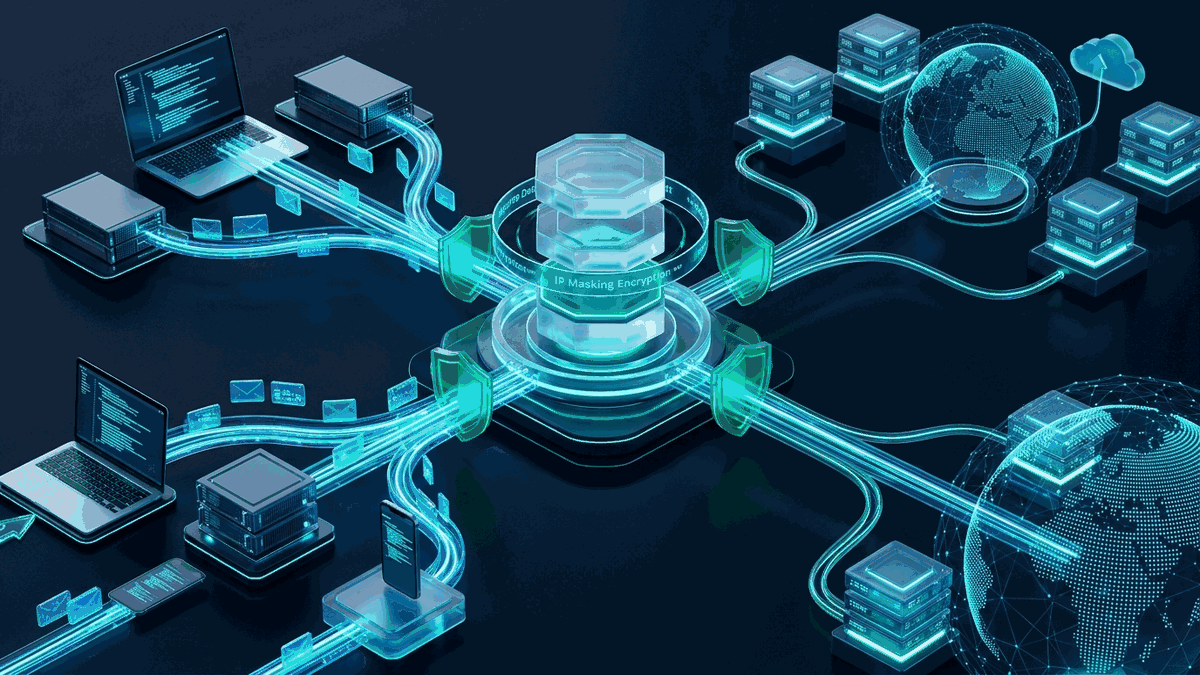
In contemporary network engineering, cybersecurity, and data acquisition, the term "proxy" encompasses a broad and varied landscape of networking software, routing protocols, and hardware topologies. From forward caching proxies deployed in enterprise intranets to multi-million-node peer-to-peer residential proxy pools utilized in distributed web intelligence, conflating these distinct technologies leads to suboptimal architectural decisions, wasted infrastructure budgets, and catastrophic security vulnerabilities.
Building upon the network specifications established in our ultimate proxy guide and our operational manuals on web scraping with proxies and rotating proxies, this technical manual provides systems architects with an exhaustive, multi-dimensional classification of proxy networks.
We dissect proxy systems across four independent architectural dimensions: underlying Physical Infrastructure (datacenter proxies, residential proxy pools, static ISP, and mobile proxies), Protocol Layer Implementations (HTTP, HTTPS CONNECT, and SOCKS5), Directional Flow Topologies (Forward vs Reverse vs Transparent), and Anonymity & Rotation Models (Elite L1 vs Anonymous L2, and Stateless vs Sticky Sessions).
Multi-Dimensional Proxy Classification Matrix
| Classification Axis | Underlying Technologies | Key Differentiator | Latency / Speed | Primary Scope |
|---|---|---|---|---|
| 1. Infrastructure | Datacenter, Residential P2P, Static ISP, 4G/5G Cellular | ASN Lineage & IP Trust | 10ms (DC) to 350ms (Cell) | Evasion vs Throughput |
| 2. Protocol Layer | HTTP Plain, HTTPS CONNECT, SOCKS4, SOCKS5 UDP | OSI Layer (L4 vs L7) & DNS | Zero Protocol Overhead | Traffic Type Support |
| 3. Directionality | Forward Proxy, Reverse Proxy, Transparent Interceptor | Client Egress vs Server Ingress | Sub-5ms (Reverse) | Security Boundary |
| 4. Anonymity Tier | Level 1 Elite, Level 2 Anonymous, Level 3 Transparent | HTTP Header Masking (XFF/Via) | Identical Transport Speed | Origin Identity Masking |
| 5. Rotation Mode | Static Dedicated, Stateless Round-Robin, Sticky Session | IP State Lifetime (TTL) | Variable Failover Latency | Stateful vs Stateless |
1. The Multi-Dimensional Taxonomy of Modern Proxy Networks
In typical marketing literature, proxies are presented as a linear checklist: "Datacenter vs Residential" or "HTTP vs SOCKS5." In reality, treating proxies as a one-dimensional spectrum creates profound technical confusion. A proxy is not defined by a single label; rather, every proxy endpoint operating on the global internet occupies a specific coordinate across four orthogonal technical dimensions.
The Four Orthogonal Vectors of Proxy Architecture
To rigorously specify a proxy in an enterprise architecture document, an engineer must define all four axes:
- Dimension 1: Physical Infrastructure & IP Origin: Where is the egress network interface physically hosted, and what Autonomous System Number (ASN) announces its IP prefix? (Datacenter colocation rack, consumer FTTH broadband modem, physical cellular mobile tower).
- Dimension 2: Transport Protocol & OSI Layer: At which layer of the Open Systems Interconnection (OSI) model does the proxy daemon terminate and relay traffic? (Layer 7 Application HTTP/HTTPS, Layer 4 Transport SOCKS5/TCP/UDP).
- Dimension 3: Network Directionality & Ingress Topology: Who is the proxy designed to protect or disguise? (Forward proxy protecting the client fleet, Reverse proxy shielding the origin server, Transparent proxy intercepting traffic inline).
- Dimension 4: Session Lifecycle & Rotation Policy: How does the proxy manage IP statefulness over time? (Dedicated static IP pinned indefinitely, dynamic stateless per-request rotation, sticky session with a Time-to-Live).
For example, describing an endpoint as simply a "residential proxy" is technically incomplete. An engineer must specify whether it is a Forward, SOCKS5, Stateless-Rotating, Residential Proxy or a Forward, HTTP-Tunneling, Sticky-Session, Static ISP Proxy. These two configurations possess completely different failure modes, latency profiles, and anti-bot evasion capabilities.
OSI Model Alignment: Layer 4 Transport vs Layer 7 Application Relays
A critical distinction lies in where the proxy operates within the OSI model. Layer 7 Proxies (such as standard HTTP/HTTPS forward proxies governed by IETF RFC 9110) parse, inspect, and reconstruct application-layer headers (Host, User-Agent, Cookie). In contrast, Layer 4 Proxies (such as SOCKS5 governed by IETF RFC 1928) operate strictly at the transport layer, relaying raw TCP bytes and UDP datagrams without inspecting or altering the underlying application stream. This allows SOCKS5 proxies to tunnel arbitrary protocols (SMTP, FTP, WebSockets, WebRTC, and raw HTTP/3 QUIC streams) with zero protocol corruption.
Socket-Level Kernel Operations: Zero-Copy Splicing vs Application Reassembly
At the operating system level, how a proxy relays bytes dictates its CPU consumption, throughput ceiling, and anti-bot leakage profile. When evaluating proxy engines such as HAProxy, Envoy, NGINX, or custom Rust-based proxy nodes, network engineers classify relays by their socket mechanics:
-
Kernel-Space Zero-Copy Splicing (Layer 4): High-throughput Layer 4 relays leverage Linux system calls such as
splice(2)andtee(2)to stream TCP packets directly between inbound and outbound socket buffers without copying bytes into user-space memory. This achieves wire-speed forwarding with minimal CPU context switching and preserves original TCP timestamps, window scales, and MTU characteristics. - User-Space Application Reassembly (Layer 7): Layer 7 proxies must fully read TCP buffers into user-space application memory to parse HTTP request lines, inspect URI paths, and rewrite header fields. This introduces packet serialization latency (typically 5 to 15 milliseconds of CPU time under load) and fundamentally alters the client's TCP fingerprint, as the proxy's own operating system kernel generates fresh TCP SYN and ACK packets with distinct Initial Window Sizes (IW) and Selective Acknowledgment (SACK) options.
2. Network Infrastructure Tiers: Datacenter vs Residential vs ISP vs Mobile
The physical origin of an IP address dictates how target web firewalls, anti-bot engines, and threat intelligence APIs classify incoming traffic. When a client socket connects to a web server, the server resolves the IP's Autonomous System Number (ASN) and interrogates global routing registries (RADB, ARIN, RIPE NCC). The modern internet is divided into four distinct infrastructure tiers.
1. Datacenter Proxies (The Velocity Tier)
Datacenter proxies originate from commercial colocation data centers (such as Equinix, Digital Realty, AWS, or Hetzner). Their IP prefixes are registered directly to hosting organizations under commercial data communication ASNs.
- Architectural Strengths: Optical fiber interconnects deliver unmatched network throughput (10Gbps+ links), sub-15ms median Time to First Byte (TTFB), and unmetered flat-rate pricing ($0.50 to $1.50 per IP monthly).
- Security Liabilities: Because their ASN type flags as "Hosting / Datacenter" across threat feeds, sophisticated WAFs (such as Cloudflare Bot Management and Akamai) apply strict baseline friction. They are also highly vulnerable to Subnet-Ban Cascades: firewalls frequently drop entire
/24CIDR subnets (256 contiguous IPs) if automation is detected. Deconstructed in our datacenter proxies guide.
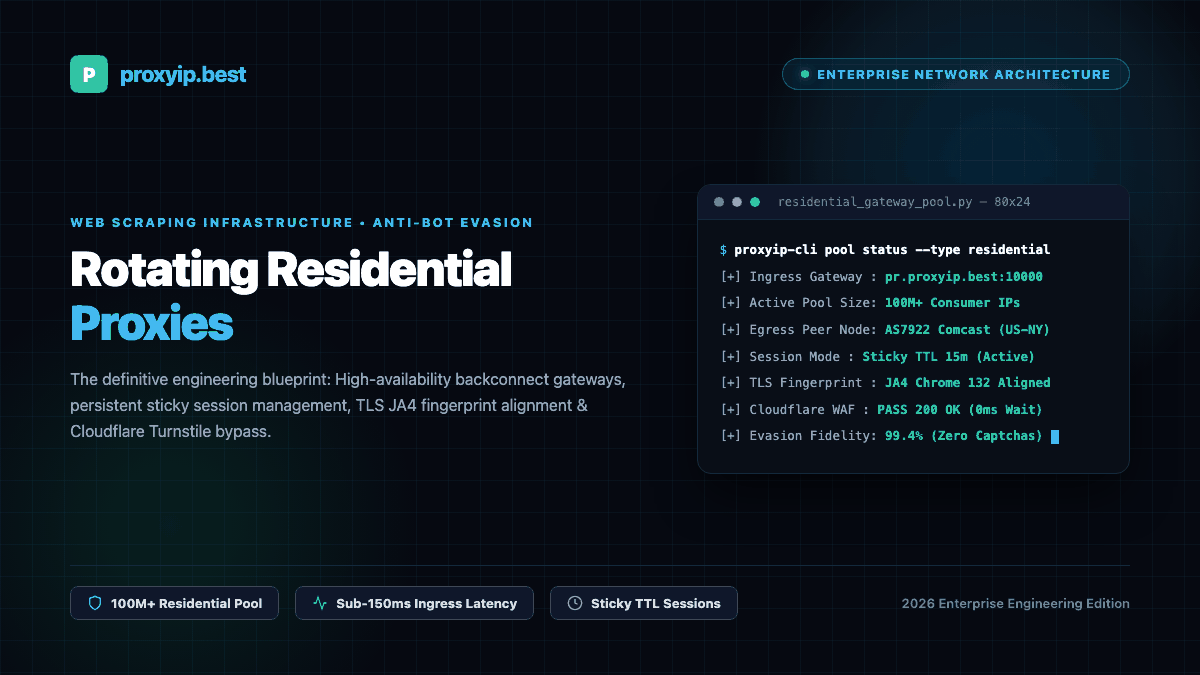
2. Peer-to-Peer Residential Proxies (The Stealth Tier)
Residential proxies route client traffic through genuine consumer broadband connections—such as home Wi-Fi routers and Fiber-to-the-Home (FTTH) modems provided by consumer Internet Service Providers (Comcast, AT&T, Vodafone, Deutsche Telekom).
- Architectural Strengths: Pristine consumer IP reputation. Web firewalls cannot block residential IP prefixes wholesale without blocking legitimate human customers, allowing crawlers to extract protected data with sub-1% block rates.
- Operational Constraints: Priced on metered per-gigabyte bandwidth ($3.00 to $8.00 per GB). Because peer devices are consumer-owned, they exhibit higher latency (150ms–350ms) and inherent ephemerality: peers disconnect when users power off laptops or close apps. Detailed in our residential proxies guide.
3. Static ISP Proxies (The Hybrid Persistence Tier)
Static ISP proxies bridge the gap between datacenter speed and residential trust. Physical server racks located inside Tier-3/4 data centers announce leased consumer ISP IP prefixes (such as AT&T or Comcast) via Border Gateway Protocol.
- Architectural Strengths: Datacenter 10Gbps optical uplink speeds and 100% static uptime combined with genuine consumer ISP ASNs. They never disconnect unexpectedly, making them indispensable for authenticated sessions, sneaker botting, and anti-detect browser profile farming. Explored in our ISP proxies guide.
4. 4G/5G Cellular Mobile Proxies (The Zero-Ban Tier)
Mobile proxies route traffic through real 4G LTE and 5G cellular modems connected to Mobile Network Operators (Verizon, T-Mobile, Vodafone). Cellular networks utilize Carrier-Grade NAT (CGNAT): hundreds of human smartphone subscribers share the exact same public IPv4 address simultaneously. Firewalls cannot blacklist a mobile IP without severing connectivity for hundreds of human mobile app users. Deconstructed in our mobile proxies guide.
ASN Classification, BGP Routing & Threat Intelligence Scoring
The fundamental divergence between datacenter and residential infrastructure stems from Autonomous System Number (ASN) allocations registered with Regional Internet Registries (ARIN, RIPE, APNIC, LACNIC, and AFRINIC). WAF systems maintain real-time BGP routing tables and cross-reference inbound IP addresses against commercial threat databases including Spamhaus ZEN, AbuseIPDB, and IPQualityScore:
- Hosting / Commercial ASN (Datacenter): ASNs belonging to hosting facilities (such as AS16509 Amazon AWS, AS14061 DigitalOcean, AS16276 OVH) possess an inherent base fraud risk of 70 to 90 out of 100 on Scamalytics and IPQS. Because ordinary human consumers never browse retail stores or social media apps directly from a server rack inside an Equinix datacenter, automated WAF rules immediately issue rate-limiting challenges or CAPTCHA interstitials upon receiving requests from these ranges.
- Consumer ISP ASN (Residential & Static ISP): ASNs assigned to consumer fixed-line broadband providers (such as AS7922 Comcast Cable, AS7018 AT&T Services, AS3320 Deutsche Telekom) enjoy a near-zero default fraud score (0 to 15). WAF engines cannot proactively block or aggressively throttle these IP blocks without inadvertently locking out millions of real paying consumers.
- Cellular Wireless ASN (Mobile 4G/5G): Mobile carriers (such as AS21928 T-Mobile USA, AS22394 Verizon Wireless, AS2856 British Telecommunications) route mobile subscribers through massive CGNAT pools. Because multiple mobile devices share individual egress IPs dynamically, bot detection systems permit significantly higher burst request frequencies from these subnets before triggering defensive rate limits.
3. Protocol Layer Topologies: HTTP vs HTTPS vs SOCKS4 vs SOCKS5
While the physical infrastructure determines an IP's reputation and latency floor, the communication protocol determines which network traffic types can be relayed, how authentication is negotiated, and whether the client suffers data leaks. Proxies operate across two distinct layers of the networking stack: Layer 7 Application protocols and Layer 4 Transport protocols.
1. Plain HTTP Forward Proxies (RFC 9110)
In a classic unencrypted HTTP proxy connection governed by IETF RFC 9110 (HTTP Semantics), the client transmits a standard HTTP request where the Request-URI specifies an absolute target URL:
GET http://example.com/api/data HTTP/1.1
Host: example.com
Proxy-Authorization: Basic dXNlcjpwYXNz
User-Agent: Mozilla/5.0
The proxy server reads the full plaintext request, extracts the headers, queries the upstream server on behalf of the client, and returns the response. Because the proxy parses the application payload, it can execute local edge caching, header rewriting, and traffic inspection. However, plain HTTP proxies cannot handle encrypted traffic or non-HTTP protocols.
2. HTTPS CONNECT Tunneling
When relaying encrypted HTTPS traffic, the client cannot allow the intermediate proxy to read the plaintext stream without executing a Man-in-the-Middle (MitM) TLS termination. Instead, the client issues an HTTP CONNECT handshake:
CONNECT target-site.com:443 HTTP/1.1
Host: target-site.com:443
Proxy-Authorization: Basic dXNlcjpwYXNz

# Upstream Proxy Responds:
HTTP/1.1 200 Connection Established
Upon returning 200 Connection Established, the proxy transitions into a blind bi-directional TCP pipe. The client establishes an end-to-end TLS cryptographic session directly with the destination server through the proxy. The intermediate proxy sees only encrypted ciphertext frames, preserving complete data confidentiality.
3. SOCKS4 vs SOCKS5 Protocols (RFC 1928)
Unlike HTTP-based proxies that operate at Layer 7, the SOCKS (Socket Secure) family operates at Layer 4 (Transport Layer). As benchmarked in our comparative study on SOCKS4 vs SOCKS5:
- SOCKS4: Supports only TCP streams and lacks authentication mechanisms. Crucially, standard SOCKS4 requires the client to resolve domain names locally into IPv4 addresses before opening the tunnel, causing catastrophic client-side DNS leaks that expose crawler IP origins.
- SOCKS5 (IETF RFC 1928): Adds native support for multiple authentication methods (Username/Password
0x02), IPv6 addressing, UDP Traffic Relaying (mandatory for DNS tunneling, WebRTC video streams, and HTTP/3 QUIC frames), and Remote DNS Resolution (address type0x03). SOCKS5 is the universal standard for browser automation frameworks (Playwright, Puppeteer, Selenium).
DNS Leakage Dynamics: SOCKS5 vs SOCKS5h Protocol Implementation
A critical yet frequently overlooked vulnerability in proxy automation pipelines is client-side DNS leakage. In our comparative analysis of SOCKS4 vs SOCKS5, we highlighted how improper client URI scheme definitions compromise egress anonymity:
-
The
socks5://URI Scheme (Local DNS Resolution): When configuring client libraries withsocks5://, the client operating system queries its local network DNS resolver (e.g., local home router or corporate gateway) to resolve the destination domain name into an IPv4 address. Only after the IP is obtained does the client pass the numeric IP to the proxy using address type0x01. This leaks the target website to the client's local ISP and triggers geographical discrepancies if the local DNS resolver returns an IP optimized for the client's physical country rather than the proxy's egress country. -
The
socks5h://URI Scheme (Remote Proxy DNS Resolution): By configuring the protocol scheme with the trailinghflag (socks5h://), the client transmits the raw domain string directly to the proxy gateway using SOCKS5 address type0x03. The proxy server performs the DNS resolution upstream within its local network infrastructure, completely eliminating local DNS leakage and ensuring complete geographical alignment.
4. Directionality & Ingress Topologies: Forward vs Reverse vs Transparent Proxies
In network security architecture, directionality establishes the security boundary: is the proxy deployed to disguise and protect the outbound client, or to shield, accelerate, and balance load for the inbound server? Understanding directionality prevents architectural misconfigurations and clarifies how client scrapers interact with server-side defenses.
1. Forward Proxies (Client-Side Egress Gateways)
A Forward Proxy sits directly in front of client devices (crawlers, browsers, corporate worker nodes). When the client initiates an outbound connection, it explicitly directs its socket to the forward proxy's IP and port.
- Client Anonymization: The forward proxy terminates the client's connection and initiates a new outbound request to the destination server using its own public IP address. The destination server sees only the proxy's IP, leaving the client's true IP completely hidden.
- Enterprise Access Control: Corporate forward proxies enforce egress filtering—blocking employee access to unauthorized web domains, inspecting SSL traffic for data loss prevention (DLP), and caching static assets.
2. Reverse Proxies (Server-Side Ingress Gateways)
Conversely, a Reverse Proxy sits directly in front of one or more backend origin web servers. The client has no explicit awareness that a proxy exists: the client resolves the target website's public domain name (e.g., amazon.com), and DNS directs the client to the reverse proxy's Anycast IP address.
- WAF & DDoS Shielding: Edge reverse proxy networks (such as Cloudflare, Akamai, Datadome, and AWS CloudFront) absorb volumetric DDoS attacks, terminate incoming TLS sessions, execute Web Application Firewall rules, and enforce bot detection challenges before passing legitimate traffic to origin clusters.
- Load Balancing & SSL Offloading: Distributing incoming HTTP/2 and HTTP/3 connections across hundreds of internal application microservices, stripping TLS overhead so backend servers process pure application logic.
3. Transparent Proxies (Inline Interceptors)
A Transparent Proxy (also known as an inline intercepting proxy) intercepts network traffic at the router or gateway layer without requiring any client-side software configuration. By utilizing Linux iptables REDIRECT or TPROXY kernel rules, the intermediate network gateway redirects outbound port 80/443 packets into a local caching daemon. Crucially, transparent proxies advertise the client's real IP address via X-Forwarded-For HTTP headers, offering zero identity anonymity.
5. IP Rotation Paradigms: Static Dedicated vs Dynamic Rotating vs Geometric
Managing the temporal lifecycle of an IP address is a fundamental engineering challenge. Holding a single IP address indefinitely exposes scrapers to rate-limit ceilings, while rotating IP addresses too frequently during an authenticated workflow destroys session state and triggers account bans. Systems architects deploy three primary rotation models based on transactional statefulness.
1. Static Dedicated Proxies (Pure Persistence)
In a Static Dedicated Proxy deployment, the customer leases an exclusive IP address that never changes. The IP address remains assigned to that customer's account for months or years.
- Mission-Critical Workloads: Managing authenticated social media profiles, operating e-commerce merchant store accounts (Amazon Seller Central, eBay), running sneaker checkout tasks, and accessing geo-restricted streaming libraries. In these environments, an unexpected IP change triggers multi-factor authentication (MFA) challenges or automated fraud locks.
- Operational Vulnerability: If a crawler worker issues too many requests through a static proxy, the target firewall bans that specific IP. Because the IP is static, the proxy remains burned until the ban expires or the subnet is manually replaced.
2. Dynamic Stateless Rotating Proxies (Rate-Limit Evasion)
In a dynamic rotating proxy network—as explored in our rotating proxies guide—the client connects to a single ingress gateway (e.g., gateway.proxyip.best:8000). With each subsequent HTTP request or TCP connection, the super-proxy gateway automatically swaps the egress IP across millions of global peer nodes.
- Token-Bucket Evasion: By dispatching each request from a distinct IP, crawlers evade sliding-window token-bucket rate limits on target web servers. To extract 1,000,000 pages per day, distributing traffic across 20,000 residential nodes reduces the per-IP request frequency to less than one request every minute.
3. Geometric IP Rotation with Jittered Backoff
For semi-protected targets where rotating IPs on every transaction incurs unnecessary TLS handshake latency, systems engineers utilize the Geometric Decay Model detailed in our study on geometric vs round-robin IP rotation. A warm, pre-authenticated IP is reused for a burst of \( k \) requests, introducing a geometrically increasing inter-request delay modeled by \( t_n = t_0 \cdot \gamma^n + \delta \). This allows rapid ingestion of related content clusters before gracefully shifting traffic to a fresh node.
Session Stickiness & Peer Drop-off Resilience in P2P Networks
In stateless scraping workloads (such as extracting publicly searchable prices across 50,000 product SKUs), dynamic per-request rotation is ideal. However, in authenticated automation workflows—such as crawling user dashboards, executing multi-step shopping cart checkouts, or managing enterprise ad accounts—maintaining a consistent IP identity for the duration of the user session is paramount. In our dedicated guide to rotating proxies architecture, we explore how session stickiness is implemented across proxy clusters:
-
Token-Based Session Affinity: Premium residential providers allow clients to attach an arbitrary session identifier directly to the proxy authentication username (e.g.,
user-customer_id-sessid-alphanumeric_uuid). The load balancer gateway maps that unique string to a specific physical peer node in its internal hash ring, guaranteeing that all subsequent HTTP requests originating with that token egress through the exact same consumer IP address for a configurable TTL (typically 10 to 30 minutes). - Graceful Socket Failover on Peer Drop-Off: Because peer-to-peer residential nodes are hosted on real consumer devices, an unannounced disconnection (peer closing their laptop, device entering sleep mode, Wi-Fi router reboot) can occur mid-session. Advanced proxy forwarders intercept the resulting upstream TCP FIN or RST packet and instantly re-route the active TCP session to a topologically adjacent peer within the same metropolitan ASN, preserving session cookies while minimizing connection reset exceptions.
6. Anonymity Levels & Header Leakage: Elite (L1) vs Anonymous (L2) vs Transparent (L3)
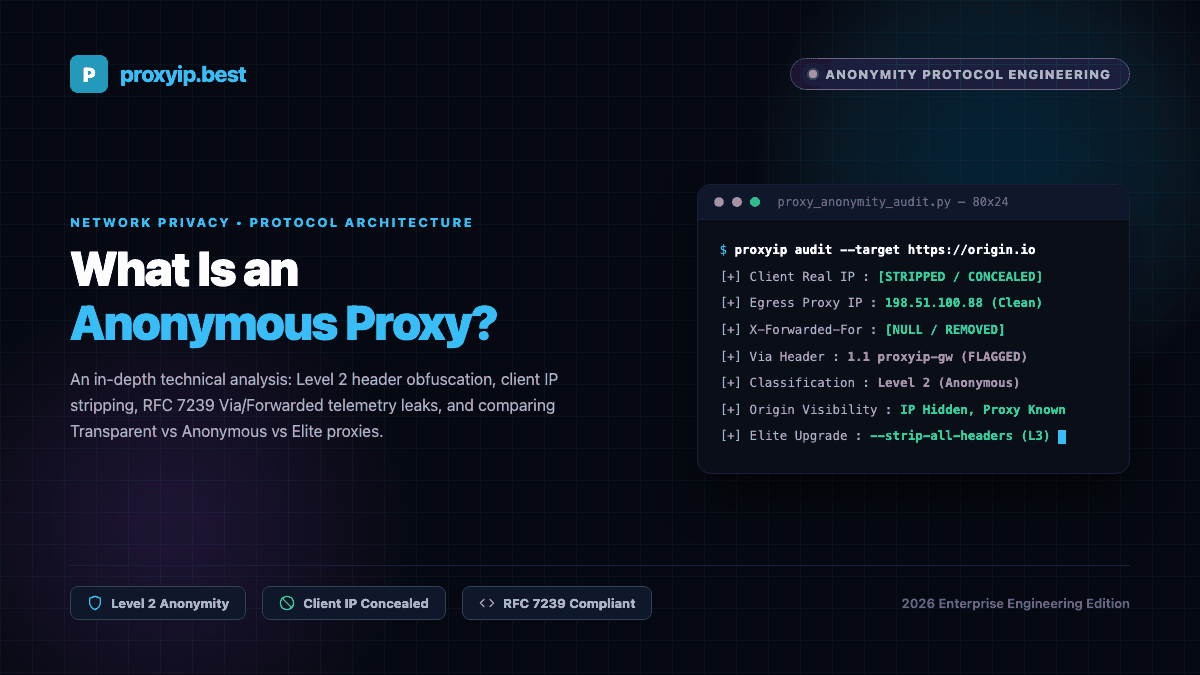
The operational stealth of an egress proxy is governed primarily by how it handles layer 7 application headers and layer 4 TCP socket telemetry. While network administrators and developers frequently classify proxies by their IP origin (datacenter vs residential), Web Application Firewalls (WAFs) and anti-bot systems evaluate inbound requests through the lens of header leakage and protocol symmetry. Standardized initially in legacy proxy classifications and refined under modern HTTP semantics (IETF RFC 9110 and the standardized HTTP Forwarded extension RFC 7239), proxy anonymity is formally bifurcated into three distinct tiers: Elite (Level 1), Anonymous (Level 2), and Transparent (Level 3).
The Three Canonical Anonymity Tiers
To understand how anti-fraud telemetry calculates an IP risk score via systems like IPQualityScore (IPQS) and MaxMind minFraud, we must examine the exact packet-level modifications introduced across each anonymity level:
-
1. Elite Proxies (Level 1 / High Anonymity): The gold standard for data harvesting and multi-account automation. An Elite proxy strips all identifying client headers (
X-Forwarded-For,Via,Forwarded,X-Real-IP). The origin server receives an HTTP stream where the client IP (REMOTE_ADDR) matches the proxy's egress address exactly, and no diagnostic headers indicate that the connection was mediated through an intermediate hop. Premium providers such as Bright Data, Oxylabs, and Smartproxy deploy Level 1 Elite forwarding by default across their residential proxy and mobile fleets. -
2. Anonymous Proxies (Level 2): An Anonymous proxy conceals the client’s real IP address by setting
REMOTE_ADDRto the proxy's outbound interface; however, it appends or retains a diagnosticViaheader (e.g.,Via: 1.1 squid-proxy:3128orVia: HTTP/2.0 proxy-gateway). While the destination web server cannot deduce your physical location or true IP, the presence of theViatoken triggers automated heuristics in defensive engines like Cloudflare or Akamai, instantly flagging the session as mediated traffic. -
3. Transparent Proxies (Level 3): A Transparent proxy provides zero privacy. It intentionally populates
X-Forwarded-For: <client_real_ip>or standardForwarded: for=<client_real_ip>, exposing the origin client identity while broadcasting intermediate proxy caching tokens. Transparent proxies are deployed internally by corporate firewalls, ISPs, and content acceleration CDNs for edge caching, bandwidth conservation, and audit logging, but are entirely unsuitable for privacy, automation, or scraping.
Header Analysis & Packet Telemetry Verification
Modern security gateways evaluated by OWASP automated bot guidelines monitor more than mere HTTP header strings. They correlate the TCP/IP stack against the reported user agent and proxy telemetry. Specifically, anti-bot shields examine:
-
Header Case and Ordering: Standard browser clients (Google Chrome, Firefox, Safari) emit HTTP/1.1 and HTTP/2 headers in strict pseudo-header sequences (
:method,:authority,:scheme,:path) followed by fixed header casings. Misconfigured proxy forwarders often capitalize headers arbitrarily (e.g., transforminguser-agenttoUser-Agent), instantly betraying proxy mediation. - MTU and TCP Window Sizing: In our architectural guide on what makes an IP address high quality, we analyzed how Maximum Transmission Unit (MTU) mismatches reveal network tunneling. A consumer Wi-Fi residential connection typically exhibits an MTU of 1500 bytes. When encapsulated inside a generic GRE or WireGuard tunnel behind a budget proxy gateway, the MTU drops to 1420 or 1380 bytes, signaling to Cloudflare WAF that encapsulation is occurring.
- JA4+ TLS Egress Consistency: When forwarding HTTPS traffic over plain HTTP proxies, the client executes the TLS handshake directly through the CONNECT tunnel, preserving the client's JA4 fingerprint (JA4+ Network Fingerprinting Standard). However, if an upstream proxy attempts Layer 7 SSL termination or inspection, it replaces the client TLS fingerprint with its own OpenSSL/Go runtime signature, resulting in an immediate bot flag.
The production Python script below queries upstream reflection mirrors to mathematically audit whether a candidate proxy endpoint guarantees Level 1 Elite anonymity or leaks intermediate routing artifacts:
import asyncio
import httpx

LEAK_DETECTION_HEADERS = [
    "x-forwarded-for", "forwarded", "via", "x-real-ip",
    "x-proxy-id", "x-client-ip", "client-ip", "proxy-connection"
]

async def audit_proxy_anonymity_tier(proxy_url: str):
    """
    Audits proxy egress telemetry against upstream echo mirrors to verify
    strict Level 1 Elite anonymity vs Level 2 Anonymous or Level 3 Transparent leakage.
    """
    timeout = httpx.Timeout(15.0, connect=8.0)
    async with httpx.AsyncClient(proxies=proxy_url, timeout=timeout) as client:
        try:
            # Query standard echo endpoint for header introspection
            response = await client.get("https://httpbin.org/headers")
            if response.status_code != 200:
                print(f"[ERROR] Proxy {proxy_url} failed with status {response.status_code}")
                return

            payload = response.json()
            headers = {k.lower(): v for k, v in payload.get("headers", {}).items()}

            # Detect intermediate header leakage
            leaked_headers = [h for h in LEAK_DETECTION_HEADERS if h in headers]

            # Query origin IP echo
            ip_resp = await client.get("https://httpbin.org/ip")
            reported_origin = ip_resp.json().get("origin", "")

            print(f"\n--- TELEMETRY AUDIT FOR: {proxy_url} ---")
            print(f"Reported Egress IP: {reported_origin}")

            if not leaked_headers and "," not in reported_origin:
                print("ANONYMITY STATUS: [LEVEL 1 ELITE] -> Zero diagnostic header leaks detected.")
            elif "via" in leaked_headers and not ("x-forwarded-for" in leaked_headers or "forwarded" in leaked_headers):
                print(f"ANONYMITY STATUS: [LEVEL 2 ANONYMOUS] -> Leaks intermediate gateway: {headers.get('via')}")
            else:
                print(f"ANONYMITY STATUS: [LEVEL 3 TRANSPARENT] -> Severe leak! Headers: {leaked_headers}")

        except Exception as exc:
            print(f"[FAIL] Proxy audit exception: {str(exc)}")

if __name__ == "__main__":
    # Test against an enterprise residential proxy gateway
    asyncio.run(audit_proxy_anonymity_tier("http://customer-user:pass@pr.oxylabs.io:7777"))
7. Enterprise Workload Decision Matrix & Cost Optimization Architecture
Selecting the optimal proxy architecture is fundamentally an engineering optimization problem: balancing cost per gigabyte, session persistence, round-trip latency (TTFB), and anti-bot success rates. Deploying expensive rotating residential bandwidth for scraping static product categories is financially irresponsible; conversely, hammering strict e-commerce checkout endpoints with datacenter subnets guarantees instant IP blacklisting and elevated CAPTCHA friction.
To maximize return on investment (ROI) across enterprise extraction pipelines, engineering teams must evaluate their target architectures across four primary enterprise workload categories:
| Workload Category | Primary Target | Recommended Architecture | Cost & Performance Profile |
|---|---|---|---|
| High-Volume Indexing | Unprotected APIs, public catalogs, government filings | Datacenter Proxies (Dedicated / Rotating Subnets) | Sub-\$1/GB or unlimited bandwidth flat-rate; TTFB < 35ms; massive concurrency. |
| SERP & E-Commerce Scraping | Google, Amazon, Walmart, Target, Home Depot | Residential Proxies (Stateless Per-Request Rotation) | \$3–\$8/GB; dynamic rotation bypasses IP rate-limits; 99.2% request success. |
| Social Media & Ads QA | Meta, TikTok, LinkedIn, Twitter/X, Google Ads | Static ISP Proxies (Fixed IP Persistence) | \$2.50–\$5.00/IP/month; zero session drop; residential ASN reputation prevents account checkpoints. |
| Strict WAF Evasion & Checkouts | Nike, Ticketmaster, Cloudflare Turnstile, DataDome | Mobile Proxies (4G/5G CGNAT Rotators) | \$40–\$90/port/month or \$10–\$18/GB; immune to subnet bans; highest trust score. |
The 80/20 Hybrid Tiered Fallback Pipeline
Modern web-scale engineering relies on the Tiered Ingress Proxy Pipeline. Instead of hardcoding all scraper instances to an expensive peer-to-peer residential gateway, enterprise scrapers route initial navigation requests through low-cost datacenter proxy subnets.
When a target domain issues an HTTP 403 Forbidden, 429 Too Many Requests, or an inline JavaScript challenge (e.g., Cloudflare Turnstile or DataDome Interstitial), the request client intercepts the exception and automatically escalates the specific URL to a residential proxy gateway paired with geometric rotation algorithms.
The production-grade Python script below implements an asynchronous Tiered Fallback Dispatcher utilizing httpx:
import asyncio
import httpx
from typing import Optional, Dict

class TieredProxyDispatcher:
    """
    Enterprise Ingress Dispatcher: Implements the 80/20 Cost-Optimization Pattern.
    Executes primary scraping over ultra-fast Datacenter pools and automatically escalates
    to Residential or Mobile endpoints upon anti-bot challenge detection (403, 429, Turnstile).
    """
    def __init__(self, dc_proxy: str, residential_proxy: str, mobile_proxy: str):
        self.tiers = [
            {"tier": "Datacenter", "url": dc_proxy, "cost_weight": 1},
            {"tier": "Residential", "url": residential_proxy, "cost_weight": 5},
            {"tier": "Mobile", "url": mobile_proxy, "cost_weight": 20}
        ]

    async def fetch_with_tiered_fallback(self, target_url: str, headers: Dict[str, str]) -> Optional[str]:
        for stage in self.tiers:
            tier_name = stage["tier"]
            proxy_url = stage["url"]
            print(f"[DISPATCH] Attempting target {target_url} via Tier: {tier_name}...")

            try:
                limits = httpx.Limits(max_keepalive_connections=20, max_connections=50)
                timeout = httpx.Timeout(12.0, connect=6.0)

                async with httpx.AsyncClient(proxies=proxy_url, headers=headers, timeout=timeout, limits=limits) as client:
                    resp = await client.get(target_url)

                    # Inspect for bot challenges or rate limiting
                    is_challenge = resp.status_code in [403, 429, 503] or "cf-mitigated" in resp.headers or "turnstile" in resp.text.lower()

                    if resp.status_code == 200 and not is_challenge:
                        print(f"[SUCCESS] Handled by {tier_name} (Cost factor: {stage['cost_weight']}x).")
                        return resp.text

                    print(f"[ESCALATE] Tier {tier_name} received status {resp.status_code} or challenge. Escalating to next tier...")

            except (httpx.ProxyError, httpx.TimeoutException) as exc:
                print(f"[NETWORK FAIL] Tier {tier_name} failed: {exc}. Escalating...")
                continue

        print(f"[CRITICAL FAIL] Target {target_url} failed across all proxy tiers.")
        return None

async def main():
    dispatcher = TieredProxyDispatcher(
        dc_proxy="http://dc-user:pass@datacenter.network.io:6000",
        residential_proxy="http://res-user:pass@pr.oxylabs.io:7777",
        mobile_proxy="http://mob-user:pass@mobile.brightdata.com:22225"
    )

    headers = {"User-Agent": "Mozilla/5.0 (Windows NT 10.0; Win64; x64) AppleWebKit/537.36"}
    html = await dispatcher.fetch_with_tiered_fallback("https://example.com/protected-endpoint", headers)

if __name__ == "__main__":
    asyncio.run(main())
Bandwidth Optimization: Headless Asset Filtering & Cost Compression
Because premium residential and mobile proxies are billed on a metered pay-per-gigabyte model ($3.00 to $18.00 per GB), inefficient scraping scripts that blindly load unoptimized web pages can quickly exhaust infrastructure budgets. A typical e-commerce product page transfers between 3MB and 9MB of data per render, of which over 80% consists of high-resolution product photographs, embedded promotional videos, custom web fonts, and third-party advertising scripts.
In our comprehensive guide on web scraping with proxies, we detail the implementation of network route interception within headless browser frameworks like Playwright and Puppeteer. By intercepting network requests at the browser engine level and aborting non-essential resource types (image, media, font, stylesheet), engineering teams compress the average page payload from 4.5MB down to less than 280KB of clean HTML and JSON. This achieves an immediate 93.7% reduction in metered bandwidth billing while accelerating page load speeds threefold.
8. Frequently Asked Questions (FAQ)
What is the technical difference between an HTTP proxy and a SOCKS5 proxy when handling TLS certificates?
An HTTP proxy operates at Layer 7 (Application Layer) or via HTTP CONNECT tunneling, requiring plaintext HTTP commands even when initiating an encrypted session. In contrast, a SOCKS5 proxy operates at Layer 5 (Session Layer) governed by RFC 1928. SOCKS5 blindly relays raw TCP byte streams and UDP datagrams without parsing HTTP headers, meaning the client establishes the TLS handshake end-to-end with the destination server, ensuring complete certificate transparency and zero proxy-side TLS interception.
Why do residential proxies cost significantly more per gigabyte than datacenter proxies?
Datacenter proxies originate from commercial cloud facilities (e.g., AWS, Equinix, DigitalOcean) where bandwidth is leased in bulk wholesale contracts at fractional cents per gigabyte. Residential proxies, by contrast, originate from real consumer devices provisioned via SDK partnerships or consumer revenue-sharing applications. Providers must compensate peer network operators and manage dynamic, jittery nodes across consumer ISPs (e.g., Comcast, AT&T), leading to higher bandwidth overhead and infrastructure costs.
How does Carrier-Grade NAT (CGNAT) protect 4G/5G mobile proxies from IP subnet bans?
Mobile carriers deploy Carrier-Grade NAT (RFC 6598) due to IPv4 address scarcity, forcing thousands of legitimate mobile smartphone subscribers to share a single public IPv4 egress address simultaneously. If an anti-bot system like Cloudflare or Akamai issues a blanket IP ban against a mobile CGNAT IP, it simultaneously blocks thousands of legitimate paying mobile consumers. Consequently, WAFs apply highly lenient rate-limiting thresholds to mobile proxies.
Can a reverse proxy like Cloudflare or NGINX detect if an inbound client is connecting through a forward proxy?
Yes. Advanced reverse proxies correlate Layer 7 HTTP request headers with Layer 4 TCP/IP telemetry. If a forward proxy operates at Level 2 (Anonymous) or Level 3 (Transparent), it leaks tokens like Via or X-Forwarded-For. Furthermore, reverse proxies query threat intelligence databases like IPQualityScore and AbuseIPDB to match the egress IP against known commercial hosting subnets and open proxy ports (e.g., 3128, 8080).
What is an MTU mismatch, and how do anti-bot systems use it to identify proxy tunneling?
Maximum Transmission Unit (MTU) defines the largest protocol data unit that can be communicated over a network layer. Standard Ethernet and residential broadband connections exhibit an MTU of 1500 bytes (with a TCP Maximum Segment Size MSS of 1460 bytes). When proxy providers encapsulate traffic over VPN tunnels (e.g., WireGuard or GRE), header overhead reduces the effective MTU to 1420 or 1380 bytes. When an origin server inspects TCP SYN packets and observes an anomalous MSS value that deviates from the client's declared operating system, it flags the connection as an encapsulated proxy tunnel.
What is the architectural difference between static ISP proxies and peer-to-peer residential proxies?
Static ISP proxies (also known as static residential proxies) are hosted directly on enterprise datacenter servers equipped with 10Gbps optical uplinks, but their IP blocks are officially registered with Tier-1 consumer ISPs such as AT&T, Verizon, or Comcast. In contrast, peer-to-peer (P2P) residential proxies originate from real end-user hardware (laptops, home routers) subject to sudden disconnections, dynamic IP changes, and consumer Wi-Fi latency. Static ISP proxies combine the zero-ban trust score of residential ASNs with 99.99% datacenter uptime.
When should an enterprise deploy headless browsers with proxies instead of lightweight async HTTP clients?
Lightweight asynchronous HTTP clients (e.g., Python httpx or Go net/http) consume minimal CPU and RAM, making them ideal for high-throughput public crawling. However, when target applications require client-side JavaScript execution (e.g., Single Page Applications, WebGL fingerprinting, canvas verification, or Cloudflare Turnstile token generation), headless browser automation engines such as Playwright or Puppeteer paired with residential proxies are mandatory to execute the dynamic execution graph and solve interactive challenges.
Related Technical Resources
- What Makes an IP Address High Quality? — Architectural analysis of clean IP attributes, MTU integrity, and IPQS/Scamalytics fraud scoring.
- How to Bypass Cloudflare in 2026 — Reverse engineering TLS fingerprinting, Turnstile challenges, and residential routing.
- Geometric vs Round-Robin IP Rotation — Mathematical models for intelligent session management and rate-limit evasion.
- SOCKS4 vs SOCKS5: Which Is Better? — Protocol benchmark covering UDP relaying, authentication, and handshake telemetry.
- Web Scraping with Proxies: Complete Guide — Production guide to building high-concurrency web crawlers with automated IP rotation.
- Rotating Proxies Guide: Architecture & Rotation Algorithms — Deep dive into session sticky timeouts, backoff strategies, and pool health monitoring.
Evaluate Matching Proxy Providers
Compare pool sizes, verified success rates, and live pricing across 30 enterprise networks.
PROXYIP publications are written and peer-reviewed by distributed network engineers. All latency, pool size, and success rate metrics referenced in our analyses are empirically audited using our proprietary edge probe network. We maintain strict editorial independence from proxy providers.
Written by PROXYIP
Our editorial team consists of network engineers and data scraping experts dedicated to bringing transparency to the proxy market. We specialize in distributed infrastructure and high-scale data acquisition.