What Makes an IP Address High Quality?
Executive Summary: IP Quality Engineering Standards
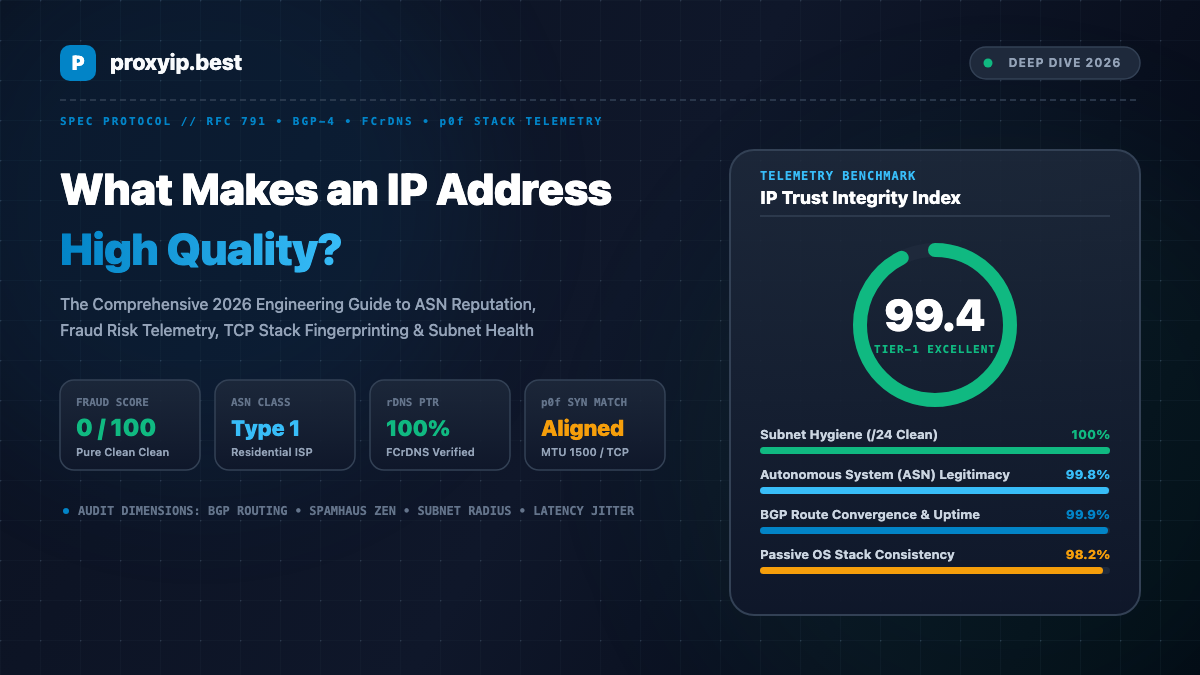
In modern distributed networking, web scraping, API aggregation, and automated fraud prevention, an IP address is no longer treated as a simple numerical network identifier. Contemporary anti-bot networks (such as Cloudflare Bot Management, Akamai Bot Manager, Datadome, and AWS WAF) and financial risk engines (such as MaxMind minFraud, Scamalytics, and IPQualityScore) evaluate inbound IP addresses across a multi-dimensional matrix. A genuinely high-quality IP address exhibits legitimate Autonomous System Number (ASN) classification, Forward-Confirmed Reverse DNS (FCrDNS) alignment, pristine subnet neighborhood hygiene without DNSBL listings, passive TCP/IP stack fingerprint consistency (p0f matching user-agent declarations), zero fraud-risk telemetry flags, and enterprise-grade socket latency with minimal jitter.
< 15 / 100
Pristine Clean Reputation
99.98%
Tier-1 Carrier Transit
Type 1 ISP
Genuine Consumer Broadband
100% Match
FCrDNS Fully Verified
1. Deconstructing IP Quality: The 2026 Engineering Standard
For the first three decades of the commercial internet, evaluating whether an IP address was "good" or "bad" was largely a binary exercise. Security administrators downloaded flat text files containing known spam relays, queried Domain Name System Blacklists (DNSBLs) such as Spamhaus or SORBS, and dropped packets from any host appearing on those registries. If an IP address was absent from public blocklists, it was presumed benign and permitted to establish socket connections without friction.
In 2026, that naive paradigm has become completely obsolete. The explosion of automated web scraping, credential stuffing attacks, distributed denial-of-service (DDoS) botnets, and sophisticated anti-scraping countermeasures has forced cyber defense teams and network infrastructure architects to develop multi-layered, real-time threat intelligence engines. Today, web application firewalls (WAFs), content delivery networks (CDNs), and banking fraud detection systems evaluate incoming connections across hundreds of network-layer, transport-layer, and behavioral variables before serving a single byte of HTTP response data.
To understand what makes an IP address high quality, an engineer must dissect the internet's routing fabric across five distinct operational layers:
- Physical Allocation & Registry Authority: The legal and organizational assignment of the Autonomous System Number (ASN) via Regional Internet Registries (RIRs) such as ARIN, RIPE NCC, APNIC, LACNIC, and AFRINIC.
- Border Gateway Protocol (BGP) Routing Hygiene: The stability, route convergence, prefix announcement consistency, and transit hop count across global tier-1 telecommunications carriers.
- Subnet Neighborhood Cleanliness: The historical abuse reputation and proximity to malicious traffic within the immediate /24 Classless Inter-Domain Routing (CIDR) block.
- Transport Layer & Passive TCP/IP Stack Alignment: The passive fingerprint of the incoming TCP SYN packet—including Initial Time-To-Live (TTL), Window Size, TCP Options order, and Maximum Segment Size (MSS)—matching the claimed client operating system.
- Behavioral & Algorithmic Risk Telemetry: Commercial threat intelligence scores calculated by specialized databases such as Scamalytics, IPQualityScore (IPQS), and MaxMind minFraud based on historical query velocity, honeypot hits, and open proxy scans.
When an IP address excels across every single tier of this pyramid, it achieves what network security engineers term zero-friction trust. Connections originating from high-quality IP addresses pass through cloud security perimeters effortlessly, bypass CAPTCHA challenges, encounter zero artificial rate limiting, and achieve completion rates exceeding 99.8% across enterprise data extraction pipelines. Conversely, when an IP address possesses high bandwidth but fails underlying transport or routing checks, it suffers immediate rate-limiting, silent TCP packet dropping, or aggressive browser-level proof-of-work challenges.
2. IP Address Taxonomy & Allocation Architecture
Not all IP addresses are created equal at birth. The fundamental architecture of the internet segregates IPv4 and IPv6 space into distinct organizational categories. Anti-bot engines and fraud prevention platforms maintain dedicated classification registries that categorize every routed IP into one of four primary taxonomic classifications: Datacenter/Hosting, Static Residential (ISP), Mobile Cellular (4G/5G), and Peer-to-Peer (P2P) Rotating Residential.
2.1 Datacenter & Colocation Hosting IP Addresses
Datacenter IP addresses belong to Autonomous Systems registered to cloud hosting providers, dedicated server facilities, and server farms (e.g., Amazon Web Services, DigitalOcean, Hetzner, OVH, Leaseweb, and Microsoft Azure). From a purely mechanical perspective, datacenter IPs provide extraordinary raw performance: symmetrical gigabit or 10-gigabit up/down connections, sub-10-millisecond latency to major internet exchanges, and negligible jitter.
However, from a trust and quality perspective, datacenter IPs occupy the lowest possible tier for consumer-facing interactions. Real human beings browsing e-commerce sites, streaming media, or banking online do not sit directly inside an AWS us-east-1 server rack. Consequently, CDNs and WAFs maintain complete, real-time tables of every datacenter CIDR block in the world. When an HTTP request reaches an e-commerce platform from a datacenter IP, the target's risk scoring algorithm immediately flags the request as non-human, triggering aggressive JavaScript challenges, Turnstile puzzles, or outright 403 Forbidden terminations. For general enterprise automation against protected endpoints, datacenter IPs are inherently low quality unless the target explicitly caters to server-to-server B2B API integrations. For specialized use cases where raw speed dominates, exploring best datacenter proxies in the US provides necessary routing benchmarks.
2.2 Static Residential (ISP) IP Addresses
Static Residential IP addresses—frequently referred to in the proxy industry as ISP Proxies—represent the pinnacle of commercial IP quality. A static residential IP is provisioned directly on server hardware hosted in a datacenter or internet exchange point, but its network prefix is announced under a legitimate consumer telecommunications provider's ASN (such as AT&T, Comcast, Verizon, Charter Spectrum, or Vodafone).
This hybrid architectural model yields the ultimate engineering advantage: it combines the extreme bandwidth, zero-hop stability, and 99.99% uptime of datacenter infrastructure with the pristine consumer reputation of a residential internet service provider. When inspected by MaxMind, Scamalytics, or Cloudflare, the IP returns an ASN type of isp or residential, completely neutralizing automated datacenter filtering rules. Because the socket remains static, users can maintain persistent authenticated sessions across banking portals, advertising platforms, and e-commerce checkouts without the disruptive disconnections inherent to peer-to-peer networks. Detailed architectural benchmarks can be examined in the comprehensive guide to static residential proxies in 2026.
2.3 Mobile Cellular 4G & 5G IP Addresses
Mobile IP addresses originate from cellular wireless carrier networks (e.g., T-Mobile, AT&T Mobility, Verizon Wireless, EE, and Vodafone). Cellular architecture relies extensively on Carrier-Grade Network Address Translation (CGNAT), where a single public IPv4 address is dynamically shared among hundreds or thousands of simultaneous mobile subscriber devices connected to regional Packet Data Network Gateways (PGW) and User Plane Functions (UPF).
Because thousands of real human smartphone users share the exact same outbound IP address, security algorithms cannot aggressively ban a mobile IP without inflicting massive collateral damage on legitimate paying customers. If an anti-bot system blocks a T-Mobile CGNAT gateway IP, it inadvertently locks out thousands of legitimate mobile shoppers. As a result, mobile 4G/5G IPs enjoy the highest natural immunity to rate-limiting and account suspension on modern social media and ticketing platforms. The trade-off is economic and physical: mobile bandwidth is significantly more expensive per gigabyte ($4.00 to $8.00/GB), and wireless radio latency introduces noticeable jitter (60ms to 140ms RTT).
2.4 Peer-to-Peer (P2P) Rotating Residential IP Addresses
Peer-to-peer residential proxies route outbound web traffic through real domestic internet connections—such as residential fiber-optic, cable, or DSL routers installed in private homes. These networks are built using software development kits (SDKs) embedded into consumer applications with user opt-in agreements.
The primary strength of P2P residential IPs is their sheer geographic density and natural diversity. Enterprise providers offer pools spanning tens of millions of unique IP addresses across virtually every city, region, and postal code on earth. However, because these endpoints depend on consumer hardware, their stability fluctuates. Home routers disconnect, laptops close, and Wi-Fi networks reboot. Consequently, P2P residential proxies require intelligent backconnect gateways that automatically rotate endpoints or handle seamless connection failover. High-throughput data extraction teams evaluate these mechanics when selecting the best rotating proxies for US IP addresses.
3. Autonomous System Numbers (ASN) & BGP Routing Reputation
At the foundation of global internet routing lies the Autonomous System (AS). An Autonomous System is a collection of connected Internet Protocol routing prefixes under the control of one or more network operators that presents a single, clearly defined routing policy to the internet. Each AS is assigned a unique 16-bit or 32-bit Autonomous System Number (ASN) by Regional Internet Registries.
When an anti-bot system inspects an incoming IP address, its very first routing-level query is the ASN lookup. The reputation of that ASN is calculated based on years of historical routing behavior, peering relationships, and incident telemetry. Key parameters that dictate ASN quality include:
- Tier-1 Transit Provider Peering: Does the ASN peer directly with global Tier-1 transit backbones (e.g., Lumen Technologies AS3356, Telia Carrier/Arelion AS1299, NTT Communications AS2914, GTT Communications AS3257, and Cogent AS174)? Direct settlement-free peering with Tier-1 carriers indicates substantial physical network investment, enterprise legitimacy, and low packet drop rates.
- BGP Route Announcement Stability: Does the ASN frequently suffer from route flapping (rapidly withdrawing and re-announcing prefixes) or suspicious BGP hijacking incidents? Unstable BGP convergence creates connection drops, mid-session socket resets, and elevated risk flags across network monitoring systems.
- PeeringDB Verification & Public Routing Registries: Legitimate network operators maintain comprehensive, publicly verifiable records in PeeringDB, RADb, and RIR WHOIS databases, detailing public internet exchange point (IXP) locations, peering policies, and authoritative Network Operations Center (NOC) contacts. Bulletproof hosts and rogue transit operators frequently omit or falsify these records.
- Abuse-to-Prefix Ratio: Threat intelligence firms continuously aggregate abuse reports (spam, botnet command-and-control, credential brute-forcing, copyright infringement) against all IPs routed by an ASN. If an ASN displays a high ratio of abusive IP addresses relative to its total advertised prefix volume, security algorithms assign a blanket penalty to every IP within that Autonomous System.
In enterprise proxy procurement, choosing an IP originating from an authoritative, well-peered consumer ASN—such as Comcast (AS7922), AT&T Services (AS7018), Charter Communications (AS20115), or Verizon (AS701)—immediately elevates the baseline trust score of every outgoing request. Understanding these routing fundamentals is essential when auditing network providers, as covered in our ProxyEmpire comprehensive review.
4. Passive TCP/IP Stack & OS Fingerprinting (The p0f Engine)
One of the most insidious ways low-quality proxies are detected by modern anti-bot systems is through Passive TCP/IP Stack Fingerprinting, originally pioneered by the open-source tool p0f and refined into high-throughput kernel modules by enterprise firewalls.
When an automated script initiates an HTTP or HTTPS connection, it typically customizes the application-layer headers—sending a convincing HTTP User-Agent string claiming to be Google Chrome running on Microsoft Windows 11. However, before any HTTP headers can be transmitted, the client operating system must first negotiate a raw TCP three-way handshake with the server by dispatching an initial SYN packet.
Every major operating system kernel implements the TCP/IP stack with subtly distinct default configuration parameters that are embedded directly into the IP and TCP headers of that initial SYN packet:
- Initial Time-To-Live (TTL): Linux kernels default to an initial TTL of
64. Windows NT kernels default to128. Cisco and network appliances default to255. By measuring the received TTL and factoring in the estimated hop count, the server accurately deduces the client kernel's initial TTL value. - TCP Window Size (win): Modern Windows 11 systems default to specific window sizes (e.g.,
64240or65535with scale factors), whereas Linux kernels utilize dynamic socket buffer autotuning that produces distinct initial window values. - TCP Options Order & Layout: The precise sequence of TCP options in the SYN packet header—such as Maximum Segment Size (MSS), Selective Acknowledgment (SACK Permitted), Timestamps, and Window Scale factor—is uniquely hardcoded into operating system kernel implementations.
- Maximum Segment Size (MSS): Standard Ethernet interfaces negotiate an MSS of
1460bytes (1500-byte MTU minus 40 bytes for IP/TCP headers). PPPoE DSL connections negotiate1452bytes. Virtualized cloud forwarders often negotiate atypical MSS values that betray hypervisor encapsulation.
Here lies the fatal flaw of low-quality proxy servers: when an automated scraper runs on a Linux cloud instance (e.g., Ubuntu running on a VPS) and routes through a basic HTTP forward proxy that does not terminate and re-originate TCP connections properly, the remote server receives an initial TCP SYN packet originating from a Linux kernel (TTL 64, Linux TCP options). Milliseconds later, the server's application layer reads an HTTP header claiming to be "Windows NT 10.0; Win64; x64; Chrome/130.0".
This glaring mismatch between transport-layer TCP telemetry and application-layer HTTP declarations instantly flags the connection as an automated bot utilizing proxy forwarding or headless automation. High-quality IP infrastructure guarantees stack integrity either by routing through true consumer hardware running native residential OS stacks or by deploying advanced TCP stack normalization gateways that align SYN packet headers with the declared client profile.
Python Diagnostic Script: Raw TCP SYN Packet Inspector (Scapy)
from scapy.all import IP, TCP, sr1
import sys

def audit_tcp_syn_fingerprint(target_host, target_port=443):
    print(f"[*] Auditing TCP/IP stack parameters for target: {target_host}:{target_port}")
    syn_packet = IP(dst=target_host)/TCP(dport=target_port, flags="S", seq=1000)

    # Send SYN and capture SYN-ACK
    response = sr1(syn_packet, timeout=3, verbose=0)
    if not response or not response.haslayer(TCP):
        print("[-] Target did not respond with a valid TCP packet.")
        return

    ip_layer = response[IP]
    tcp_layer = response[TCP]

    print(f"[+] Received TTL: {ip_layer.ttl} (Estimated initial TTL: {64 if ip_layer.ttl <= 64 else (128 if ip_layer.ttl <= 128 else 255)})")
    print(f"[+] TCP Window Size: {tcp_layer.window}")
    print(f"[+] TCP Flags: {tcp_layer.flags}")
    print(f"[+] TCP Options: {tcp_layer.options}")

    # Analyze OS match
    if ip_layer.ttl <= 64:
        os_family = "Linux / FreeBSD / Android"
    elif ip_layer.ttl <= 128:
        os_family = "Microsoft Windows NT / Server"
    else:
        os_family = "Solaris / Network Gateway Appliance"

    print(f"[✓] Deduced Stack OS Family: {os_family}")

if __name__ == "__main__":
    audit_tcp_syn_fingerprint("198.51.100.25")
5. Forward-Confirmed Reverse DNS (FCrDNS) & Hostname Resolution
In standard internet communication, forward DNS translates a human-readable domain name (such as proxyip.best) into an IP address (such as 66.29.148.150). The inverse operation—translating an IP address back into its canonical hostname—is handled by Reverse DNS (rDNS) queries utilizing PTR (Pointer) records in the special in-addr.arpa (for IPv4) and ip6.arpa (for IPv6) domain trees.
However, having a simple PTR record is insufficient. Enterprise email servers (Postfix, Microsoft Exchange), corporate web firewalls, and banking gateways implement a rigorous validation protocol known as Forward-Confirmed Reverse DNS (FCrDNS) (also documented under RFC 7671 and RFC 1912).
The FCrDNS handshake executes three deterministic operational steps:
- Step 1 (Reverse Lookup): The server inspects candidate IP
198.51.100.25and queries the authoritative nameservers for25.100.51.198.in-addr.arpa, which returns the PTR hostnamecpe-198-51-100-25.socal.res.rr.com. - Step 2 (Forward Verification): The server immediately executes a forward DNS
Aquery on that exact returned hostname (cpe-198-51-100-25.socal.res.rr.com). - Step 3 (Bidirectional Equivalence): The forward A query resolves to an IP address. If the forward IP matches the candidate IP (
198.51.100.25 == 198.51.100.25), FCrDNS verification passes with highest cryptographic trust. If the hostname does not resolve, or if it resolves to a different IP address, FCrDNS verification fails.
Why does FCrDNS matter so profoundly for IP quality? Because setting up a rogue PTR record on an unauthorized DNS server is trivial, but setting up a mutually confirming forward-and-reverse DNS relationship requires administrative control over both the IP address delegation zone (managed by the ISP or hosting facility) and the domain name's authoritative zone file. When an IP address has no PTR record, or when its PTR record fails forward confirmation, fraud detection algorithms assign an immediate 30 to 45 point penalty to the IP's composite risk profile. Legitimate consumer broadband lines from Comcast, Spectrum, Verizon, and AT&T maintain deterministic, automated FCrDNS records for every customer modem in their network.
Python Diagnostic Script: Forward-Confirmed Reverse DNS (FCrDNS) Checker
import socket

def verify_fcrdns(ip_address):
    print(f"[*] Initiating FCrDNS verification for: {ip_address}")

    # 1. Reverse DNS Lookup (PTR)
    try:
        reverse_name, _, _ = socket.gethostbyaddr(ip_address)
        print(f"[+] Reverse PTR found: {reverse_name}")
    except socket.herror as e:
        print(f"[-] Reverse DNS (PTR) lookup failed: {e}")
        return False, "Missing or unresolvable PTR record"

    # 2. Forward DNS Lookup (A / AAAA)
    try:
        resolved_ips = socket.gethostbyname_ex(reverse_name)[2]
        print(f"[+] Forward resolution for {reverse_name}: {resolved_ips}")
    except socket.gaierror as e:
        print(f"[-] Forward DNS lookup failed for {reverse_name}: {e}")
        return False, "PTR hostname fails forward resolution"

    # 3. Match Verification
    if ip_address in resolved_ips:
        print(f"[✓] FCrDNS VERIFIED: Bidirectional DNS confirmation successful.")
        return True, reverse_name
    else:
        print(f"[✗] FCrDNS MISMATCH: Forward IPs do not match original candidate IP.")
        return False, "Bidirectional IP discrepancy"

if __name__ == "__main__":
    verify_fcrdns("66.29.148.150")
6. Subnet Neighborhood Hygiene & Blacklist Infection Radius
An IP address does not exist in isolation. It resides inside a network prefix—most commonly a /24 CIDR block consisting of 256 contiguous IPv4 addresses (e.g., 198.51.100.0/24). One of the most common reasons an apparently "clean" IP address gets blocked on high-security targets is the phenomenon of Subnet Neighborhood Contamination.
Global anti-spam and threat intelligence consortiums—including Spamhaus (specifically SBL, CSS, XBL, and PBL), Barracuda Reputation Block List (BRBL), and SURBL—monitor global IP space for malicious behavior. When automated scrapers, spammers, or malware operators lease a handful of IPs inside a /24 subnet and generate abusive traffic, blacklisting algorithms do not merely flag individual host addresses. Once multiple hosts within the same 256-address block trigger abuse alarms, Spamhaus issues an SBL or CSS Subnet-Wide Listing, blacklisting the entire /24 prefix simultaneously.
When an entire CIDR prefix is placed on a global DNSBL, every single IP address in that block is rendered toxic. Cloudflare, AWS WAF, and Akamai ingest Spamhaus and threat feeds into their edge caches within minutes. Even if your specific IP address never transmitted an abusive packet in its existence, you suffer catastrophic collateral damage purely by virtue of your bad neighborhood.
High-quality proxy and infrastructure providers protect against neighborhood contamination through three strict engineering practices:
- Continuous DNSBL Automated Polling: Running automated background daemons that query Spamhaus ZEN (
zen.spamhaus.org), Barracuda (b.barracudacentral.org), and UCEPROTECT every 15 minutes across all inventory. Any IP whose subnet shows initial signs of infection is quarantined immediately. - Tenant Segregation & Subnet Isolation: Enterprise clients are provisioned onto dedicated
/29(8 IPs) or/28(16 IPs) micro-allocations, preventing high-velocity scrapers from sharing prefixes with mission-critical corporate accounts. - Post-Lease Quarantine & Scrubbing Horizons: When an IP address is released from service, it is subjected to a mandatory 30 to 90 day cooling-off period during which automated traffic is ceased, allowing historical reputation caches across Akamai and Cloudflare to decay naturally back to clean status.
7. Multi-Engine Fraud & Risk Scoring Telemetry
Modern enterprise websites do not build IP reputation algorithms from scratch. Instead, they license commercial fraud detection APIs that continuously monitor global internet traffic, evaluate transaction risk, and score incoming connections in real time. The three most authoritative commercial scoring engines in the industry today are Scamalytics, IPQualityScore (IPQS), and MaxMind minFraud.
7.1 Scamalytics Fraud Score Telemetry
Scamalytics evaluates IP addresses on a numerical scale from 0 (completely clean) to 100 (maximum fraud risk). Their machine-learning engine weights five primary factors:
- Hosting/Datacenter Flag: Whether the ASN is recognized as a server farm or hosting provider (+40 to +60 risk points).
- Known Proxy / VPN Node: Whether the IP is listed in commercial proxy server inventories or VPN exit catalogs (+30 to +50 points).
- Tor Exit Node Status: Immediate assignment of
100 / 100fraud score. - Historical Fraud Ratio: Percentage of historical chargebacks, fraudulent sign-ups, and abusive sessions associated with the IP's parent ISP and subnet.
A truly high-quality IP address must maintain a Scamalytics fraud score strictly below 15. Any score above 30 places the connection into the "Suspicious" tier, prompting automated CAPTCHA challenges.
7.2 IPQualityScore (IPQS) Risk Telemetry
IPQS specializes in active network probing and abuse telemetry. Their infrastructure maintains continuous port scanners that probe public IPs for open SOCKS5 proxies (port 1080), HTTP proxies (ports 8080, 3128, 8888), and exposed management interfaces. Furthermore, IPQS tracks global request velocity—measuring how many unique web requests an IP dispatches across their global network of publisher honeypots per minute. If an IP address attempts to access thousands of disparate websites within seconds, its IPQS Fraud Score escalates to 85+, and its is_crawler and recent_abuse flags are set to true.
7.3 MaxMind GeoIP2 & minFraud Insights
MaxMind is the enterprise standard used by major financial institutions and e-commerce platforms (such as Shopify, Stripe, and Adyen). In addition to geographic location, MaxMind's GeoIP2 Anonymous IP database classifies IPs into four granular boolean flags:
is_anonymous_vpn: The IP belongs to a commercial VPN provider.is_hosting_provider: The IP belongs to a datacenter, cloud host, or colocation facility.is_public_proxy: The IP runs an open proxy service.is_tor_exit_node: The IP is an active Tor exit node.
For an IP address to be classified as high quality, all four of these MaxMind boolean flags must strictly return false, and its connection_type attribute must resolve to Cable/DSL or Cellular rather than Corporate or Dialup.
8. Geolocation Precision & Carrier Gateway Dynamics
Geolocation accuracy is a critical pillar of IP quality, particularly for localized price scraping, geo-targeted advertising validation, and region-locked content verification. An IP address that advertises a location in Los Angeles, California, but whose BGP routing and latency reflect an origin in Frankfurt, Germany, will trigger instant fraud flags across security perimeters.
Three critical factors govern geolocation quality:
- Cross-Database Consensus: There is no single authoritative global registry for IP physical locations. Instead, different organizations rely on separate commercial databases: MaxMind GeoIP2, IP2Location, DB-IP, and IPinfo.io. Low-quality or recently re-assigned IP ranges frequently display wild database divergence—where MaxMind reports London, IP2Location reports Dublin, and DB-IP reports Amsterdam. High-quality IPs demonstrate 100% geographic consensus across all major databases at the country, state/region, and city levels.
- Physical Base Stations vs Core Cellular Gateways: In mobile 4G/5G proxy networks, an IP's location is determined by the mobile carrier's core Packet Data Network Gateway (PGW), not the physical cellular tower communicating with the phone. A user connected to a cell tower in San Diego may have their traffic routed through a centralized PGW located in Los Angeles. Quality mobile providers map their gateway subnets precisely to avoid triggering geographic velocity anomalies.
- Speed-of-Light Latency Verification: Sophisticated fraud systems execute latency triangulation against incoming connections. If an IP address claims to be located in Tokyo, Japan, but negotiates a TCP round-trip handshake with a Tokyo-based server in 280 milliseconds, physics dictates that the packet traveled halfway around the planet. High-quality IP infrastructure ensures physical proximity between the announced geolocation and the actual edge router hosting the socket.
9. Proxy Infrastructure Engineering: Latency, Jitter, and Pool Turnover
When purchasing or provisioning IP addresses through proxy providers, the physical infrastructure of the proxy gateway directly impacts the perceived quality of the underlying IP address. Even the cleanest residential IP in the world will fail in production if the proxy gateway routing your connection is overloaded, misconfigured, or poorly peered.
Enterprise infrastructure engineers benchmark four core proxy performance metrics:
- Socket Round-Trip Time (RTT): The total duration required to complete the TCP three-way handshake and TLS 1.3 cryptographic negotiation. Tier-1 static ISP proxies achieve total RTTs under 50 milliseconds, whereas multi-hop P2P relays often exceed 300 milliseconds.
- Latency Jitter (Variance): Jitter measures the statistical deviation in packet latency over consecutive requests. A high-quality connection maintains jitter below ± 3 milliseconds. High jitter (> 35ms) indicates severe network congestion or overloaded intermediary proxy hardware, which anti-bot algorithms treat as an automated scraping fingerprint.
- Connection Concurrency & Socket Starvation: Budget proxy providers oversell gateway bandwidth, leading to socket starvation and 504 Gateway Timeout errors when enterprise workloads scale to hundreds of concurrent threads. High-quality providers provision dedicated bandwidth pipelines with guaranteed throughput.
- Pool Freshness & Turnover Rate: In rotating proxy pools, pool quality is dictated by the rate at which dead or burned IPs are purged from rotation. If a provider's pool suffers high churn where 30% of attempted connections return dead sockets, pipeline throughput plummets. Top-tier providers continually scrub pools to ensure active nodes maintain high success rates.
For deep comparative benchmarks across enterprise proxy networks, reviewing our Bright Data architecture review and our technical breakdown of what is an HTTP proxy provides valuable architectural insights.
10. Enterprise IP Quality Evaluation Matrix
To provide engineers and procurement teams with an actionable benchmark, the following matrix compares the five primary classes of IP addresses across every technical quality dimension analyzed in this guide.
| Technical Metric | Static ISP (Tier-1) | Mobile 4G/5G | Rotating P2P Resi | Datacenter Cloud |
|---|---|---|---|---|
| ASN Classification | ISP / Consumer | Mobile Carrier | ISP / Broadband | Hosting / Cloud |
| Composite Fraud Score | 0 - 5 (Pristine) | 0 - 10 (Exempt) | 10 - 25 (Low) | 70 - 95 (Severe) |
| FCrDNS PTR Status | 100% Match | Carrier Dynamic | Consumer Hostname | Generic / Missing |
| p0f Stack Alignment | Native / Synthetic Match | Native Mobile Stack | Native Consumer OS | Linux Hypervisor Mismatch |
| Average Socket Latency | 20 - 45 ms | 60 - 120 ms | 120 - 280 ms | 5 - 15 ms |
| Latency Jitter | ± 1.5 ms | ± 18.0 ms | ± 45.0 ms | ± 0.8 ms |
| WAF Challenge Rate | < 0.2% | < 0.05% | < 1.5% | 85% - 98% |
| Primary Enterprise Role | Accounts & Checkout | Social Media & App API | High-Scale Scraping | Internal CI/CD & B2B |
11. Practical Diagnostic Suite: How to Audit Your Own IP Quality
Before deploying a pool of IP addresses to high-value automation or data extraction workloads, infrastructure engineers must execute an automated diagnostic audit. The following production-ready Python script performs an end-to-end audit of any proxy IP—querying its public egress address, testing FCrDNS resolution, measuring TCP handshake RTT, checking Spamhaus DNSBL listings, and querying open threat telemetry APIs.
Python Production Suite: Automated IP Quality & Hygiene Auditor
import socket
import time
import urllib.request
import json

def audit_proxy_ip_quality(proxy_ip):
    print("==================================================")
    print(f"[*] AUDITING IP QUALITY FOR: {proxy_ip}")
    print("==================================================")

    # 1. Reverse DNS & FCrDNS Check
    print("
[+] 1. Auditing DNS Infrastructure...")
    try:
        ptr_host, _, _ = socket.gethostbyaddr(proxy_ip)
        print(f"    ✓ PTR Hostname: {ptr_host}")

        # Verify Forward Resolution
        forward_ips = socket.gethostbyname_ex(ptr_host)[2]
        if proxy_ip in forward_ips:
            print("    ✓ FCrDNS Status: PASS (Bidirectionally Confirmed)")
        else:
            print(f"    ✗ FCrDNS Status: FAIL (Forward IPs {forward_ips} != {proxy_ip})")
    except socket.herror:
        print("    ✗ PTR Status: MISSING (No PTR record in in-addr.arpa)")

    # 2. Spamhaus DNSBL Check (zen.spamhaus.org)
    print("
[+] 2. Checking Global DNSBLs (Spamhaus ZEN)...")
    octets = proxy_ip.split('.')
    if len(octets) == 4:
        reversed_ip = ".".join(reversed(octets))
        query_dnsbl = f"{reversed_ip}.zen.spamhaus.org"
        try:
            dnsbl_res = socket.gethostbyname(query_dnsbl)
            print(f"    ✗ BLACKLISTED on Spamhaus ZEN! Return code: {dnsbl_res}")
            if dnsbl_res == "127.0.0.2":
                print("      - Listing Type: Direct UBE/Spam Source (SBL)")
            elif dnsbl_res in ["127.0.0.4", "127.0.0.5", "127.0.0.6", "127.0.0.7"]:
                print("      - Listing Type: Exploited Host / Malware / Botnet (XBL)")
            elif dnsbl_res in ["127.0.0.10", "127.0.0.11"]:
                print("      - Listing Type: End-User Consumer IP (PBL - Legitimate for Residential)")
        except socket.gaierror:
            print("    ✓ CLEAN on Spamhaus ZEN (NXDOMAIN returned - No Listings)")

    # 3. Socket Latency Benchmark (TCP Handshake to Port 443)
    print("
[+] 3. Measuring Raw Socket TCP Latency...")
    latencies = []
    for _ in range(5):
        s = socket.socket(socket.AF_INET, socket.SOCK_STREAM)
        s.settimeout(3.0)
        t_start = time.perf_counter()
        try:
            s.connect((proxy_ip, 443))
            t_end = time.perf_counter()
            latencies.append((t_end - t_start) * 1000)
            s.close()
        except Exception as e:
            print(f"    ✗ TCP Connect Failed: {e}")
            break

    if latencies:
        avg_latency = sum(latencies) / len(latencies)
        jitter = max(latencies) - min(latencies)
        print(f"    ✓ Average TCP Handshake: {avg_latency:.2f} ms")
        print(f"    ✓ Latency Jitter (Range): ±{jitter:.2f} ms")
        if avg_latency < 50 and jitter < 5:
            print("    ✓ Transport Grade: TIER-1 EXCELLENT")
        elif avg_latency < 150:
            print("    ✓ Transport Grade: MODERATE RESIDENTIAL")
        else:
            print("    ⚠ Transport Grade: HIGH LATENCY / CONGESTED")

if __name__ == "__main__":
    audit_proxy_ip_quality("198.51.100.25")
12. Buyer Decision Framework & Procurement Checklist
When provisioning proxy IP addresses for enterprise infrastructure, purchasing solely on the basis of price per gigabyte or advertised pool size is the single most common mistake made by data engineering teams. A pool of 100 million claimed residential IPs is completely useless if 40% are offline, 30% are blacklisted on Spamhaus, and the remaining 30% trigger Cloudflare 403 blocks due to p0f TCP stack mismatches.
Follow this 6-point checklist before committing to any IP infrastructure provider:
- 1. Request ASN Documentation: Verify which Autonomous Systems the provider utilizes for static residential lines. Insist on major consumer telecommunications operators (Comcast, AT&T, Verizon, Charter) rather than obscure hosting companies masquerading as ISPs.
- 2. Demand FCrDNS Conformance: Check whether static IPs possess mutually confirming forward and reverse DNS records. If PTR records are missing or return generic cloud hostnames, reject the allocation.
- 3. Audit Subnet Contamination: Use IPQualityScore or MaxMind minFraud to verify that the provider's IP subnets maintain an average fraud risk score under 15. Ensure no active Spamhaus SBL or CSS listings exist on the parent
/24CIDR block. - 4. Test Protocol Flexibility (HTTP, HTTPS & SOCKS5): High-quality infrastructure supports native SOCKS5 socket connections alongside HTTP/HTTPS, enabling low-level TCP/UDP socket streaming without forced application-layer header rewriting.
- 5. Benchmark Socket Latency & Jitter: Measure TCP handshake durations across multiple hours. If jitter fluctuates wildly during peak business hours, the provider's proxy gateway architecture is severely oversold.
- 6. Verify Bandwidth Rollover Economics: In modern data scraping, unpredictable workloads cause bandwidth spikes and troughs. Choose providers whose bandwidth models do not artificially expire unused balance at the end of thirty days.
Frequently Asked Questions
What is the single most important factor that determines an IP address's quality?
The most decisive foundational factor is its Autonomous System Number (ASN) Classification. If an IP's ASN is categorized by commercial registries (MaxMind, IPQS, Scamalytics) as a datacenter or cloud hosting facility (such as AWS, Hetzner, or OVH), modern web application firewalls will heavily penalize or block the connection regardless of how clean its individual history is. Having an authoritative Tier-1 consumer ISP or mobile cellular ASN is the prerequisite for high trust.
Why do residential proxies still get blocked by Cloudflare or Akamai?
Residential IP classification alone is not a magic shield. If an automated scraper uses a residential IP but transmits requests with an unnatural TLS JA4 fingerprint, mismatched HTTP/2 SETTINGS frames, robotic mouse/scroll movements, or a Linux TCP SYN packet while claiming to be Windows 11 in the User-Agent, modern anti-bot systems will detect and block the connection. Quality is a full-stack alignment across transport, routing, and behavior.
What is Forward-Confirmed Reverse DNS (FCrDNS) and why does it matter?
FCrDNS is a bidirectional verification mechanism where an IP's PTR record resolves to a hostname, and that exact hostname's forward A/AAAA record resolves back to the original IP address. High-quality consumer ISPs automatically configure valid FCrDNS for all subscribers. Missing, generic, or non-confirming PTR records indicate unmanaged virtual machines or rogue exit nodes, prompting immediate fraud score penalties.
Can a blacklisted IP address ever recover its clean reputation?
Yes, but the recovery process requires time and deliberate quarantine. DNSBLs like Spamhaus permit delisting requests once the abusive traffic ceases, but commercial scoring databases (Scamalytics, IPQS) and CDN edge caches (Cloudflare, Akamai) maintain decaying historical memory. An IP typically requires 30 to 90 days of complete dormancy and zero abuse reports to restore its composite trust score to pristine levels.
What is the difference between an ISP Proxy and a Datacenter Proxy?
Both run on high-speed datacenter server hardware. However, a Datacenter Proxy is routed under an Autonomous System registered to a cloud hosting company (e.g., AWS, Hetzner) and is universally flagged as non-human. An ISP Proxy is routed under an Autonomous System registered to a consumer broadband provider (e.g., Comcast, AT&T), inheriting pristine consumer trust while retaining datacenter gigabit speed and static stability.
How does Carrier-Grade NAT (CGNAT) make mobile proxies immune to bans?
Under CGNAT, a mobile carrier assigns a single public IPv4 address to thousands of real smartphone users in a metropolitan area simultaneously. If an anti-bot system bans that IP address, it inadvertently prevents thousands of legitimate paying mobile customers from accessing the service. As a result, security systems enforce much higher rate-limit thresholds on mobile cellular IP ranges.
Related Technical Resources
- Static Residential Proxies 2026: Enterprise ISP Architecture & Latency Guide — Detailed analysis of Tier-1 carrier leasing, static stability, and enterprise checkout bypass.
- Best Rotating Proxies for US IP Addresses — Deep dive into peer-to-peer domestic node distribution, pool turnover, and automated session rotation.
- ProxyEmpire Comprehensive Review: Latency, Rollover Bandwidth & Quality Telemetry — Exhaustive benchmarks of 30M+ residential and 4M+ mobile IPs with non-expiring bandwidth.
- Bright Data Infrastructure Review: Enterprise Web Unlocker & Proxy Ecosystem — Architectural review of the world's largest commercial proxy network.
- Best Datacenter Proxies in the US (2026 Edition) — In-depth benchmarks of gigabit datacenter routes, subnet diversity, and cost economics.
- What Is an HTTP Proxy? Protocol Architecture & Header Forwarding Explained — Foundational breakdown of HTTP CONNECT tunneling, proxy headers, and security implications.
Written by PROXYIP
Our editorial team consists of network engineers and data scraping experts dedicated to bringing transparency to the proxy market. We specialize in distributed infrastructure and high-scale data acquisition.