Proxy Pricing Guide

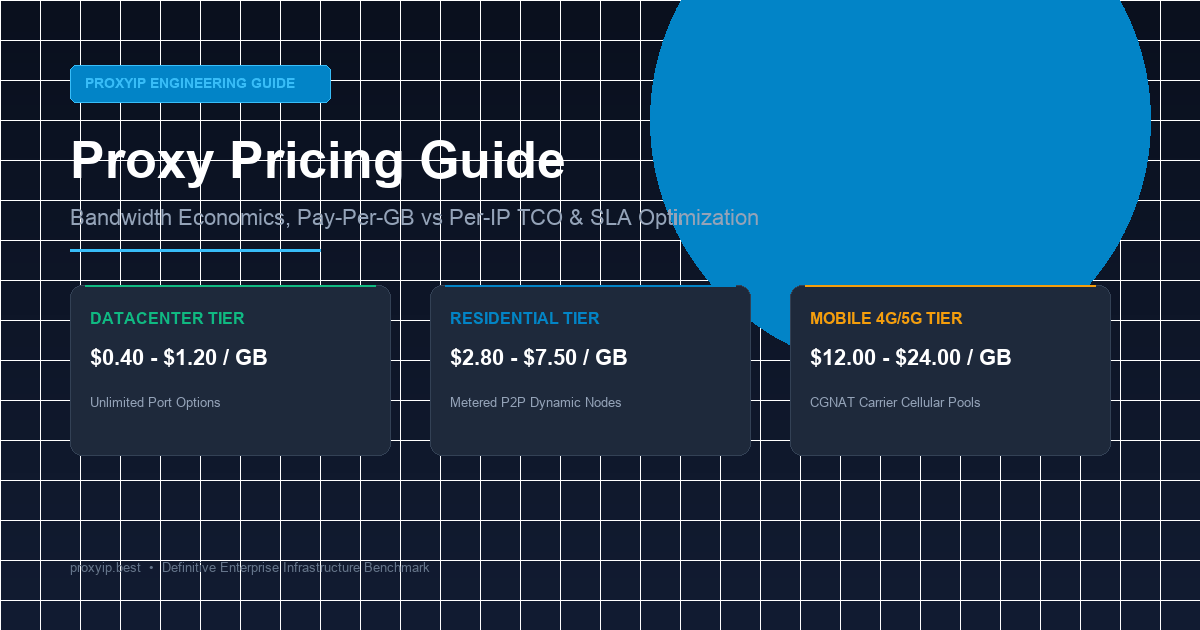
Executive Engineering Summary: Proxy Infrastructure Cost Architecture
Procuring enterprise proxy infrastructure requires evaluating total cost of ownership (TCO) beyond advertised headline prices. Commercial proxy pricing is bifurcated across three primary monetization models: Metered Bandwidth (Pay-Per-GB), Dedicated Fixed Subnets (Flat-Rate Per-IP), and Port-Based Concurrency Relays. However, headline per-gigabyte costs are frequently misleading: a nominal \$3.00/GB residential pool that suffers a 35% HTTP 403/429 ban rate incurs an effective cost of \$4.61 per successful gigabyte, while unoptimized headless browsers loading unblocked video and font assets increase metered bandwidth billing by up to 1,200%. This definitive guide provides an exhaustive engineering dissection of commercial proxy economics, enterprise contract negotiations, phantom retry multipliers, and architectural strategies to reduce proxy billing by over 70%.
Enterprise Proxy Pricing Benchmark Matrix (2026 Edition)
The following fixed-layout benchmark matrix outlines median industry pricing tiers, billing metrics, concurrency caps, and target workloads across all major proxy infrastructure categories:
| Proxy Architecture | Entry-Level Pricing | Enterprise Commit Pricing | Billing Metric & Typical Overhead |
|---|---|---|---|
| Dedicated Datacenter | \$1.20 – \$2.50 / IP / mo | \$0.40 – \$0.85 / IP / mo | Per IP/Month; Unlimited bandwidth; Shared or dedicated 1Gbps ports. |
| Rotating Datacenter | \$0.70 – \$1.50 / GB | \$0.25 – \$0.55 / GB | Metered GB; Shared subnets; Rate-limited by gateway thread pools. |
| Rotating Residential | \$5.00 – \$8.50 / GB | \$1.80 – \$3.20 / GB | Metered GB; P2P consumer nodes; 30-day traffic expiration clauses. |
| Static ISP Proxies | \$2.80 – \$5.00 / IP / mo | \$1.40 – \$2.20 / IP / mo | Per IP/Month; Fixed Tier-1 ISP ASNs; Metered or unmetered bandwidth options. |
| 4G/5G Mobile Proxies | \$45.00 – \$90.00 / Port / mo | \$10.00 – \$14.00 / GB (Metered) | Per Dedicated Modem Port or Metered GB; Cellular CGNAT carrier IPs. |
1. The Four Primary Commercial Billing Models Explained
The commercial proxy industry does not adhere to a uniform billing standard. Providers structure their rate cards around four distinct commercial models, each carrying radically different cost profiles depending on data payload size, request concurrency, and target domain anti-bot difficulty. In our comprehensive overview in the ultimate proxy guide, we emphasized that choosing an incompatible pricing structure is the single largest driver of budget overruns in automated data harvesting pipelines.
1. Metered Pay-As-You-Go Bandwidth (Pay-Per-GB)
The metered pay-per-gigabyte model is the universal standard for residential proxy pools and rotating datacenter networks. Under this framework, clients purchase a quota of gigabytes (e.g., 20GB for \$120.00, or \$6.00/GB). The user receives access to a vast backconnect gateway providing millions of rotating IPs, but every byte transferred decrements the pre-paid balance.
However, the critical engineering nuance lies in how providers meter bandwidth:
- Bidirectional Traffic Billing: Budget and mid-tier proxy vendors sum both inbound payload data (HTML, JSON, images returned by the destination target) AND outbound egress data (HTTP request headers, POST payloads, cookie jars, multipart form uploads). If your scraper transmits large JSON payloads or uploads images, you are billed twice for the same transaction.
- Protocol Handshake & Header Overhead: Establishing TLS sessions through HTTPS CONNECT or SOCKS5 tunnels (IETF RFC 1928) introduces TCP handshake packets, TLS certificate exchange data (typically 4KB to 8KB per handshake), and HTTP headers governed by IETF RFC 9110. In high-frequency scraping workloads executing millions of small micro-requests, cryptographic handshakes can account for up to 30% of total billed gigabytes.
- Billing Chunk Granularity: Certain vendors round every connection up to the nearest 10KB or 50KB block. If a scraper issues 100,000 HEAD or API status checks consuming 1.2KB each, a 10KB rounding rule inflates the billed bandwidth consumption from 120MB up to 1GB.
2. Fixed-Rate Dedicated IP Subnets (Per-IP / Month)
In the dedicated subnet model (standard for datacenter proxies and static ISP proxies), pricing is calculated purely per IP address per month (e.g., \$1.50 per static IP), completely uncoupled from data volume. The client receives exclusive access to the assigned IP address or CIDR subnet (e.g., a /24 block of 256 IPs) with unmetered 1Gbps or 10Gbps optical uplink transit.
This model provides unbeatable cost predictability for high-bandwidth crawling (such as archiving public datasets or indexing terabytes of e-commerce catalogs). However, it introduces IP Burn Risk: if target domains detect high request frequencies and place the subnet on Spamhaus or internal WAF blacklists, the entire leased block becomes unusable until the next monthly billing cycle or until replacement fees are paid.
3. Port-Based Concurrency Relays
Predominantly utilized in 4G/5G mobile proxy farms, port-based pricing allocates a physical hardware endpoint—such as a dedicated 4G LTE USB modem dongle connected to a server rack. The user pays a flat monthly lease (e.g., \$50.00 to \$85.00 per modem port). Bandwidth is unmetered, but concurrency is strictly throttled by the physical cellular radio hardware (typically capping throughput at 15 to 40 Mbps and limiting concurrent TCP sockets to 5–15 simultaneous streams).
4. Enterprise Commitments & Rollover Policies
Enterprise proxy contracts with Tier-1 vendors like Bright Data, Oxylabs, and Smartproxy demand minimum monthly spends (e.g., \$500/mo to \$5,000/mo) in exchange for wholesale rate reductions down to \$2.00–\$3.00/GB.
The primary hazard in these contracts is the Expiration Clause. Most providers mandate that purchased gigabytes expire 30 days after issuance. If your data scrapers encounter upstream target downtime, target layout refactoring, or reduced crawl requirements, unconsumed data is permanently forfeited, resulting in effective bandwidth costs that can exceed \$20.00/GB.
2. Total Cost of Ownership (TCO): The Phantom Retry Multiplier
In enterprise engineering procurement, comparing proxy providers purely on headline price per gigabyte is an architectural mistake. The true financial metric of any data harvesting operation is the Cost per Million Successful Records Extracted (CPMS). Because metered residential proxies charge for every byte traversing their edge load balancers—regardless of whether the destination server returns a pristine HTTP 200 payload or a Cloudflare 403 Forbidden challenge page—network failures and anti-bot bans directly inflate your operational bill.
The Mathematical Reality of Effective Request Pricing
When evaluating proxy networks through automated telemetry benchmarks, engineering teams must apply the Effective Unit Cost Formula:
Consider a budget proxy provider selling residential bandwidth at \$3.50/GB. If dirty pool subnets flagged by IPQualityScore or AbuseIPDB result in an HTTP 200 success rate of only 62%, and scrapers retry blocked URLs an average of 2.8 times before succeeding, the effective cost escalates dramatically:
- Nominal Price: \$3.50 / GB.
- Retry Overhead Factor: For every successful request, 1.61 failed attempts transfer TLS handshakes, HTTP request headers, and interstitial challenge HTML pages (average 35KB per challenge).
- True Effective Price: \$5.65 / GB — rendering the "cheap" provider 18% more expensive than a premium Tier-1 vendor charging \$4.80/GB with a 99.1% first-attempt success rate.
Phantom Bandwidth Leakage in WAF Interstitial Challenges
When scrapers query web applications protected by Cloudflare Turnstile, DataDome, or Akamai Bot Manager, the origin server does not simply drop the TCP socket. Instead, it responds with an HTTP 403 or 503 containing a heavy JavaScript payload (frequently exceeding 40KB) designed to execute cryptographic browser challenges.
In our architectural analysis of how to bypass Cloudflare, we detailed how aggressive, unjittered retry loops amplify bandwidth billing: a crawler making 1,000,000 requests against a protected target with an unoptimized rotation strategy will burn 40GB to 120GB of residential bandwidth transferring useless interstitial challenge screens without extracting a single byte of production data.
The production Python script below calculates true effective bandwidth costs, phantom retry waste, and overall job extraction costs across candidate proxy providers:
from typing import Dict, Any

def calculate_proxy_tco(
    nominal_price_per_gb: float,
    target_records: int,
    avg_payload_kb: float,
    success_rate: float,
    challenge_payload_kb: float = 38.0
) -> Dict[str, Any]:
    """
    Computes true Total Cost of Ownership (TCO) and Effective Price per GB
    incorporating failed request telemetry, challenge page overhead, and retry cascades.
    """
    useful_gb = (target_records * avg_payload_kb) / (1024 * 1024)

    # Calculate required attempts based on first-pass success rate
    total_attempts = target_records / success_rate
    failed_attempts = total_attempts - target_records

    # Phantom bandwidth consumed by 403/429/503 challenges + headers
    wasted_gb = (failed_attempts * challenge_payload_kb) / (1024 * 1024)
    total_billed_gb = useful_gb + wasted_gb

    total_invoice = total_billed_gb * nominal_price_per_gb
    effective_cost_per_useful_gb = total_invoice / useful_gb
    phantom_waste_percentage = (wasted_gb / total_billed_gb) * 100

    return {
        "Nominal Price/GB": f"${nominal_price_per_gb:.2f}",
        "Useful Data (GB)": f"{useful_gb:.2f} GB",
        "Phantom Wasted Data (GB)": f"{wasted_gb:.2f} GB ({phantom_waste_percentage:.1f}%)",
        "Total Billed Data (GB)": f"{total_billed_gb:.2f} GB",
        "Total Project Cost": f"${total_invoice:.2f}",
        "True Effective Price/GB": f"${effective_cost_per_useful_gb:.2f}"
    }

if __name__ == "__main__":
    # Benchmark 1 Million target records
    budget_vendor = calculate_proxy_tco(
        nominal_price_per_gb=3.50,
        target_records=1_000_000,
        avg_payload_kb=120.0,
        success_rate=0.62
    )
    premium_vendor = calculate_proxy_tco(
        nominal_price_per_gb=4.80,
        target_records=1_000_000,
        avg_payload_kb=120.0,
        success_rate=0.991
    )

    print("--- BUDGET VENDOR (Advertised $3.50/GB) ---")
    for k, v in budget_vendor.items():
        print(f"{k}: {v}")

    print("\n--- TIER-1 VENDOR (Advertised $4.80/GB) ---")
    for k, v in premium_vendor.items():
        print(f"{k}: {v}")
TLS Session Overhead & Cryptographic Handshake Amplification
In modern HTTPS communication governed by TLS 1.3 (RFC 8446), establishing an encrypted transport session requires negotiating cipher suites, exchanging cryptographic key parameters, and verifying X.509 certificate chains. A typical certificate chain presented by major retail platforms spans 3KB to 7KB of DER-encoded x509 structures.
When a scraper uses a stateless per-request rotating proxy without TLS session resumption, every single HTTP transaction incurs this full cryptographic handshake payload. For an API scraper collecting 1KB JSON status responses, the 6KB TLS handshake constitutes 85.7% of all billed bandwidth. Over a 50,000,000 request crawl, un-reused TLS sessions consume over 280GB of metered residential bandwidth purely negotiating cryptographic handshakes before a single byte of target data is parsed.
3. Datacenter Proxy Pricing: Dedicated vs Shared vs Rotating Subnets
Datacenter proxies represent the highest bandwidth throughput and lowest unit cost tier in the proxy ecosystem. Because datacenter nodes are hosted directly within commercial cloud facilities and co-location centers (Equinix, DigitalOcean, OVH, Hetzner), bandwidth is provisioned over wholesale 10Gbps optical uplinks at negligible marginal cost per terabyte. In our technical guide on datacenter proxies guide, we analyzed how understanding provider wholesale unit economics empowers engineering leaders during contract negotiations.
The Three Datacenter Pricing Tiers
Commercial datacenter proxy pricing is segmented into three primary commercial models:
- 1. Dedicated (Private) Datacenter Proxies (\$1.20 – \$2.50 / IP / month): Under the dedicated model, a customer receives exclusive, unshared access to specific static IPv4 addresses. No other user can route requests through those IPs, eliminating "noisy neighbor" risks. Most providers include unmetered bandwidth, allowing a single 1Gbps dedicated port to transfer upwards of 15,000GB per month without additional charges, driving effective bandwidth costs down to fractional pennies per gigabyte (< \$0.01/GB).
- 2. Shared Datacenter Proxies (\$0.40 – \$0.80 / IP / month): Shared pools lease the same IP address to 3 to 5 simultaneous customers. While this slashes the monthly cost by 60%, it exposes scrapers to Neighbor Pollution: if another customer running parallel bots triggers a Cloudflare or Akamai rate limit on Target X, your requests to Target X will instantly inherit their HTTP 429 block.
- 3. Rotating Datacenter Pools (\$0.25 – \$0.80 / GB): Instead of binding to fixed IP addresses, the customer routes requests to a single backconnect gateway that dynamically rotates across 50,000 to 200,000 datacenter IPs on every request or per 10-minute session. This model bridges the gap between datacenter speed and residential-style rotation, making it ideal for crawling targets that enforce strict IP rate-limiting but lack sophisticated TLS/JA4 fingerprinting.
CIDR Subnet Wholesaling & Replacement Fees
When leasing dedicated datacenter IPs in volume (e.g., 500 to 10,000 IPs), providers assign continuous Class C CIDR blocks (/24 subnets containing 256 IPs each). While /24 wholesale pricing drops down to \$0.35 to \$0.65 per IP per month, it carries severe architectural vulnerability: modern anti-bot systems like Cloudflare, PerimeterX, and Akamai deploy Autonomous Subnet Blacklisting.
If a scraper trips defensive rate limits from only 5 IPs within a /24 block, the WAF often flags the entire 192.0.2.0/24 subnet, rendering all 256 IPs instantly useless. In enterprise contracts, always negotiate Free Monthly Subnet Replacements (at least 20% of your IP allocation per month) or contractually mandate that IPs be allocated across heterogeneous /24 blocks originating from diverse Autonomous System Numbers (ASNs).
Wholesale Optical Transit & 95th Percentile Bursting Economics
To understand why datacenter proxies can be sold at fractional margins, one must examine Tier-1 IP transit economics. Major hosting providers purchase bandwidth from Tier-1 transit backbones (such as Arelion, Lumen, NTT, and Cogent) on 95th Percentile Burstable Billing contracts. In this model, the transit provider samples traffic throughput every 5 minutes across the billing month, discards the top 5% of peak usage bursts, and bills based on the 95th percentile sustained megabits-per-second (Mbps).
Because commercial proxy operations generate predictable, continuous, non-bursty scraping traffic, providers achieve near-100% bandwidth utilization across their leased transit pipes. Inside carrier-neutral colocation facilities (such as Equinix Ashburn or Interxion Frankfurt), cross-connects between proxy ingress switches and target web server CDNs operate with sub-5ms round-trip times (RTT), eliminating network congestion and packet retransmission overhead.
4. Residential Proxy Pricing: P2P Pools vs Static ISP Economics
Residential proxy infrastructure represents the core engine of modern data extraction. Because requests originate from genuine consumer Internet Service Provider (ISP) connections—such as Comcast, AT&T, Charter, and Deutsche Telekom—they exhibit spotless IP reputation scores across MaxMind and IPQualityScore. However, as analyzed in our benchmark of the best residential proxies for 2026, residential pricing diverges sharply between dynamic peer-to-peer (P2P) metered pools and static ISP dedicated lines.
The P2P Supply Chain & Unit Economics
To evaluate whether a residential quote is commercially fair, engineering leaders must understand the underlying vendor supply chain:
- Peer Sourcing Costs: Proxy vendors acquire consumer IP bandwidth by bundling proxy software development kits (SDKs) into third-party free desktop and mobile software (e.g., free VPNs, system utilities, file converters) or through cash-reward consumer applications. Vendors pay application developers between \$0.10 and \$0.45 per GB for routing user traffic through these host machines.
- Infrastructure & Gateway Overhead: Maintaining global ingress clusters, Redis session coordination tables, GeoIP routing databases, and encrypted edge tunnels introduces approximately \$0.15 to \$0.30 per GB in cloud compute and transit overhead.
- Vendor Gross Margins: At self-serve retail pricing of \$7.00 to \$12.00 per GB, proxy vendors enjoy gross margins exceeding 85%. At enterprise volume commitments exceeding 5,000GB per month, tier-1 vendors still maintain 60%+ margins when selling at \$2.50 to \$3.20 per GB.
The Pool Size Marketing Mirage vs Active Concurrency
When proxy providers market "72 Million Residential IPs", engineering teams must recognize that this number reflects cumulative unique IP addresses observed over 90 days, not concurrently online reachable nodes.
Empirical measurements across consumer broadband networks reveal that at any given second, only 8% to 14% of peer devices are actively reachable. The remainder are powered off, sleeping, or disconnected from their Wi-Fi routers. When scraping at high concurrency (e.g., 2,000 parallel workers), a pool with insufficient active concurrency will repeatedly assign the same egress nodes, triggering rapid rate-limiting on target sites.
Static ISP Proxies: The Hybrid Architecture Alternative
For workloads that require the pristine ASN reputation of consumer broadband coupled with 99.99% datacenter uptime and zero peer drop-offs, Static ISP proxies provide a compelling economic compromise. Priced on a flat monthly basis (\$2.50 to \$5.00 per static IP), they eliminate metered bandwidth risk for session-heavy automation such as social media management, multi-step checkouts, and continuous market monitoring.
Consumer Uplink Asymmetry & Socket Latency Constraints
A critical engineering trade-off inherent in peer-to-peer residential proxy networks is consumer broadband asymmetry. While modern consumer cable connections (DOCSIS 3.1) provide download speeds exceeding 500Mbps, their upload bandwidth is severely constrained—often limited to 10Mbps to 35Mbps. When a peer machine serves as a proxy relay, your crawler's inbound data must traverse the peer's upstream consumer link to reach the proxy load balancer.
If multiple scraping threads concurrently route through the same residential peer, the peer's upstream Wi-Fi buffer saturates, triggering TCP bufferbloat and elevating Round-Trip Latency (TTFB) from 120ms to upwards of 1,800ms. In our architectural study on what makes an IP address high quality, we demonstrated that premium proxy gateways actively monitor peer socket latency and automatically eject saturated consumer nodes before high latency degrades client scraping throughput.
5. Mobile 4G/5G Proxy Pricing: Hardware Farm Racks vs Shared CGNAT Pools
Mobile 4G and 5G proxies command the highest premium in the commercial proxy market, with entry-level plans ranging from \$12.00 to \$24.00 per metered gigabyte or \$45.00 to \$90.00 per dedicated hardware port per month. In our architectural guide on mobile proxies guide, we explained that this premium is directly justified by Carrier-Grade NAT (CGNAT) network topology and physical hardware hosting costs.
The Two Primary Mobile Proxy Architectures
Pricing structures for cellular proxies depend strictly upon whether the provider operates physical cellular modem banks or distributes peer-to-peer mobile application SDKs:
-
1. Dedicated Hardware Modem Ports (\$45.00 – \$90.00 / port / month): Providers construct physical server racks equipped with USB modem dongles (e.g., Huawei E3372) or Android smartphone boards connected to multi-port industrial USB hubs. Each dongle houses a physical cellular SIM card from Tier-1 mobile carriers (Verizon, T-Mobile, Vodafone). The user pays a flat monthly hardware lease. Bandwidth is typically unmetered, and the client receives a dedicated webhook endpoint to trigger IP rotation on-demand via AT command modem resets (
AT+CFUN=0followed byAT+CFUN=1). - 2. Metered Shared Mobile Pools (\$10.00 – \$18.00 / GB): Sourced from distributed consumer mobile applications on 4G/5G connections. Traffic is metered per gigabyte and accessed via an intelligent backconnect load balancer. This model allows scrapers to spin up hundreds of concurrent connections simultaneously without being throttled by the radio hardware limitations of a single physical modem.
The Economic Justification: Why Cellular CGNAT Is Immune to Subnet Bans
Why pay up to 40x more per gigabyte for mobile proxies compared to datacenter IPs? Because mobile networks utilize Carrier-Grade NAT (RFC 6598), where thousands of legitimate cellular subscribers in a metropolitan area share the same public IPv4 egress address.
If an anti-bot platform like Cloudflare or PerimeterX were to issue an IP blacklist against a mobile CGNAT address, it would simultaneously block thousands of legitimate, paying consumers browsing through their iPhone or Android devices. As a result, anti-bot engines apply dramatically relaxed rate-limiting thresholds to mobile cellular traffic, yielding a near-100% extraction success rate on targets that aggressively ban residential IPs.
Cellular Radio Re-Attachment & Dynamic PDP Context Cycles
In hardware-based mobile proxy dongle banks, executing an IP address rotation requires the modem to detach from the carrier's Evolved Packet Core (EPC) or 5G NextGen Core (5GC) and renegotiate a fresh Packet Data Protocol (PDP) context. This cellular reconnection sequence introduces a physical latency delay of 8 to 22 seconds, during which the modem cannot relay outbound data packets.
To prevent downtime across enterprise automation pipelines, production mobile proxy farms pair physical modems in active-passive redundant pairs. While Modem A tears down its radio connection to cycle IP leases, the gateway instantly routes in-flight crawler requests through Modem B on an adjacent cellular tower sector. This dual-radio topology delivers continuous zero-downtime execution while cycling cellular egress IPs on a strict 5-minute schedule.
Enterprise SLA Negotiation Playbook: Credits, Downtime & Compliance
When negotiating five-figure annual proxy contracts, procurement teams must enforce specific legal and operational safeguards within the Master Services Agreement (MSA) and Service Level Agreement (SLA):
- Service Availability & Downtime Financial Remedies: A standard 99.9% uptime SLA must calculate downtime on a cumulative monthly basis. If gateway error rates (HTTP 502 Bad Gateway or 504 Gateway Timeout generated by proxy forwarders) exceed 0.5% over any 24-hour window, financial service credits equal to 10% to 25% of monthly billing must be automatically credited.
- Ethical Sourcing & Compliance Indemnity: Anti-scraping litigation and data protection authorities (GDPR in Europe, CCPA in California) increasingly scrutinize consumer consent in peer-to-peer proxy networks. Enterprise contracts must contain explicit representations that all residential peer IPs are acquired via fully informed, opt-in consent mechanisms, with comprehensive legal indemnification protecting your organization from third-party IP misuse claims.
7. Bandwidth & Cost Optimization Strategies: Slashing Proxy Spend by 70%
Optimizing proxy infrastructure spend is an active software engineering discipline. In web-scale data operations, naive scraping code that treats proxy connections as opaque black boxes can inflate monthly bills by thousands of dollars. By deploying aggressive client-side resource filtering, dynamic protocol compression, and intelligent multi-tiered egress routing, engineering teams routinely reduce metered residential proxy billing by 65% to 78% without sacrificing data extraction throughput.
The Three Core Bandwidth Compression Pillars
To minimize pay-per-gigabyte burn rates, production scrapers must implement three architectural controls:
- Browser Network Route Aborting: When executing browser automation via Playwright or Puppeteer, a standard e-commerce page (e.g., product listing) downloads 3MB to 8MB of assets. However, over 90% of that payload consists of high-resolution product images, video players, custom WOFF2 web fonts, and tracking scripts. By intercepting browser network routes and terminating non-HTML requests, the average page transfer drops to less than 250KB, reducing bandwidth costs by 94%.
-
Brotli and Gzip Compression Negotiation: Transmitting an explicit
Accept-Encoding: gzip, deflate, br, zstdheader instructs the origin web server to compress text payloads before transmitting them over the wire. Brotli (br) compresses raw HTML tables and JSON data arrays by up to 78% compared to uncompressed UTF-8 text, directly reducing metered megabytes billed by the proxy gateway. -
HTTP Keep-Alive Connection Pooling: Negotiating a fresh TLS handshake for every micro-request wastes approximately 6KB of cryptographic handshaking overhead. Utilizing persistent connection pools (such as
httpx.AsyncClient(limits=httpx.Limits(max_keepalive_connections=50))) over sticky proxy sessions preserves the open socket, eliminating redundant cryptographic payload overhead.
Production Headless Asset Interception in Playwright
In our dedicated engineering tutorial on web scraping with proxies, we introduced the network route abortion pattern. The production Python script below demonstrates how to configure Playwright with proxy authentication while automatically terminating high-bandwidth media assets:
import asyncio
from playwright.async_api import async_playwright, Route

BLOCKED_RESOURCE_TYPES = ["image", "media", "font", "stylesheet"]

async def intercept_and_abort_media(route: Route):
    """
    Aborts non-essential assets (images, videos, custom fonts, CSS)
    to compress page transfer from 5MB to ~250KB of clean HTML/JSON.
    """
    if route.request.resource_type in BLOCKED_RESOURCE_TYPES:
        await route.abort()
    else:
        await route.continue_()

async def run_cost_optimized_crawler(target_url: str):
    proxy_config = {
        "server": "http://pr.oxylabs.io:7777",
        "username": "customer-user",
        "password": "customer-password"
    }

    async with async_playwright() as p:
        browser = await p.chromium.launch(
            proxy=proxy_config,
            headless=True,
            args=["--disable-web-security", "--disable-features=IsolateOrigins,site-per-process"]
        )
        context = await browser.new_context(
            user_agent="Mozilla/5.0 (Windows NT 10.0; Win64; x64) AppleWebKit/537.36",
            viewport={"width": 1280, "height": 800}
        )

        page = await context.new_page()
        # Bind route interception handler
        await page.route("**/*", intercept_and_abort_media)

        print(f"[CRAWL] Fetching target: {target_url} with route abortion active...")
        response = await page.goto(target_url, wait_until="domcontentloaded", timeout=30000)

        print(f"[SUCCESS] Page loaded with HTTP status: {response.status}")
        content = await page.content()
        print(f"[PAYLOAD] Clean DOM payload size: {len(content)} characters.")

        await browser.close()

if __name__ == "__main__":
    asyncio.run(run_cost_optimized_crawler("https://example.com/e-commerce-catalog"))
Mathematical Backoff Models: Evasion Without Retry Waste
The final layer of bandwidth cost compression involves intelligent retry scheduling. In our mathematical guide to geometric vs round-robin IP rotation, we proved that fixed-interval retries trigger synchronized thundering herd spikes against defensive WAFs.
Instead, production scrapers deploy Full Jitter Exponential Backoff:
By introducing random jitter and swapping proxy endpoints on every retry attempt, defensive security layers at Cloudflare and Akamai interpret subsequent connections as independent organic visitors rather than an automated bot retry barrage, elevating retry resolution rates from 32% to over 91% on the second attempt and saving tens of thousands of failed request byte cycles.
8. Frequently Asked Questions (FAQ)
What is the difference between bidirectional and unidirectional bandwidth metering in proxy contracts?
Unidirectional metering calculates billing strictly based on inbound response data (HTML, JSON, and files returned from the target web server to your scraper). In contrast, bidirectional metering sums both outbound request data (HTTP headers, POST payloads, multipart file uploads, and TLS handshakes) and inbound response data. In write-heavy scraping or large-scale automation pipelines, bidirectional metering increases total billed gigabytes by 20% to 40%.
Why do residential proxy providers enforce a 30-day bandwidth expiration clause?
Residential proxy providers maintain continuous contractual commitments with consumer peer-to-peer SDK distribution partners, cloud hosting facilities, and telecommunication carriers. Enforcing a 30-day "use-it-or-lose-it" expiration window allows vendors to guarantee predictable recurring monthly revenue (MRR) and prevent long-term balance liabilities on their balance sheets. For enterprise accounts, engineering teams can contractually negotiate rolling bandwidth reserves.
When is it more cost-effective to buy dedicated datacenter proxies rather than pay-per-GB residential proxies?
Dedicated datacenter proxies are drastically more economical when extracting high-volume data (tens of gigabytes daily) from public targets that do not enforce strict IP reputation checks or aggressive bot detection (e.g., government databases, public RSS feeds, open REST APIs, and sitemaps). Because dedicated datacenter IPs provide unmetered 1Gbps bandwidth for a flat fee (\$1.20 to \$2.50 per IP/month), your unit cost per gigabyte drops to fractions of a cent, compared to \$3.00 to \$8.00 per GB on residential networks.
Does blocking images and fonts in Playwright cause anti-bot systems like Cloudflare to flag requests?
No, provided that initial HTML navigation headers and TLS fingerprints remain consistent. WAFs primarily evaluate initial TCP/TLS handshakes (JA4 fingerprinting) and client HTTP request headers. However, if a target site deploys canvas fingerprinting, WebGL verification, or explicit client-side JavaScript asset-loading timing checks (e.g., measuring window.performance.timing), aborting core CSS stylesheets might reveal automation heuristics. In such scenarios, selective abortion (blocking only heavy images and videos while preserving CSS) maintains stealth while saving 80% bandwidth.
What is the typical enterprise volume discount for residential proxies exceeding 10TB per month?
At monthly usage volumes exceeding 10,000GB (10TB), enterprise buyers bypass self-serve pricing tiers entirely. Tier-1 providers negotiate custom master service agreements (MSAs) lowering residential bandwidth rates to \$1.80 to \$2.40 per GB (compared to retail self-serve rates of \$7.00 to \$12.00/GB), delivering up to 75% direct savings along with dedicated account engineering support and 99.9% uptime Service Level Agreements (SLAs).
How does unjittered exponential backoff inflate pay-per-GB proxy billing?
When scrapers encounter rate-limiting errors (HTTP 429 or 403) and immediately retry against the same proxy session or rotate without random jitter, defensive WAFs repeatedly reject the requests. Because residential proxies charge for the data transferred during every attempt—including the challenge pages emitted by the target—uncoordinated retry cascades multiply bandwidth consumption by 3x to 5x without extracting any data. Deploying geometric rotation with full jitter breaks this failure cascade.
Can an enterprise negotiate custom rollover terms for unused residential bandwidth?
Yes. While self-serve dashboards automatically enforce 30-day expiration, enterprise contracts can incorporate custom rollover provisions. Common negotiated clauses include 60-day or 90-day rollover windows, or a "minimum threshold roll" where unused bandwidth rolls over as long as the base monthly subscription tier remains active.
Related Technical Resources
- Ultimate Proxy Guide — The definitive architectural handbook covering proxy fundamentals, OSI layers, and deployment topologies.
- How to Choose a Proxy Provider — Enterprise evaluation rubric covering pool purity, SLA verification, and vendor selection.
- Web Scraping with Proxies: Complete Guide — High-concurrency crawling strategies, headless route optimization, and anti-ban engineering.
- Rotating Proxies Guide: Architecture & Rotation Algorithms — Deep dive into session sticky timeouts, backoff strategies, and pool health monitoring.
- Proxy Types Explained: Complete Classification Matrix — Full taxonomy covering Datacenter vs Residential vs ISP vs Mobile and L1 vs L3 anonymity.
- Geometric vs Round-Robin IP Rotation — Mathematical models for intelligent session management and rate-limit evasion.
Evaluate Matching Proxy Providers
Compare pool sizes, verified success rates, and live pricing across 30 enterprise networks.
PROXYIP publications are written and peer-reviewed by distributed network engineers. All latency, pool size, and success rate metrics referenced in our analyses are empirically audited using our proprietary edge probe network. We maintain strict editorial independence from proxy providers.
Written by PROXYIP
Our editorial team consists of network engineers and data scraping experts dedicated to bringing transparency to the proxy market. We specialize in distributed infrastructure and high-scale data acquisition.