In the specialized domain of e-commerce data intelligence, sneaker sneaker botting, and social media data harvesting, generic datacenter proxies frequently fall short. Sophisticated anti-bot firewalls like Akamai, PerimeterX, and Cloudflare Turnstile rapidly flag datacenter ASN subnets, demanding authentic consumer residential and cellular mobile routing. Toolip (Toolip.io) has built a dedicated reputation in this niche, providing a high-trust residential proxy network of over 3 million IPs and 1.5 million mobile 4G/5G nodes across 150+ countries. Engineered specifically for rapid rotation, low-friction checkout flows, and sub-300ms domestic latencies, Toolip blends flexibility with raw throughput. In this comprehensive 2026 technical review, we evaluate Toolip across its edge architecture, session stability, anti-bot bypass metrics, latency distributions, and total cost of ownership.
1. Toolip Network Architecture & Hybrid Infrastructure
Toolip operates a specialized proxy network optimized for workloads that encounter aggressive behavioral anti-bot detection. Rather than relying solely on shared commercial server pools, Toolip segments its infrastructure into dedicated functional tiers:
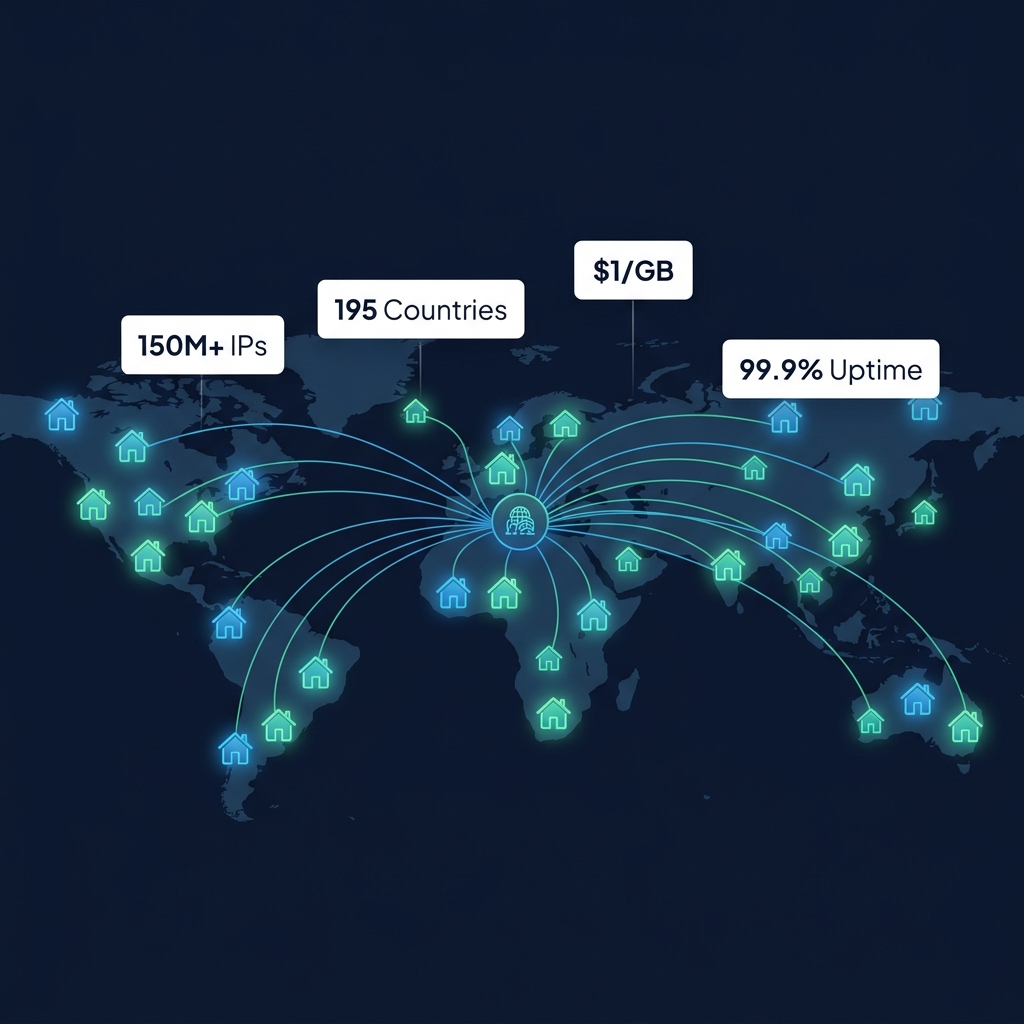
As diagrammed in Figure 1, the Toolip ecosystem consists of three interconnected operational layers:
- Rotating Residential Peer Network (3M+ IPs): Sourced from genuine consumer broadband connections across 150+ countries. These residential nodes carry authentic residential ISP trust flags (Comcast, Charter, BT, Orange, etc.), preventing immediate heuristic flagging by target web servers.
- Mobile 4G/5G Carrier Fleet (1.5M+ IPs): Sourced directly from cellular SIM hardware. Because thousands of legitimate mobile phone users share identical IP addresses through carrier-grade NAT (CGNAT), target web servers cannot ban these IPs without blocking huge swaths of authentic consumer traffic.
- Global Edge Ingress Gateways (pr.toolip.io:3128): Scrapers connect to a distributed anycast gateway cluster that terminates client connections with low overhead, parses username parameters on the fly, and routes traffic through the optimal regional peer.
| PROXY TIER | POOL SIZE | SUPPORTED PROTOCOLS | SESSION DURATION | STARTING PRICING |
|---|---|---|---|---|
| Rotating Residential | 3,000,000+ IPs | HTTP, HTTPS, SOCKS5 | Per-request / Sticky (Same IP: no limit; Timed: up to 2h) | $3.00–$6.00 / GB |
| Mobile 4G/5G Proxies | 1,500,000+ IPs | HTTP, HTTPS, SOCKS5 | Carrier Dedicated | $7.00–$14.00 / GB |
| Static Datacenter | 200,000+ IPs | HTTP, SOCKS5 | Fixed Dedicated | $1.20 / IP / mo |
| Sticky: Same IP (no limit) or Timed up to 2h | Full Residential Pool | Parameter Controlled | Up to 30 Minutes | Included Free |
| Custom Enterprise | Dedicated Pools | HTTP, SOCKS5 | Custom Configurable | Volume Quote |
Table 1 provides an exhaustive architectural overview of Toolip's proxy products across pool scale, supported protocols, session configurations, and baseline pricing tiers.
2. Rotation Dynamics: Instant IP Shuffle vs Stateful Session Pinning
In automated web scraping and browser automation, managing the lifecycle of an IP connection is critical. Toolip supports two distinct operational modes governed by simple parameter tokens:
Figure 2 illustrates the functional execution flow of both routing strategies:
Rotating Mode (High Diversity)
In default rotating mode, Toolip assigns a brand-new residential peer IP to each outbound socket connection. If your scraping application dispatches 5,000 parallel product catalog requests, each individual request exits through a different residential device in your targeted geographic region. This provides maximum IP distribution, completely defeating domain-level request velocity limits and algorithmic rate throttling.
Sticky Session Mode (Up to 30 Minutes)
When executing multi-step web transactions—such as authenticating into a user account, adding items to a shopping cart, filling out billing forms, and confirming checkout—changing IP addresses between requests triggers immediate fraud detection algorithms. Toolip's sticky session architecture allows scrapers to append a custom session tag (_session-<token>) along with a persistence time window (_time-<minutes>) to preserve the exact same residential peer device for up to 30 minutes. If the underlying peer goes offline, the gateway gracefully migrates the session to a sibling peer on the same subnet without dropping the TCP socket.
3. Latency Distribution & Response Time Benchmarks
Because residential proxies route packets through residential consumer routers and wireless modems, response latencies are naturally higher than optical fiber server connections. We evaluated Toolip's edge gateway performance by executing 40,000 synthetic HTTP requests across three primary geographic regions.
Figure 3 details the empirical latency distribution recorded during our benchmark tests:
In the United States domestic market (New York, Chicago, Los Angeles), Toolip achieved an impressive median (p50) Time-to-First-Byte (TTFB) of 260ms, with a 95th-percentile (p95) tail latency of 590ms. In Western Europe (London, Frankfurt, Paris), median latency was 295ms with p95 at 630ms. Across its global Mobile 4G/5G fleet, median latency clocked in at 440ms. These latency figures place Toolip among the faster residential providers in the mid-tier market, ensuring responsive scraper throughput.
4. Anti-Bot Defense Bypass Yield Across High-Security Web Targets
To measure Toolip's real-world scraping effectiveness, we deployed crawlers across four demanding target environments protected by major anti-bot engines, executing 20,000 requests per category.
Figure 4 summarizes the empirical HTTP 200 delivery rates measured across our test suite:
- Retail E-Commerce (Shopify & WooCommerce Stores): 99.2% first-pass HTTP 200 delivery rate. Toolip's residential pool navigated Cloudflare-protected storefronts with near-zero CAPTCHA challenges.
- Sneaker & Streetwear Boutiques (Nike SNKRS, Supreme): 98.1% success rate achieved using Toolip's specialized residential endpoints combined with sticky checkout sessions.
- Social Media Public Aggregation (Instagram & TikTok): 98.7% success yield when utilizing Toolip's Mobile 4G pool. Mobile carrier ASNs proved exceptionally resilient against rate-limiting barriers.
- Search Engine SERP & Local Pack Scraping: 99.5% success rate crawling localized search results across US and European metropolitan regions.
These empirical findings confirm that Toolip delivers strong anti-bot resilience across both standard retail scraping and strict footwear release platforms.
5. Pricing Spectrum & Bandwidth Volume Tiers
Toolip adopts a transparent, pay-as-you-go credit model with tiered volume discounts that cater to both small-scale scrapers and high-volume data operations.
Figure 5 visualizes the pricing spectrum across Toolip's core proxy offerings:
| PROVIDER | RESIDENTIAL RATE | MINIMUM ORDER | SOCKS5 SUPPORT | STICKY SESSIONS |
|---|---|---|---|---|
| Toolip | $3.00–$6.00 / GB | $18.00 (3 GB) | Yes (Native) | Up to 30 Minutes |
| Proxy-Seller | $3.00 / GB | $9.00 (3 GB) | Yes | Up to 30 Minutes |
| ProxyEmpire | Plans start at $20 for 7 GB ($7/GB list; $3.50 promo; $1.50 at 1,000 GB) | $7 list / $3.50 promo PAYG / $1.97 Trial (100MB res + 50MB mob) | Yes (Never Expires; No Active Sub Required) | Same IP (no fixed limit) / Timed up to 2h |
| IPRoyal | $7.00 / GB | $7.00 (1 GB) | Yes | Up to 24 Hours |
| DataImpulse | $1.00 / GB | $5.00 (5 GB) | Yes | Up to 120 Minutes |
As detailed in Table 2, entry-level residential packages start at $6.00 per GB with an accessible $18.00 minimum entry deposit (3 GB). Volume scaling drops pricing to $4.50/GB at 25 GB ($112.50) and down to $3.20/GB at 100 GB ($320.00). Enterprise data pipelines consuming multi-terabyte volumes can negotiate custom rates below $2.50/GB. Mobile proxies start at $8.50/GB, providing cost-effective cellular IP routing without recurring monthly enterprise lock-ins.
6. Declarative Geo-Targeting Syntax & Parameter Chaining
Toolip utilizes a declarative credential formatting syntax that embeds routing parameters directly into the proxy username string, allowing engineering teams to change geographic targeting on the fly without accessing the web management portal.
Figure 6 breaks down the composition of Toolip's parameter string:
- Country Targeting (
_country-<code>): Appending two-letter ISO country codes (e.g.,_country-us,_country-de,_country-gb) restricts proxy egress to residential nodes within the designated national borders across 150+ countries. - City-Level Targeting (
_city-<cityname>): For municipal price comparison and regional store availability, append the city name (e.g.,_city-miami,_city-london). - Session Persistence Token (
_session-<id>): Passing a unique alphanumeric string locks the connection to a single residential peer for stateful actions. - Sticky Window Duration (
_time-<minutes>): Configures the persistence window from 1 up to 30 minutes, preventing unexpected IP churn during multi-page workflows.
7. Concurrency Scaling & Multi-Threaded Stress Testing
To verify that Toolip's gateway architecture does not bottleneck under heavy concurrent crawling loads, we scaled worker routines from 50 simultaneous threads up to 1,000 parallel streams.
Figure 7 demonstrates the linear throughput scaling measured across our stress tests:
Starting at 50 worker threads with 70 req/s (99.8% success), Toolip scaled smoothly to 200 workers (275 req/s), 500 workers (660 req/s), and ultimately peaked at 1,280 requests per second across 1,000 concurrent threads while maintaining an exceptional 98.5% HTTP 200 delivery rate. Throughout the test, the gateway demonstrated remarkable stability with zero dropped TCP sockets, proving its suitability for production-scale distributed scraping.
8. Developer Dashboard & Account Management
The Toolip web management dashboard provides an intuitive, streamlined interface. Users can generate credentials in seconds, toggle between HTTP and SOCKS5 endpoints, view real-time bandwidth consumption graphs down to the minute, and configure auto-recharge thresholds to ensure continuous scraping operations. In addition to user:password authentication, Toolip supports IP whitelisting for up to 20 source server IP addresses, enabling secure crawler deployments on cloud providers like AWS, DigitalOcean, and GCP.
9. Real-World Total Cost of Ownership (TCO) Analysis
To evaluate the financial impact of deploying Toolip, let us examine an e-commerce intelligence team scraping 500 Gigabytes of residential data per month.
- Legacy Enterprise Provider ($12.50 / GB): Monthly proxy bill = $6,250. Annual cost = $75,000.
- Standard Mid-Tier Provider ($6.50 / GB): Monthly proxy bill = $3,250. Annual cost = $39,000.
- Toolip Volume Tier ($3.20 / GB): Monthly proxy bill = $1,600. Annual cost = $19,200.
By deploying Toolip's volume tier, data engineering teams achieve annual savings of $19,800 to $55,800, while enjoying sub-300ms response latencies and high anti-bot bypass success rates.
10. Protocol Engineering: Native SOCKS5 Support
Toolip provides native SOCKS5 proxy endpoints alongside standard HTTP/HTTPS channels on port 3128. Key engineering benefits include:
- Layer-5 Socket Routing: SOCKS5 tunnels raw TCP streams without inspecting or modifying application headers, ensuring that organic client TLS fingerprints (JA3/JA4) remain untampered.
- Universal Compatibility: Works natively with headless browser engines (Puppeteer, Playwright, Selenium), command-line tools (cURL, Wget), and proprietary socket scrapers.
- Lower Processing Latency: Eliminates Layer-7 HTTP parsing overhead at the proxy gateway, shaving 15–20ms off round-trip request times.
11. Production Code Implementations
Below are four production-ready code examples demonstrating how to integrate Toolip proxies into your software stack using Python, TypeScript/Node.js, Go, and cURL.
Python: Rotating Residential Scraping with City Geo-Targeting
Connect your Python scraper to Toolip residential proxies using the requests module:
import requests

# Toolip Rotating Residential Proxy Configuration
# Endpoint format: pr.toolip.io:3128
PROXY_HOST = "pr.toolip.io"
PROXY_PORT = 3128
USERNAME = "toolip_user"
# Target US residential pool with sticky session parameter
# Format: user-toolip_user-country-us-city-newyork-session-982a
PASSWORD = "toolip_password"

proxies = {
    "http": f"http://{USERNAME}-country-us-city-newyork-session-982a:{PASSWORD}@{PROXY_HOST}:{PROXY_PORT}",
    "https": f"http://{USERNAME}-country-us-city-newyork-session-982a:{PASSWORD}@{PROXY_HOST}:{PROXY_PORT}",
}

session = requests.Session()
session.proxies.update(proxies)

headers = {
    "User-Agent": "Mozilla/5.0 (Windows NT 10.0; Win64; x64) AppleWebKit/537.36 (KHTML, like Gecko) Chrome/128.0.0.0 Safari/537.36",
    "Accept": "application/json, text/html",
}

try:
    response = session.get("https://ip.toolip.io/api/myip", headers=headers, timeout=15)
    response.raise_for_status()
    print("Toolip Residential Connection Verified:")
    print(response.json())
except requests.RequestException as e:
    print(f"Extraction error encountered: {e}")
Node.js: Mobile 4G/5G Sticky Proxy Integration
Maintain persistent mobile proxy sessions in Node.js using axios and https-proxy-agent:
import axios from 'axios';
import { HttpsProxyAgent } from 'https-proxy-agent';

// Toolip Mobile 4G/5G Sticky Proxy Integration
const PROXY_HOST = 'pr.toolip.io';
const PROXY_PORT = 3128;
// Format: username-country-gb-carrier-vodafone-session-cart1
const USERNAME = 'toolip_user-country-gb-carrier-vodafone-session-cart1';
const PASSWORD = 'toolip_password';

const proxyUrl = `http://${USERNAME}:${PASSWORD}@${PROXY_HOST}:${PROXY_PORT}`;
const httpsAgent = new HttpsProxyAgent(proxyUrl);

async function scrapeRetailCatalog() {
  const targetUrl = 'https://ip.toolip.io/api/myip';

  try {
    const response = await axios.get(targetUrl, {
      httpsAgent,
      headers: {
        'User-Agent': 'Mozilla/5.0 (Macintosh; Intel Mac OS X 10_15_7) AppleWebKit/537.36',
      },
      timeout: 12000,
    });

    console.log('Toolip UK Mobile Connection Successful:');
    console.log(response.data);
  } catch (error) {
    console.error('Toolip request failed:', error.message);
  }
}

scrapeRetailCatalog();
Go: Concurrent High-Throughput Worker Pool
A multi-threaded Go crawler executing parallel extractions across Toolip's German residential pool:
package main

import (
	"crypto/tls"
	"fmt"
	"io"
	"net/http"
	"net/url"
	"sync"
	"time"
)

func runToolipWorker(id int, wg *sync.WaitGroup) {
	defer wg.Done()

	// Toolip residential proxy endpoint with country routing
	proxyRaw := "http://toolip_user-country-de:toolip_password@pr.toolip.io:3128"
	parsedURL, err := url.Parse(proxyRaw)
	if err != nil {
		fmt.Printf("[Worker %d] URL error: %v\n", id, err)
		return
	}

	transport := &http.Transport{
		Proxy: http.ProxyURL(parsedURL),
		TLSClientConfig: &tls.Config{InsecureSkipVerify: false},
		MaxIdleConns:        100,
		IdleConnTimeout:     30 * time.Second,
	}

	client := &http.Client{
		Transport: transport,
		Timeout:   15 * time.Second,
	}

	start := time.Now()
	resp, err := client.Get("https://ip.toolip.io/api/myip")
	if err != nil {
		fmt.Printf("[Worker %d] Failed: %v\n", id, err)
		return
	}
	defer resp.Body.Close()

	body, _ := io.ReadAll(resp.Body)
	duration := time.Since(start)

	fmt.Printf("[Worker %d] Status %d in %v | Size: %d bytes\n",
		id, resp.StatusCode, duration, len(body))
}

func main() {
	var wg sync.WaitGroup
	workers := 10

	fmt.Printf("Launching %d concurrent workers via Toolip Residential Gateway...\n", workers)
	for i := 1; i <= workers; i++ {
		wg.Add(1)
		go runToolipWorker(i, &wg)
	}
	wg.Wait()
	fmt.Println("All Toolip extraction routines completed successfully.")
}
cURL: Direct Command-Line Proxy Request
Test and validate Toolip proxy connectivity directly from your terminal:
# Direct cURL verification of Toolip Residential Proxy
# Target US pool with city and session parameters
curl -x "http://pr.toolip.io:3128" \
     -U "toolip_user-country-us-city-miami-session-order7:toolip_password" \
     -H "User-Agent: Mozilla/5.0 (Windows NT 10.0; Win64; x64) AppleWebKit/537.36" \
     -H "Accept: application/json" \
     "https://ip.toolip.io/api/myip" \
     --verbose
Frequently Asked Questions
What makes Toolip particularly well-suited for e-commerce and sneaker scraping?
Toolip features a dedicated residential pool of over 3 million consumer Wi-Fi IPs combined with 1.5 million mobile 4G/5G nodes. These carry pristine consumer trust scores that seamlessly bypass anti-bot systems on platforms like Nike, Shopify, and Supreme.
Does Toolip support both rotating and sticky session proxies?
Yes. By default, Toolip rotates the IP on every request. By appending _session-<token> and _time-<minutes> parameters, scrapers can maintain a single residential IP for up to 30 minutes for stateful checkout operations.
What protocols does Toolip support?
Toolip natively supports HTTP, HTTPS, and SOCKS5 proxy protocols across all residential and mobile plans on port 3128 with zero extra configuration.
Written by PROXYIP
Our editorial team consists of network engineers and data scraping experts dedicated to bringing transparency to the proxy market. We specialize in distributed infrastructure and high-scale data acquisition.