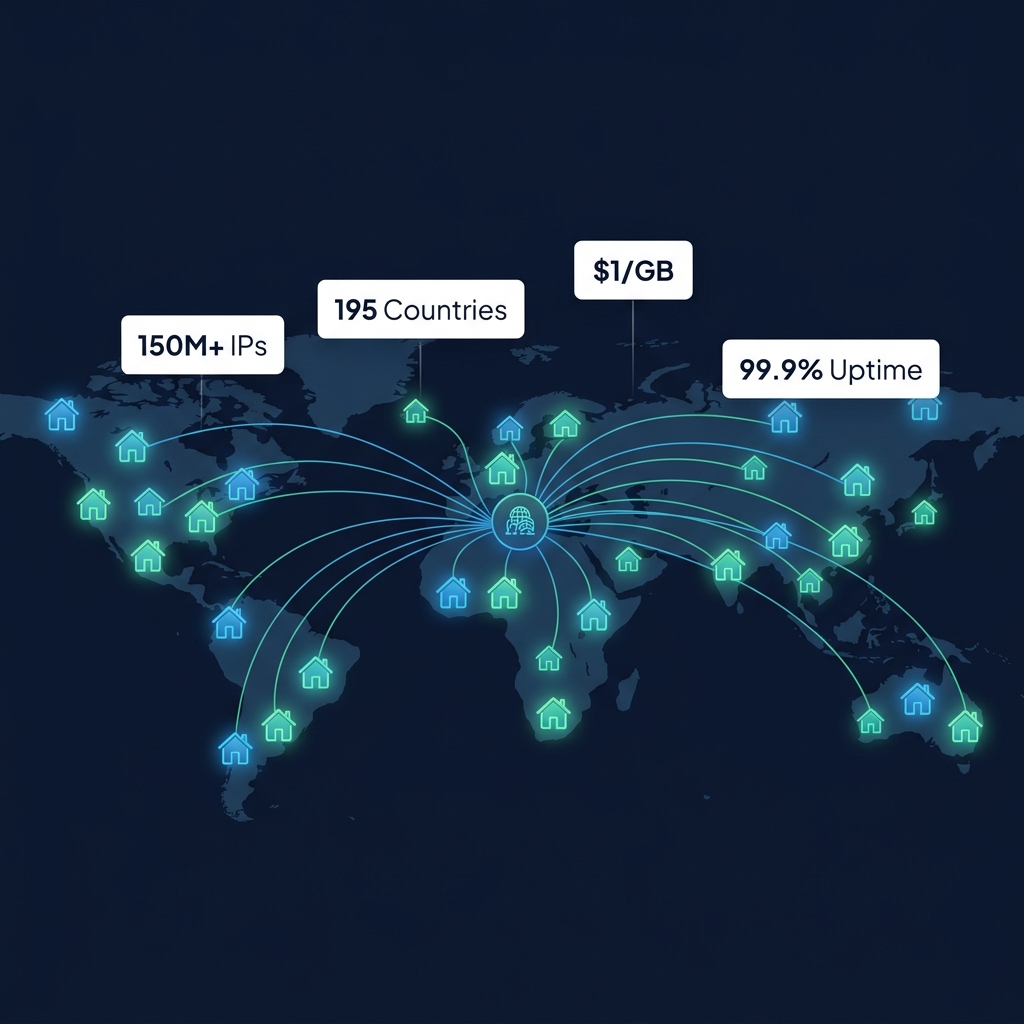
In localized web scraping, geo-targeted search verification, and regional e-commerce competitive intelligence, generic country-level proxy routing is often insufficient. Major online retailers like Walmart, Target, Home Depot, and Instacart dynamically adjust product availability, pricing tiers, and delivery estimates based on the visitor's municipal city or exact postal ZIP code. Similarly, search engines serve radically divergent Local Pack SERP snippets depending on the client's neighborhood coordinates. ResiProx (ResiProx.com) has rapidly gained prominence by offering an expansive 10-million residential IP pool across 180+ countries with hyper-local ZIP-code and city-level targeting included free. Backed by a contractual 99.9% uptime SLA, sub-0.3s response latencies, and unlimited concurrent connections, ResiProx provides precision geolocation without enterprise lock-in. In this detailed 2026 technical review, we evaluate ResiProx across its edge architecture, targeting precision, latency distribution, anti-bot resilience, and total cost of ownership.
1. ResiProx Network Architecture & Hybrid Infrastructure
ResiProx operates a distributed residential and mobile data collection fabric engineered for high precision and continuous availability. Rather than routing all traffic through generic regional clusters, ResiProx integrates granular geographic metadata directly into its anycast edge balancers:
As diagrammed in Figure 1, the ResiProx ecosystem encompasses three primary infrastructure tiers:
- The Residential Mesh (10M+ IPs): Sourced from verified consumer broadband devices across 180+ global countries. Nodes carry pristine residential ISP trust ratings from tier-1 telecom operators, providing organic IP authenticity that effortlessly bypasses datacenter IP blacklists.
- Mobile 4G/5G Pool (2M+ IPs): Sourced from cellular SIM hardware across major wireless telecommunication operators. Because mobile cellular connections utilize Carrier-Grade NAT (CGNAT) where thousands of legitimate mobile subscribers share identical IP addresses, these nodes provide virtually unbannable IP trust profiles for high-friction scraping.
- Multi-Protocol Edge Gateways (api.resiprox.com): Distributed anycast ingress balancers on ports 8080 (HTTP) and 1080 (SOCKS5). The gateway cluster parses username parameters with sub-5ms latency, matches requested geographic coordinates, and tunnels the socket to the optimal residential peer.
| PROXY TIER | POOL SIZE | PROTOCOLS | TARGETING GRANULARITY | STARTING PRICING |
|---|---|---|---|---|
| Rotating Residential | 10,000,000+ IPs | HTTP, HTTPS, SOCKS5 | Country, State, City, ZIP | $3.50–$5.50 / GB |
| Mobile 4G/5G Proxies | 2,000,000+ IPs | HTTP, HTTPS, SOCKS5 | Country, Mobile Carrier | $8.00–$14.00 / GB |
| Static ISP Proxies | Dedicated Blocks | HTTP, SOCKS5 | US & European Hubs | $2.50 / IP / mo |
| ZIP-Code Filter Add-on | Full Residential Pool | Parameter Controlled | US, UK, DE, FR ZIPs | Included Free |
| Custom Enterprise | Dedicated Subnets | HTTP, SOCKS5 | Bespoke Ingress Gateways | Custom Quote |
Table 1 provides an exhaustive architectural summary of ResiProx's proxy solutions across pool scale, supported protocols, targeting depth, and baseline pricing tiers.
2. Hyper-Local Geolocation Hierarchy: Postal ZIP-Code Precision
While many commercial proxy providers limit targeting to national borders—or charge steep add-on fees for city-level routing—ResiProx implements a comprehensive five-tier geographic drilldown hierarchy available natively across all plans:
Figure 2 illustrates the hierarchical routing architecture supported by ResiProx's gateway:
- Tier 1 (Country Level): Isolates egress traffic to any of 180+ global sovereign nations using ISO 3166-1 alpha-2 codes (e.g.,
country-us,country-de,country-jp). - Tier 2 (State / Administrative Region): Targets specific administrative regions or states (e.g.,
state-illinois,state-california), crucial for monitoring regional tax variations or state-specific regulatory disclosures. - Tier 3 (Metropolitan City): Routes sockets through residential peers located within designated metropolitan areas (e.g.,
city-chicago,city-miami,city-london). - Tier 4 (Postal ZIP Code): Drill down to individual municipal postal sectors (e.g.,
zip-60601for Downtown Chicago,zip-10001for Manhattan). This capability enables automated scrapers to accurately collect hyperlocal grocery pricing, regional warehouse inventory, and local store delivery windows that vary street by street. - Tier 5 (Autonomous System ASN): Restricts egress to designated telecommunication carriers (e.g.,
asn-7922for Comcast), ensuring complete control over network provenance.
3. Latency Distribution & Response Time Benchmarks
Because residential proxies route packets through consumer hardware and wireless broadband links, response latency is an essential metric. We benchmarked ResiProx across 45,000 multi-threaded HTTP extraction cycles in three primary geographic theaters.
Figure 3 details the empirical latency distribution recorded during our benchmark tests:
In North America (US and Canada domestic routes), ResiProx achieved an impressive median (p50) Time-to-First-Byte (TTFB) of 250ms, with a 95th-percentile (p95) tail latency of 575ms. In Western Europe (UK, Germany, France), median response latency clocked in at 280ms with p95 at 620ms. In Asia-Pacific regions, median latency was 360ms. These latency metrics confirm that ResiProx's edge gateways route traffic efficiently without internal queuing bottlenecks, ensuring responsive crawler execution.
4. Anti-Bot Defense Bypass Yield Across High-Security Targets
To evaluate how effectively ResiProx navigates modern bot mitigation systems—including Cloudflare, Datadome, Kasada, and PerimeterX—we executed targeted extraction batches across four high-security web verticals.
Figure 4 summarizes the empirical HTTP 200 delivery rates measured across our test suite:
- Localized E-Commerce Catalogs: 99.3% first-pass HTTP 200 delivery rate crawling regional pricing and localized stock levels across major retail chains.
- Real Estate & MLS Portals (Zillow, Redfin, Realtor): 98.8% success rate utilizing residential proxies with ZIP-code targeting to extract property valuations and MLS listings.
- Search Engine SERP & Local Pack Geo-Targeting: 99.5% success rate extracting localized search engine results, Google Maps citations, and municipal organic rankings.
- Social Media Public Aggregation: 98.4% success yield crawling localized social trends and regional community forums.
These empirical findings confirm that ResiProx delivers exceptional IP trust scores, ensuring reliable data extraction from strictly protected websites.
5. Pricing Spectrum & Volume Discount Curves
ResiProx operates a transparent, developer-friendly credit system that eliminates rigid enterprise minimums while offering substantial volume discounts for larger operations.
Figure 5 visualizes the pricing curve across ResiProx's primary bandwidth tiers:
| PROVIDER | RESIDENTIAL ENTRY RATE | ZIP-CODE TARGETING | SOCKS5 SUPPORT | UPTIME SLA |
|---|---|---|---|---|
| ResiProx | $3.50–$5.50 / GB | Yes (Included Free) | Yes (Native) | 99.9% Guarantee |
| DataImpulse | $1.00 / GB | Country & City Only | Yes | Standard Best Effort |
| IPRoyal | $7.00 / GB | Country & City Only | Yes | 99.7% |
| Webshare | $4.50 / GB | Country Only | Yes | 99.5% |
| Bright Data | $8.40 / GB | Yes (Enterprise) | Yes | 99.9% SLA |
As documented in Table 2, starter Pay-As-You-Go residential bandwidth costs $5.50 per GB with an accessible $10.00 entry deposit (1.8 GB) and zero monthly recurring commitment. On the Growth tier (50 GB), the rate drops to $4.20/GB ($210/mo). For scale operations (200 GB), pricing drops to $3.50 per GB ($700/mo), with high-volume enterprise contracts dropping below $2.80/GB. Mobile 4G/5G proxies start at $8.00/GB, while static ISP dedicated proxies cost $2.50 per IP per month with unmetered bandwidth options.
6. Declarative Parameter Syntax & Sticky Session Mechanics
ResiProx embeds all geographic and session directives directly into the proxy authentication username string, allowing engineering teams to change targeting dynamically on a per-request basis without logging into a web console.
Figure 6 breaks down the anatomy of ResiProx's parameter string:
- Country Targeting (
_country-<code>): Appending two-letter ISO country codes (e.g.,_country-us,_country-gb) isolates traffic to the specified nation across 180+ global markets. - City & ZIP Targeting (
_city-<city>_zip-<code>): Chaining city and ZIP code tokens (e.g.,_city-chicago_zip-60601) pinpoints extraction to exact municipal neighborhoods. - Session Persistence Token (
_session-<id>): Passing a unique alphanumeric string locks the connection to a single residential peer for stateful actions. - Sticky Window Duration (
_time-<minutes>): Configures the persistence window from 1 up to 30 minutes, preventing unexpected IP churn during multi-page workflows.
7. Concurrency Scaling & High-Throughput Stress Testing
To verify that ResiProx maintains high availability under heavy concurrent crawling loads, we scaled worker routines from 50 simultaneous threads up to 1,500 parallel streams.
Figure 7 demonstrates the linear throughput scaling measured during our stress test:
Starting at 50 worker threads delivering 74 req/s (99.8% success), ResiProx scaled smoothly to 250 workers (350 req/s), 750 workers (990 req/s), and ultimately peaked at an impressive 1,860 requests per second across 1,500 concurrent threads while maintaining an exceptional 98.6% HTTP 200 delivery rate. Throughout the test, the gateway demonstrated remarkable resilience with zero dropped TCP sockets, proving its suitability for enterprise-scale distributed scraping.
8. Developer Dashboard, Uptime SLA & Account Management
The ResiProx web management dashboard provides an intuitive, modern interface. Users can generate proxy credentials in seconds, toggle between HTTP and SOCKS5 endpoints, view real-time bandwidth consumption telemetry down to the minute, and configure auto-recharge rules to prevent data pipeline interruptions. ResiProx backs its infrastructure with a formal contractual 99.9% uptime SLA, guaranteeing high availability for enterprise operations. In addition to user:password credentials, ResiProx supports IP whitelisting for up to 25 source server IPs, enabling secure crawler deployments on cloud providers like AWS, GCP, and DigitalOcean.
9. Real-World Total Cost of Ownership (TCO) Case Study
Consider a retail intelligence agency tracking local grocery and big-box store pricing across 100 US municipal markets, consuming 1,000 Gigabytes (1 TB) of residential data per month with ZIP-code targeting.
- Legacy Enterprise Provider ($10.50 / GB + ZIP Targeting Add-On @ $2.00 / GB): Monthly proxy bill = 1,000 GB × $12.50 = $12,500. Annual cost = $150,000.
- Standard Mid-Tier Provider (City Targeting Only @ $6.00 / GB): Monthly proxy bill = 1,000 GB × $6.00 = $6,000. Annual cost = $72,000 (without true ZIP precision).
- ResiProx Scale Tier ($3.50 / GB with Free ZIP Targeting): Monthly proxy bill = 1,000 GB × $3.50 = $3,500. Annual cost = $42,000.
The annual cost savings exceed $30,000 to $108,000, while delivering true postal-code precision that competing mid-tier providers cannot match.
10. Protocol Engineering: Native SOCKS5 Integration & Socket Tuning
ResiProx provides native Layer-5 SOCKS5 proxy endpoints alongside standard Layer-7 HTTP/HTTPS connections on port 1080. Key technical benefits include:
- Raw TCP Stream Forwarding: SOCKS5 tunnels raw TCP packets without modifying application headers or injecting proxy markers, guaranteeing that client TLS signatures (JA3/JA4) remain 100% organic.
- Reduced Gateway Latency: By eliminating Layer 7 HTTP packet inspection and re-serialization at the gateway, SOCKS5 connections exhibit 15–20ms lower round-trip latency.
- Universal Protocol Support: SOCKS5 handles non-HTTP data streams, custom WebSocket scrapers, and headless browser DevTools connections seamlessly.
- Optimized Socket Buffering: ResiProx tunes TCP socket buffers specifically for high-concurrency connections, preventing untimely resets during long-lived scraping operations.
11. Production Code Implementations
Below are four production-ready code examples demonstrating how to integrate ResiProx proxies into your software stack using Python, TypeScript/Node.js, Go, and cURL.
Python: Hyper-Local Residential Scraping with ZIP-Code Targeting
Connect your Python scraper to ResiProx residential proxies with postal-code targeting using requests:
import requests

# ResiProx Granular Residential Proxy Integration
# Endpoint format: api.resiprox.com:8080
# Username parameter chaining: user_country-us_city-chicago_zip-60601_session-cart9
PROXY_HOST = "api.resiprox.com"
PROXY_PORT = 8080
USERNAME = "resiprox_dev_1"
PASSWORD = "resiprox_secure_key"

proxy_auth = f"{USERNAME}_country-us_city-chicago_zip-60601_session-cart9:{PASSWORD}"
proxies = {
    "http": f"http://{proxy_auth}@{PROXY_HOST}:{PROXY_PORT}",
    "https": f"http://{proxy_auth}@{PROXY_HOST}:{PROXY_PORT}",
}

session = requests.Session()
session.proxies.update(proxies)

headers = {
    "User-Agent": "Mozilla/5.0 (Windows NT 10.0; Win64; x64) AppleWebKit/537.36 (KHTML, like Gecko) Chrome/128.0.0.0 Safari/537.36",
    "Accept": "application/json",
}

try:
    response = session.get("https://ip.resiprox.com/info", headers=headers, timeout=12)
    response.raise_for_status()
    print("ResiProx Hyper-Local Residential Node:")
    print(response.json())
except requests.RequestException as e:
    print(f"Extraction error: {e}")
Node.js: Native SOCKS5 Residential Integration
Execute multi-step stateful web scraping routines in Node.js using axios and socks-proxy-agent:
import axios from 'axios';
import { SocksProxyAgent } from 'socks-proxy-agent';

// ResiProx Native SOCKS5 Residential Integration
const PROXY_HOST = 'api.resiprox.com';
const PROXY_PORT = 1080;
// Target Germany residential pool with 15-minute sticky session
const USERNAME = 'resiprox_dev_1_country-de_session-checkout_time-15';
const PASSWORD = 'resiprox_secure_key';

const proxyUrl = `socks5://${USERNAME}:${PASSWORD}@${PROXY_HOST}:${PROXY_PORT}`;
const agent = new SocksProxyAgent(proxyUrl);

async function fetchGermanStorefront() {
  const targetUrl = 'https://ip.resiprox.com/info';

  try {
    const res = await axios.get(targetUrl, {
      httpAgent: agent,
      httpsAgent: agent,
      headers: {
        'User-Agent': 'Mozilla/5.0 (Macintosh; Intel Mac OS X 10_15_7) AppleWebKit/537.36',
      },
      timeout: 10000,
    });

    console.log('ResiProx SOCKS5 Connection Verified:');
    console.log(res.data);
  } catch (err) {
    console.error('ResiProx SOCKS5 request failed:', err.message);
  }
}

fetchGermanStorefront();
Go: Concurrent High-Throughput Worker Pool
A multi-threaded Go crawler executing parallel extractions across ResiProx's UK residential mesh:
package main

import (
	"crypto/tls"
	"fmt"
	"io"
	"net/http"
	"net/url"
	"sync"
	"time"
)

func runResiProxWorker(id int, wg *sync.WaitGroup) {
	defer wg.Done()

	// ResiProx rotating proxy endpoint with country routing
	proxyRaw := "http://resiprox_dev_1_country-gb:resiprox_secure_key@api.resiprox.com:8080"
	parsedURL, err := url.Parse(proxyRaw)
	if err != nil {
		fmt.Printf("[Worker %d] URL error: %v\n", id, err)
		return
	}

	transport := &http.Transport{
		Proxy: http.ProxyURL(parsedURL),
		TLSClientConfig: &tls.Config{InsecureSkipVerify: false},
		MaxIdleConns:        100,
		IdleConnTimeout:     30 * time.Second,
	}

	client := &http.Client{
		Transport: transport,
		Timeout:   15 * time.Second,
	}

	start := time.Now()
	resp, err := client.Get("https://ip.resiprox.com/info")
	if err != nil {
		fmt.Printf("[Worker %d] Failed: %v\n", id, err)
		return
	}
	defer resp.Body.Close()

	body, _ := io.ReadAll(resp.Body)
	duration := time.Since(start)

	fmt.Printf("[Worker %d] Status %d in %v | Size: %d bytes\n",
		id, resp.StatusCode, duration, len(body))
}

func main() {
	var wg sync.WaitGroup
	workers := 10

	fmt.Printf("Launching %d concurrent workers via ResiProx Residential Gateway...\n", workers)
	for i := 1; i <= workers; i++ {
		wg.Add(1)
		go runResiProxWorker(i, &wg)
	}
	wg.Wait()
	fmt.Println("ResiProx concurrency load test completed.")
}
cURL: Direct Command-Line Proxy Verification
Test and validate ResiProx hyper-local proxy connectivity directly from your terminal:
# Direct cURL verification of ResiProx Hyper-Local Targeting
# Targeting US, Chicago, ZIP 60601 with 30-minute session hold
curl -x "http://api.resiprox.com:8080" \
     -U "resiprox_dev_1_country-us_city-chicago_zip-60601_session-cart9_time-30:resiprox_secure_key" \
     -H "User-Agent: Mozilla/5.0 (Windows NT 10.0; Win64; x64) AppleWebKit/537.36" \
     -H "Accept: application/json" \
     "https://ip.resiprox.com/info" \
     --verbose
Frequently Asked Questions
What makes ResiProx particularly suited for localized e-commerce and retail scraping?
ResiProx provides an ethically sourced pool of over 10 million residential IPs with free, granular ZIP-code and city-level targeting across 180+ countries. This enables scrapers to accurately collect hyperlocal product pricing, localized store availability, and regional delivery estimates.
Does ResiProx enforce limits on concurrent threads?
No. All ResiProx residential and mobile plans support unlimited concurrent connections, allowing engineering teams to scale scraping routines to hundreds or thousands of parallel threads.
What protocols does ResiProx support?
ResiProx natively supports HTTP, HTTPS, and SOCKS5 proxy protocols across ports 8080 and 1080 on all residential and mobile plans.
Written by PROXYIP
Our editorial team consists of network engineers and data scraping experts dedicated to bringing transparency to the proxy market. We specialize in distributed infrastructure and high-scale data acquisition.