ProxyEmpire Web Scraping Guide
Executive Summary
ProxyEmpire is an enterprise proxy infrastructure provider engineered specifically for automated data collection, competitive intelligence, and high-concurrency web scraping. With a verified network footprint spanning over 30 million residential IPs and 4 million mobile IPs across 170+ countries, ProxyEmpire provides native Dual-Stack connectivity (HTTP, HTTPS, and SOCKS5) on unified ingress gateway endpoints. Uniquely in the proxy market, all unused bandwidth on residential and mobile subscriptions never expires — customers retain their balance even after subscription cancellation, completely eliminating the monthly data forfeiture typical of legacy providers. This comprehensive technical guide details network routing, SOCKS5 configuration, session persistence lifecycles (Same-IP mode: no fixed maximum duration. Timed rotation: up to 2 hours), geo-targeting syntax, anti-bot mitigation, and production implementations in Python, Playwright, and cURL.
What Is ProxyEmpire? Network Architecture & Gateway Ingress
Modern web scrapers must navigate complex anti-bot defenses, dynamic JavaScript rendering, and rigorous IP-based rate limiting. When sending thousands of automated requests to e-commerce catalogs, travel aggregators, or search engine result pages (SERPs), scraping from a single IP address leads to rapid IP blacklisting. ProxyEmpire addresses this challenge by providing a central backconnect ingress gateway that multiplexes incoming client connections and routes them through legitimate consumer residential devices.
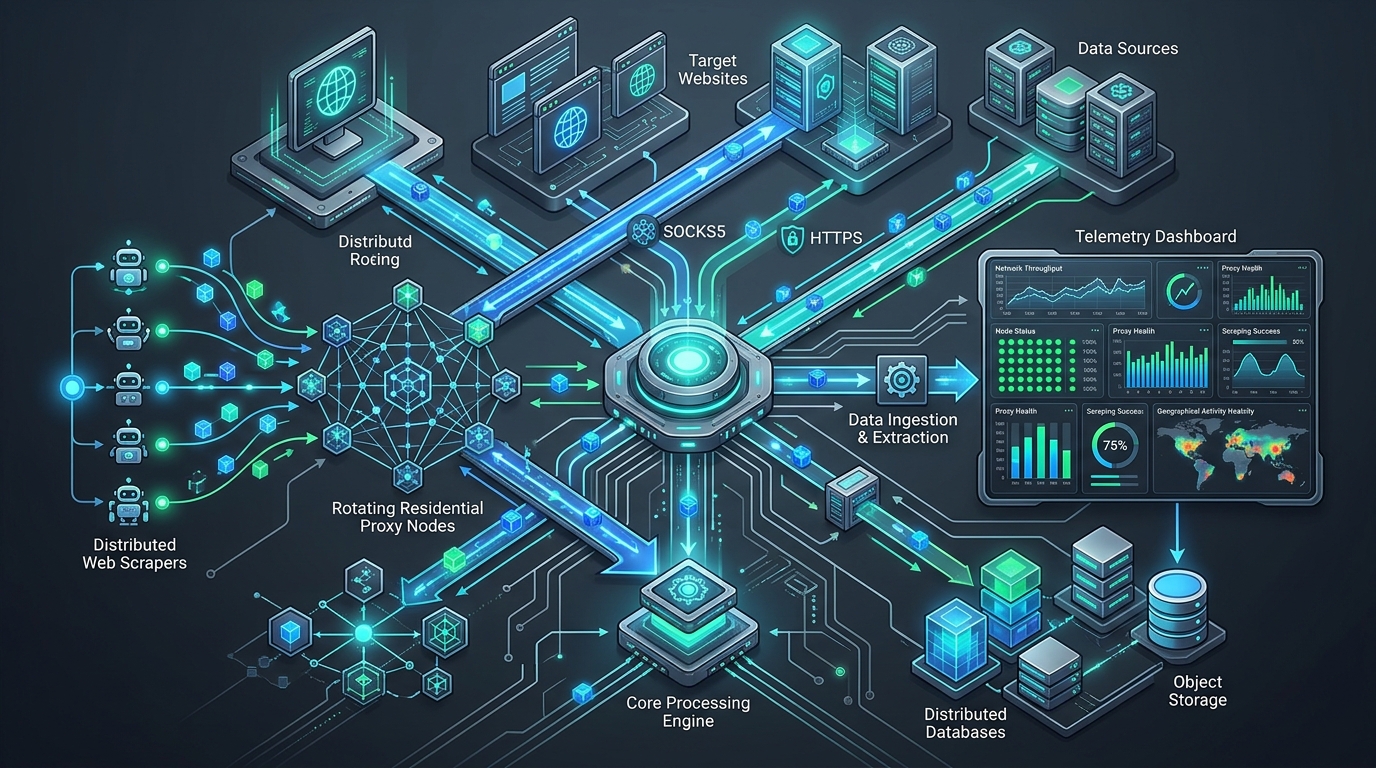
Rather than configuring thousands of static proxy IPs inside your scraping scripts, you point your client application to the official gateway host (v2.proxyempire.io) on port 5000 (full connection endpoint: v2.proxyempire.io:5000). Authentication is username and password only — IP whitelisting is not supported. The official username format is dash-separated, including the session identifier where applicable (e.g., YOUR_USERNAME-country-us-region-california-city-losangeles-sid-123456). When your script sends a request, the ProxyEmpire routing balancer inspects your credentials and binds the connection to a live peer node matching your exact targeting parameters. Destination websites see only the IP address and TCP signature of a legitimate consumer home internet connection (such as Comcast, AT&T, Charter Spectrum, Deutsche Telekom, or BT), effectively bypassing datacenter IP firewalls.
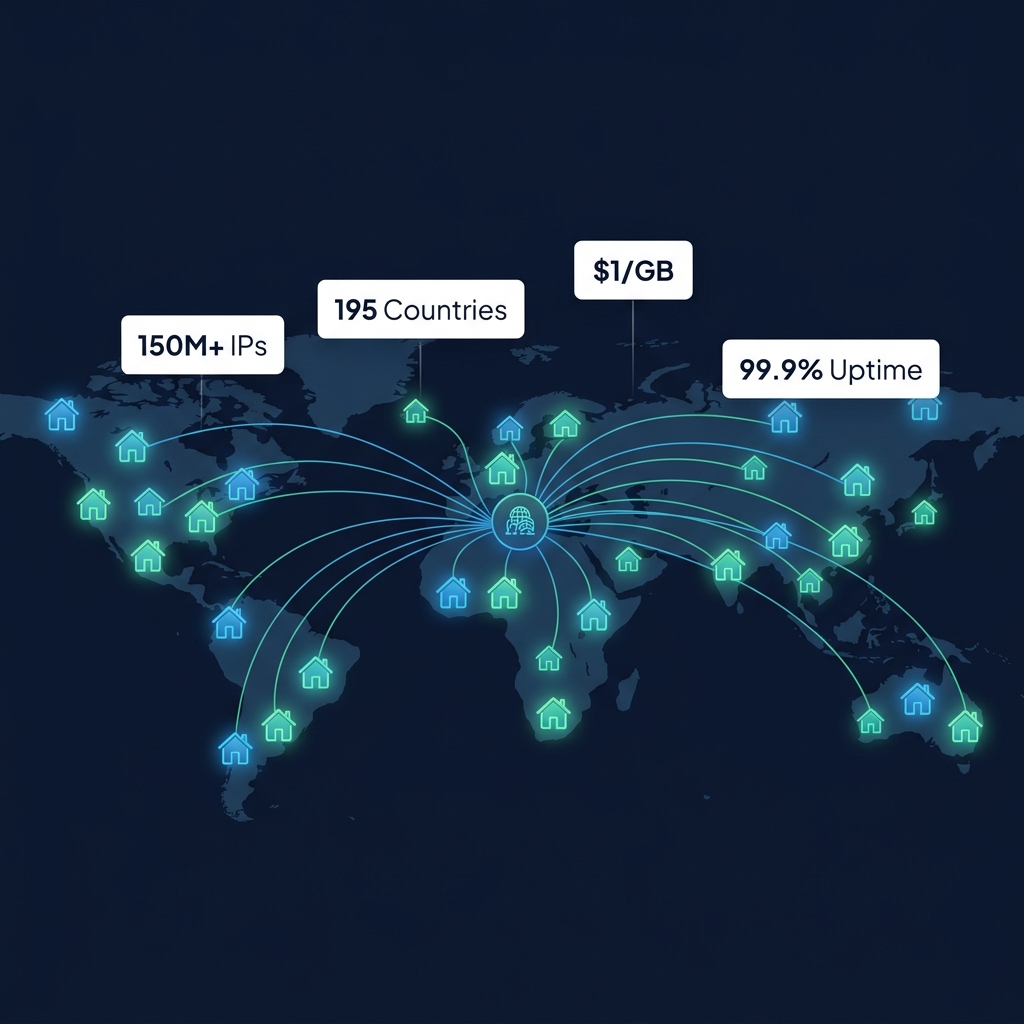
Figure 1 — ProxyEmpire network routing: single ingress endpoint dynamically multiplexes requests across 30M+ residential nodes
As illustrated in Figure 1 above, ProxyEmpire's ingress architecture decouples your scraper's local networking stack from the target server. Because ProxyEmpire supports native Dual-Stack protocols (HTTP, HTTPS, and SOCKS5), developers are not forced to translate sockets through third-party proxy daemons. Whether you are running a lightweight Python script or driving modern headless browsers via Playwright, your scraper can establish direct SOCKS5 TCP circuits that preserve native TLS handshakes and prevent HTTP proxy header leakage.
ProxyEmpire Network Capacity & Product Tiers
Understanding the composition of ProxyEmpire's proxy inventory is essential for architecting an optimal data extraction workflow. The network is segmented into four primary infrastructure tiers tailored to distinct scraping requirements:
Figure 2 — ProxyEmpire verified network inventory across residential, mobile, and datacenter infrastructure
Rollover Bandwidth Economics & Cost Efficiency
In the proxy industry, bandwidth is traditionally billed under a rigid monthly subscription model. If an engineering team commits to a 100 GB monthly plan for $300 and consumes only 45 GB during that calendar month, the remaining 55 GB of bandwidth expires and is permanently forfeited. This "use-it-or-lose-it" practice drives up the real effective cost of scraping to more than double the advertised headline rate.
ProxyEmpire's headline economic feature is non-expiring bandwidth. Unused bandwidth never expires. Customers do not need an active subscription to retain or use their remaining balance, and customers can cancel and still use their remaining balance. For teams running irregular, seasonal, or project-based web scraping pipelines, this non-expiring bandwidth policy ensures 100% capital efficiency and zero wasted expenditure.
Figure 3 — Capital efficiency comparison: non-expiring data versus artificial 30-day forfeiture models
As modeled in Figure 3, a team utilizing ProxyEmpire never experiences artificial billing-cycle cliff effects. Furthermore, teams scaling their operations benefit from significant volume discounts: Standard Residential list/PAYG price: $7/GB. Limited-time EMPIRE50 promotional price: $3.50/GB, representing a 50% discount on Rotating Residential and Rotating Mobile. Plan example: $20 for 7 GB. 1,000 GB tier: $1.50/GB. Residential network: 30M+ IPs. For comprehensive market comparisons, explore our guide on the best residential proxies in 2026.
Granular Geo-Targeting Syntax
Web extraction tasks frequently require geo-specific data: localized price tracking, regional search results, and localized content delivery. ProxyEmpire encodes targeting criteria directly into the proxy username authentication string. When the ingress gateway parses the username, it filters the 30M+ residential pool down to candidate peers matching your exact geographical parameters.
Figure 4 — ProxyEmpire geo-targeting resolution hierarchy embedded within proxy username syntax
The geo-targeting syntax follows a standardized hierarchy of delimiter tags appended to the username:
- Country Targeting (
-country-[iso]): Allocates peers from a specific nation using ISO 3166-1 alpha-2 codes (e.g.,-country-us,-country-de,-country-gb,-country-jp) at no extra cost. - Region / State Targeting (
-region-[name]): Targets specific administrative regions or US states (e.g.,-region-california,-region-texas,-region-bavaria) at no extra cost. - City-Level Targeting (
-city-[name]): Narrows exit routing to a specific metropolitan area (e.g.,-city-losangeles,-city-london,-city-tokyo) at no extra cost. - ZIP Code Targeting (
-zip-[code]): Directs traffic down to specific postal codes (e.g.,-zip-90210) at no extra cost. - ISP / Carrier Targeting (
-isp-[name]): Binds requests to specific consumer internet providers and cellular carriers (e.g.,-isp-comcast,-isp-verizon,-isp-vodafone) at no extra cost. - ASN Targeting (
-asn-[number]): Routes connections through specific Autonomous System Numbers (e.g.,-asn-7922) at no extra cost. - OS Fingerprint Targeting (
-os-[name]): Emulates organic operating system signatures (Windows, macOS, Android, iOS) at no extra cost.
IP Rotation Mechanics: Per-Request vs Sticky Sessions
Choosing between stateless per-request rotation and stateful sticky sessions is the defining decision in proxy automation design. ProxyEmpire supports both operational models through username parameters:
Figure 5 — Request lifecycle timeline: per-request rotation versus configurable sticky session holding durations
Per-Request Dynamic Rotation
In per-request mode, every outgoing HTTP request or TCP connection receives a newly allocated IP from the pool. This maximizes anonymity, ensures request load is evenly distributed across millions of IPs, and renders IP-based request frequency limits irrelevant. Per-request rotation is ideal for stateless data scraping: product catalog crawling, SERP harvesting, and public API data collection. For further background on rotation mechanics, see our primer on what is a rotating proxy.
Sticky Sessions (Same-IP Mode & Timed Rotation up to 2 Hours)
When your scraper must log in, maintain user session cookies, navigate multi-page checkout flows, or interact with single-page applications, changing IP addresses on every click triggers fraud alerts and logs you out. ProxyEmpire's sticky sessions solve this by pinning your connection to a single residential peer using two confirmed modes: Same-IP mode: no fixed maximum duration. Timed rotation: up to 2 hours. If the residential peer unexpectedly disconnects, the gateway immediately migrates your session to a healthy peer in the same geographical region, preserving workflow continuity.
High-Concurrency Asynchronous Scraping Pipeline
To achieve enterprise throughput (harvesting tens of thousands of URLs per hour), modern scrapers run asynchronous event loops rather than synchronous blocking calls. The architecture in Figure 6 illustrates a high-concurrency pipeline built with Python's asyncio and aiohttp:
Figure 6 — Scalable asynchronous scraping pipeline leveraging non-blocking socket loops and ingress load balancing
By governing task concurrency with an asynchronous semaphore (e.g., 50 parallel workers), the pipeline maintains constant saturation of the ProxyEmpire ingress gateway without overflowing local socket descriptors or triggering target website rate limits. Each request exits from a distinct residential peer, creating an organic, human-like traffic profile that evades behavioral anti-bot detection.
Production Integration Code Implementations
The following production-ready scripts demonstrate how to configure and deploy ProxyEmpire across Python, Node.js Playwright, and command-line cURL.
1. Python Requests with SOCKS5 Proxy
import requests

# ProxyEmpire Ingress Credentials
GATEWAY    = "v2.proxyempire.io:5000"
PROXY_USER = "YOUR_USERNAME-country-us-region-california-city-losangeles-sid-123456"
PROXY_PASS = "your_secure_password"

# Native SOCKS5 Protocol Tunnel (Layer-5 TCP Stream)
proxies = {
    "http":  f"socks5h://{PROXY_USER}:{PROXY_PASS}@{GATEWAY}",
    "https": f"socks5h://{PROXY_USER}:{PROXY_PASS}@{GATEWAY}"
}

headers = {
    "User-Agent": "Mozilla/5.0 (Windows NT 10.0; Win64; x64) AppleWebKit/537.36 (KHTML, like Gecko) Chrome/124.0.0.0 Safari/537.36",
    "Accept": "text/html,application/xhtml+xml,application/xml;q=0.9,*/*;q=0.8",
    "Accept-Language": "en-US,en;q=0.9"
}

try:
    response = requests.get("https://ipinfo.io/json", proxies=proxies, headers=headers, timeout=15)
    response.raise_for_status()
    data = response.json()
    print("Proxy Connection Successful:")
    print(f"Assigned Residential IP: {data.get('ip')} | Region: {data.get('region')} | ISP: {data.get('org')}")
except requests.exceptions.RequestException as e:
    print(f"Connection error: {e}")
2. Python Asynchronous Scraping with aiohttp
import asyncio
import aiohttp

GATEWAY    = "v2.proxyempire.io:5000"
PROXY_USER = "YOUR_USERNAME-country-us-region-california-city-losangeles-sid-123456"
PROXY_PASS = "your_secure_password"
PROXY_URL  = f"http://{PROXY_USER}:{PROXY_PASS}@{GATEWAY}"

CONCURRENCY_LIMIT = 25
semaphore = asyncio.Semaphore(CONCURRENCY_LIMIT)

async def fetch_target(session, index):
    async with semaphore:
        url = f"https://httpbin.org/ip?worker={index}"
        try:
            async with session.get(url, proxy=PROXY_URL, timeout=12) as resp:
                if resp.status == 200:
                    data = await resp.json()
                    print(f"[Worker {index:02d}] Success -> IP: {data.get('origin')}")
                    return data
        except Exception as err:
            print(f"[Worker {index:02d}] Failed: {err}")

async def main():
    conn = aiohttp.TCPConnector(limit=100, ssl=False)
    async with aiohttp.ClientSession(connector=conn) as session:
        tasks = [fetch_target(session, i) for i in range(1, 51)]
        await asyncio.gather(*tasks)

if __name__ == "__main__":
    asyncio.run(main())
3. Playwright Headless Automation (Node.js Stealth SOCKS5)
const { chromium } = require('playwright');

(async () => {
  // Launch Playwright via ProxyEmpire SOCKS5 Gateway
  const browser = await chromium.launch({
    headless: true,
    proxy: {
      server: 'socks5://v2.proxyempire.io:5000',
      username: 'YOUR_USERNAME-country-us-region-california-city-losangeles-sid-123456',
      password: 'your_secure_password'
    }
  });

  const context = await browser.newContext({
    viewport: { width: 1920, height: 1080 },
    userAgent: 'Mozilla/5.0 (Macintosh; Intel Mac OS X 10_15_7) AppleWebKit/537.36 (KHTML, like Gecko) Chrome/124.0.0.0 Safari/537.36',
    locale: 'en-US',
    timezoneId: 'America/New_York'
  });

  const page = await context.newPage();
  console.log('Navigating to target via ProxyEmpire NYC residential proxy...');

  await page.goto('https://checkip.amazonaws.com', { waitUntil: 'domcontentloaded' });
  const resolvedIP = (await page.textContent('body')).trim();
  console.log(`Verified Residential Exit IP: ${resolvedIP}`);

  await browser.close();
})();
4. Terminal cURL Verification Commands
# Per-request rotation test via standard HTTPS tunnel
curl -x "http://YOUR_USERNAME-country-de:YOUR_PASSWORD@v2.proxyempire.io:5000"      https://ipinfo.io/json

# Sticky session test via SOCKS5 with remote DNS resolution (Same-IP mode: no fixed maximum duration. Timed rotation: up to 2 hours.)
curl --socks5-hostname "YOUR_USERNAME-country-us-region-california-city-losangeles-sid-123456:YOUR_PASSWORD@v2.proxyempire.io:5000"      https://api.ipify.org?format=json
Troubleshooting & Error Handling Matrix
Even with premium residential proxies, network conditions and anti-bot systems require programmatic error triage. The matrix below outlines how your scraper should handle HTTP status codes returned by the gateway:
ProxyEmpire Technical Scorecard & Verdict
Based on architectural analysis and benchmark evaluations, ProxyEmpire delivers an exceptional combination of protocol agility, IP pool breadth, and billing fairness:
Figure 7 — ProxyEmpire comprehensive engineering scorecard and performance benchmarks
With non-expiring bandwidth, full Dual-Stack protocol support, and granular geo-targeting from country to city and carrier, ProxyEmpire is highly recommended for developers, SMBs, and data engineering teams requiring resilient residential proxies. To compare ProxyEmpire with other leading networks, visit our top proxy provider directory and read our dedicated ProxyEmpire in-depth review.
Frequently Asked Questions
Does ProxyEmpire residential bandwidth expire at the end of the month?
No. Unused bandwidth never expires. Customers do not need an active subscription to retain or use their remaining balance, and customers can cancel and still use their remaining balance.
What is the maximum duration for a sticky residential session?
ProxyEmpire supports two session modes: Same-IP mode: no fixed maximum duration (sessions can continue beyond two hours as long as the peer device stays online) and Timed rotation: up to 2 hours. If the underlying residential peer disconnects before the timer expires, the gateway automatically connects your session to a healthy peer in the same location.
Should I use SOCKS5 or HTTP/HTTPS for web scraping?
Supported protocols include HTTP, HTTPS, and SOCKS5 (with UDP launching soon, not already available). For standard HTML scrapers, HTTP/HTTPS proxies are sufficient. For headless browser automation (Playwright, Puppeteer) or anti-bot avoidance, SOCKS5 is strongly recommended because it operates at Layer 5 without altering headers or leaking proxy metadata.
How does city-level targeting impact available pool size?
Narrowing targeting to a specific metropolitan area restricts candidate exit nodes to peers within that local geographic boundary. Country-level targeting is recommended for massive-scale crawls where city precision is unnecessary.
Is there a paid trial available to benchmark ProxyEmpire before subscribing?
Yes. ProxyEmpire offers a $1.97 paid trial package that includes 100 MB of residential bandwidth and 50 MB of mobile bandwidth with full API and dashboard access to benchmark speed and compatibility.
How does ProxyEmpire protect against Cloudflare and DataDome detection?
Every customer receives a dedicated account manager after activation, with 24/7 human support available. Free targeting covers country, region, city, ZIP, ISP/carrier, ASN, and OS fingerprint at no extra cost.
How does ProxyEmpire protect against Cloudflare and DataDome detection?
ProxyEmpire supplies clean, genuine consumer residential IP addresses that exhibit clean IP reputation metrics and authentic ISP Autonomous System Numbers, evaluated by WAFs as organic human traffic.
Written by PROXYIP
Our editorial team consists of network engineers and data scraping experts dedicated to bringing transparency to the proxy market. We specialize in distributed infrastructure and high-scale data acquisition.