Proxy Rotation Strategies for High-Volume Scraping

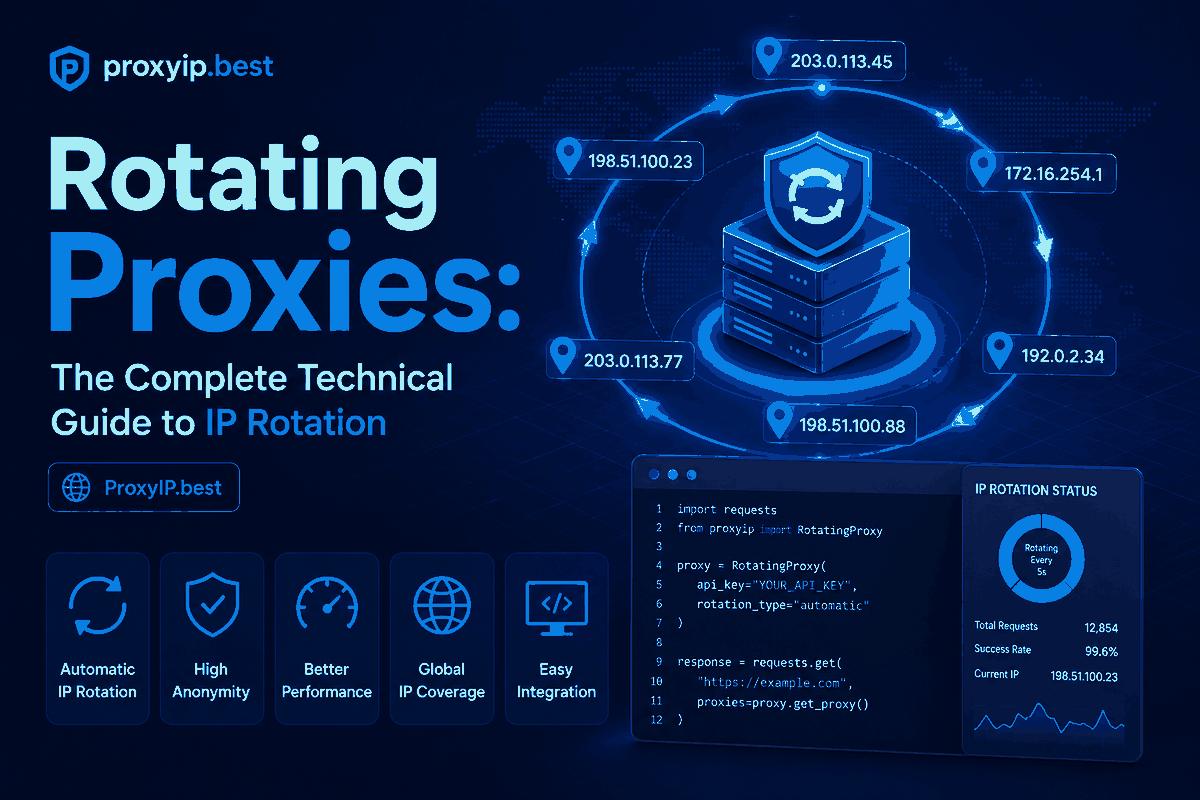
Rotation is the art of distributing requests across many IP addresses so that no single one triggers rate limits, behavioural alarms, or outright bans. Get it right and you can scrape millions of pages reliably; get it wrong and you can burn an entire pool in a matter of hours, leaving your scraper blocked and your budget wasted. Rotation is where many otherwise well-built scrapers quietly fail.
This guide covers the rotation patterns professional data teams rely on in 2026, from simple per-request rotation to sophisticated geo-aware and weighted strategies, plus the resilience logic that keeps a pool healthy under load. It builds directly on the fundamentals in our residential proxies guide and complements our anti-block techniques.
- Per-request rotation spreads load and avoids rate limits
- Sticky sessions preserve state for logins and checkouts
- Backoff and retry logic protect your pool from burnout
- Geo-aware rotation matches IPs to target markets
- Weighting toward clean subnets improves success rates
Per-Request vs Session-Based Rotation
Per-request rotation assigns a brand-new IP to every single call, maximising anonymity and spreading load so thinly that no individual address ever looks suspicious. This is the right default for stateless scraping — crawling product listings, collecting search results, or gathering independent pages where each request stands alone and carries no shared session state.
Session-based, or sticky, rotation holds a single IP for a defined window so that a sequence of related requests appears to come from one coherent user. This is essential for stateful interactions: logging in, navigating a multi-page flow, adding to a cart, or completing a checkout. Most gateway providers let you choose between the two simply by appending a session token to your username, for example user-session-abc123, and the backend keeps that IP pinned for the configured duration. Knowing which mode each part of your job needs is the foundation of an effective rotation strategy.
Backoff, Retry, and Pool Health
When a request fails, the worst thing you can do is immediately retry it through the same IP — that is a fast route to getting both the IP and the pattern flagged. Instead, implement exponential backoff: wait a little longer after each successive failure, rotate to a fresh IP, and add random jitter so retries do not arrive in a robotic rhythm. This both improves your success rate and protects the pool from looking automated.
Equally important is pool hygiene. Track which IPs return blocks or CAPTCHAs and temporarily quarantine them rather than continuing to hammer dead addresses. Periodically validate your working set with a proxy checker so you retire burned IPs before they waste requests. A pool that is actively maintained — with failing IPs quarantined and recovered over time — stays healthy far longer than one used until exhaustion.
Geo-Aware and Weighted Rotation
Naive rotation treats every IP as interchangeable, but the best strategies are aware of geography and quality. Geo-aware rotation matches the IP's location to the target market: scraping a German retailer from German residential IPs produces natural-looking traffic and reduces challenges, whereas hitting it from random global addresses raises suspicion. For multi-market jobs, segment your pool by country and route each request to the appropriate segment.
Weighted rotation goes a step further by biasing selection toward your cleanest, highest-performing subnets while still occasionally exercising the rest. Over time you learn which subnets succeed most often against a given target and lean into them. Enterprise networks like Oxylabs and Bright Data automate much of this with intelligent backend routing, but understanding the principle lets you build similar logic even on simpler providers.
Scaling Rotation in Production
At small scale you can manage rotation in application code, but as volume grows you need infrastructure. Centralise rotation behind a single internal endpoint or a managed gateway so every worker draws from the same coordinated pool and shares quarantine state, preventing one worker from retrying an IP another just got blocked on. Instrument everything: track success rate per subnet, per country, and per target so you can spot degradation early.
Concurrency tuning matters too. Pushing too many parallel requests through a limited pool reuses IPs too quickly and triggers rate limits; too little concurrency wastes the pool's capacity. Find the balance empirically by raising concurrency until success rates start to dip, then backing off. With centralised coordination, healthy backoff, and continuous measurement, rotation scales smoothly from thousands to millions of requests. Choose a rotation-friendly provider from our directory to build on.
Best Networks for Rotation
These providers offer the most flexible rotation controls and largest clean pools.
| Provider | Best For | Entry Price | Network Type |
|---|---|---|---|
| Oxylabs | Enterprise scraping | $8/GB | Residential / DC / Mobile |
| Bright Data | Hard anti-bot targets | $8.40/GB | Residential / ISP / Mobile |
| Smartproxy | Best value all-rounder | $4/GB | Residential / Datacenter |
| IPRoyal | Budget & sneakers | $1.75/GB | Residential / Mobile |
| SOAX | Precise geo-targeting | $12/GB | Residential / Mobile / ISP |
Recommended Providers
For rotation-heavy workloads, these networks provide the controls and pool depth you need.
- Oxylabs — enterprise-grade network with 100M+ residential IPs and a near-perfect success rate.
- Bright Data — the most advanced unlocking technology for the toughest anti-bot targets.
- Smartproxy — the best balance of price, usability and performance for growing teams.
- IPRoyal — budget-friendly, non-expiring residential traffic.
- SOAX — precise city and carrier-level targeting on a clean pool.
Browse the full directory on our proxy providers page, or grab a discount from the latest coupons.
Frequently Asked Questions
How often should I rotate proxies?
For stateless scraping, rotate every request or every few requests. For stateful flows, hold a sticky session for the full duration of the interaction, then rotate for the next task.
What causes a proxy pool to burn out?
Hammering failed IPs, ignoring rate limits, reusing addresses too quickly, and high concurrency on a small pool. Backoff, quarantine, and concurrency tuning prevent it.
What is the difference between rotating and sticky sessions?
Rotating sessions give a new IP per request for anonymity; sticky sessions hold one IP for a window to preserve state across related requests like logins and checkouts.
How do I rotate proxies at scale?
Centralise rotation behind a shared gateway so all workers coordinate pool and quarantine state, and instrument success rates per subnet and target to tune the system continuously.
Further Reading & Trusted Resources
To deepen your understanding of proxy rotation, we recommend cross-referencing independent sources. The Wikipedia entry on proxy servers offers a solid technical foundation, while community-driven testing sites such as ProxyTrust and 5-Proxy publish hands-on benchmarks that complement our own findings. For protocol specifics, the SOCKS protocol reference and the web scraping overview are worth bookmarking.
You can validate any IPs you acquire using our own free proxy checker, then compare shortlisted vendors side by side with the PROXYIP comparison tool.
Final Thoughts
Smart rotation is what separates hobby scrapers from production pipelines. Combine per-request and sticky strategies, add resilient backoff and retry logic, keep your pool clean, and make rotation geo- and quality-aware. Measure continuously and tune concurrency to your pool size. Pick a rotation-friendly provider from our directory and validate it with the checker.
Written by PROXYIP
Our editorial team consists of network engineers and data scraping experts dedicated to bringing transparency to the proxy market. We specialize in distributed infrastructure and high-scale data acquisition.