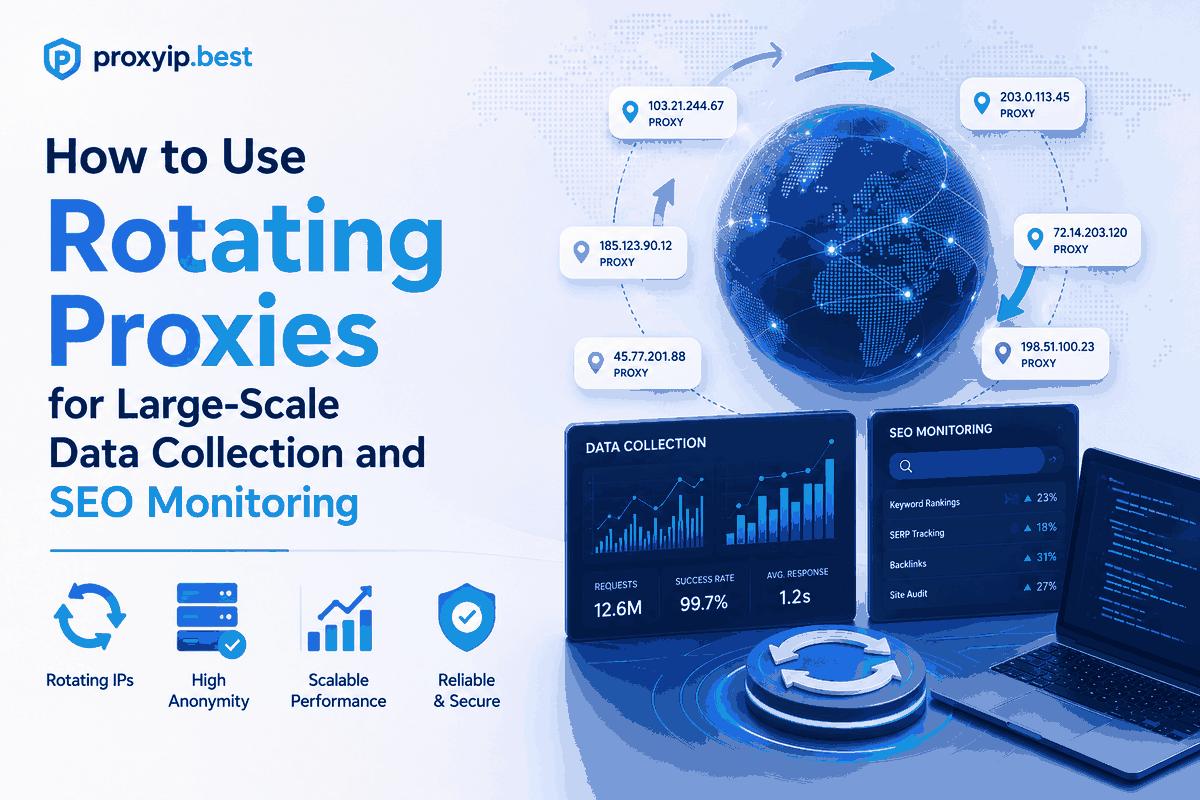
How to Use Rotating Proxies for Large-Scale Data Collection and SEO Monitoring
In the modern digital economy, data is the ultimate competitive currency. Organizations across the globe rely on web scraping, e-commerce monitoring, and real-time market research to make informed decisions. However, extracting web data at an enterprise scale is no longer as simple as sending basic HTTP requests to a target website. The web has grown increasingly hostile to automated crawlers. Security platforms utilize advanced artificial intelligence, behavioral analytics, and sophisticated bot-detection frameworks to identify and immediately block non-human traffic.
At the center of this battle is the Internet Protocol (IP) address. When a single IP address sends hundreds or thousands of rapid requests to a web server, it is immediately flagged as a bot. To bypass these limitations and maintain uninterrupted access to critical public web data, businesses utilize IP rotation. Specifically, implementing a network of rotating proxy services is the industry standard for maintaining access to modern web systems.
This comprehensive guide details the technical specifications, architectural setups, and deployment best practices for using rotating proxies to power large-scale data collection pipelines and SEO monitoring infrastructures. We will explore how to route traffic, optimize success rates, and construct resilient scraping frameworks that can bypass even the most aggressive security architectures.
Understanding the Mechanics of Rotating Proxies
To successfully integrate proxy solutions into a data harvesting environment, we must first understand how they operate. A proxy server acts as an intermediary gateway between your scraper and the destination web server. Under normal circumstances, your system communicates directly with the target server, exposing your home or cloud hosting provider's IP address. By routing your requests through a proxy server, the target server sees only the IP address of the proxy.
A standard static proxy assigns you a single IP address that remains constant over time. While useful for basic tasks, static IPs are easily rate-limited or permanently blocked when used for web scraping. A rotating proxy system solves this issue by automatically changing the outbound IP address routed to the destination server.
How IP Rotation Works Under the Hood
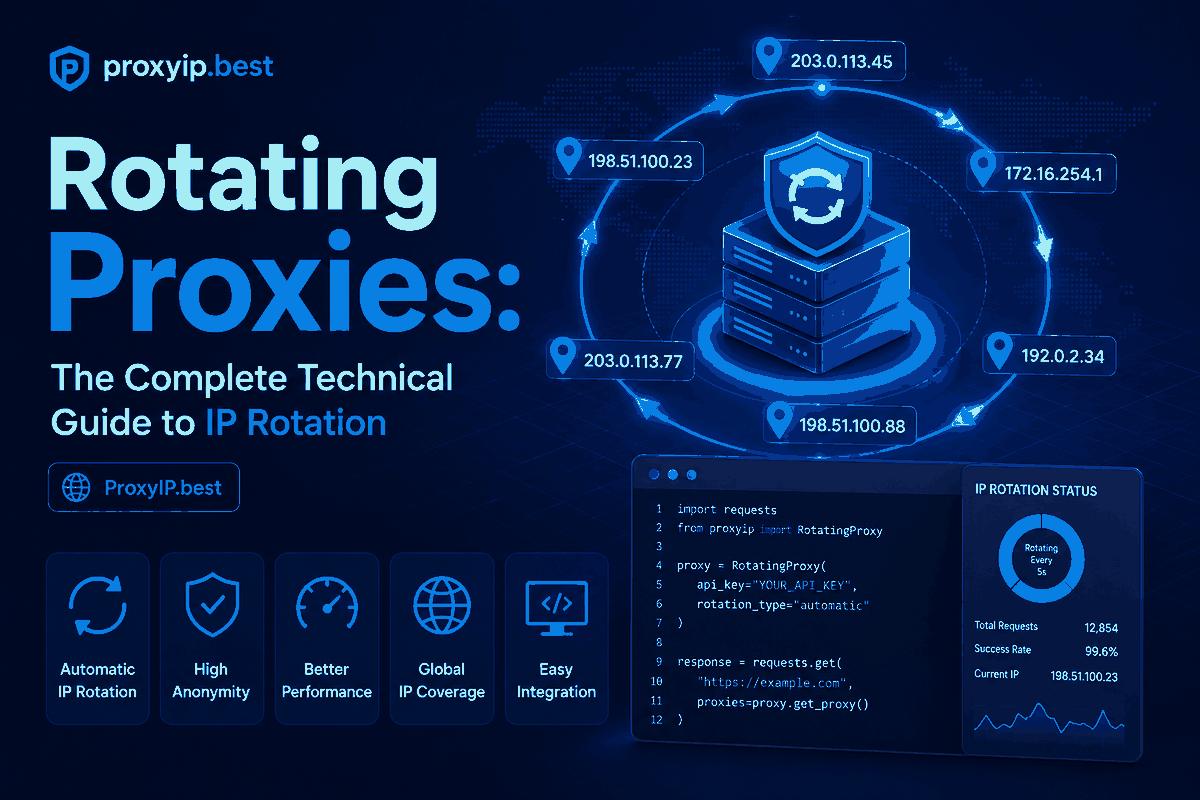
The core mechanism of modern rotating proxies relies on a backconnect proxy architecture. Instead of connecting directly to thousands of individual proxy servers, your scraper communicates with a single entry point called the backconnect gateway. The gateway is a server with a specific hostname and port (for example, gate.proxyip.best:8000). When you send a request to this gateway, the gateway automatically selects a clean IP address from its active residential proxy pool and routes your request through that IP address to the target site.
From the perspective of your code, you only need to configure one proxy URL. The complexity of managing thousands of physical connections, checking IP health, and executing the rotation is handled entirely by the proxy gateway. This abstraction simplifies client-side architecture and ensures minimal overhead for your application.
Rotating vs. Sticky Sessions
Depending on the nature of your target website and data extraction pipeline, you will require different session configurations:
- Rotating Sessions (Per-Request Rotation): The gateway assigns a brand-new IP address for every individual HTTP request. This is the optimal configuration for massive, stateless web scraping operations (e.g., harvesting price logs or downloading product listings) where no state or login session needs to be maintained.
- Sticky Sessions (Session Persistence): The gateway maintains the same outbound IP address for a specified duration (typically ranging from 1 to 30 minutes). This is achieved by appending a session ID parameter to your authentication string (e.g.,
username-session-12345). Sticky sessions are crucial when navigating sites that require logins, shopping cart interactions, or multi-step checkout processes, where an immediate change of IP address would cause the website to terminate the session.
The Network Hierarchy: Datacenter, Residential, and Mobile Pools
Understanding where these IP addresses originate is essential for estimating success rates and costs. As documented on resources like Wikipedia's article on proxy servers, proxy networks are generally classified into three distinct categories based on their network architecture and ownership.
First, datacenter proxies originate from cloud servers and server farms. They are extremely fast and inexpensive, but their block rates are high because security systems can easily identify their IP ranges. Second, residential proxies are real IP addresses assigned by local Internet Service Providers (ISPs) to households. They possess the highest trust scores because they look exactly like legitimate residential users browsing the web. Third, mobile proxies route traffic through 3G, 4G, or 5G cellular networks, which are highly trusted but carry a premium price tag.
The Role of Rotating Proxies in Large-Scale Data Collection
Implementing large-scale data extraction requires a system that can bypass modern bot detection filters. When you scrape millions of pages daily, target websites use defensive layers to block your scrapers. Let's analyze how rotating proxies enable you to bypass these barriers.
Overcoming Advanced Bot Detection and WAFs
Modern Web Application Firewalls (WAFs) like Cloudflare, Akamai, and Imperva analyze incoming connection packets in real-time. They look at rate limits, TLS configurations, and client behavior. If a scraper uses a single IP address to request hundreds of pages, the WAF immediately triggers a rate-limit block or displays a CAPTCHA screen. By distributing requests across a wide web scraping proxy solution, rotating proxies keep the requests per IP below detection thresholds, ensuring high success rates.
Navigating Geolocation-Targeted Content
Many e-commerce stores, flight booking portals, and search engines display different content, prices, or languages depending on the visitor's geographic location. Scraping this data accurately requires sending requests from the correct region. High-quality rotating residential proxies allow you to target specific countries, states, and cities. The backconnect gateway handles the geolocation routing, ensuring you receive local data without regional blocks.
Technical Insight: In modern data collection, IP geolocation targeting is not just about choosing a country. To scrape hyper-localized pricing or regional search results, you must choose a proxy provider that allows targeting down to specific metropolitan areas or Autonomous System Numbers (ASNs).
Managing High Concurrency and Throughput
To collect millions of data points daily, scrapers must run multiple requests in parallel. Managing this concurrency requires a proxy system with high throughput. A backconnect gateway lets you send thousands of concurrent requests, routing each through a different IP address from the pool. This allows your scraper to run at high speed without overloading individual IP addresses.
The Role of Rotating Proxies in SEO Monitoring
Search Engine Optimization (SEO) monitoring requires continuous, automated tracking of search engine result pages (SERPs). Because search engines guard their data and personalizing algorithms, scraping SERPs is one of the most challenging tasks in web data collection.
Bypassing Search Engine Defenses
Search engines like Google employ advanced security systems to prevent automated scraping. Sending multiple automated queries from a single IP address will quickly trigger CAPTCHA screens. Using a clean residential proxy pool is essential to bypass these filters. Because these IPs belong to residential ISPs, search engines treat them as real search queries, allowing you to gather ranking data without interruption.
Ensuring Search Result Accuracy via Hyper-Localization
Search results are highly personalized based on user location. A search query for "plumber near me" or "best CRM software" will yield different organic rankings in New York than it does in London. For precise tracking, you must use a dedicated SEO proxy monitoring guide to configure regional targeting. Routing your queries through localized residential IP addresses ensures you capture the exact rankings displayed to users in those specific areas.
Auditing Competitor Sites and Backlink Networks
Monitoring competitor changes, crawling site architectures, and checking backlinks at scale requires sending high-volume requests to competitor domains. If those domains detect automated audits from a single server IP, they may block your scraper or present dummy page versions. Rotating your IPs ensures your competitive audits run undetected and gather accurate competitor insights.
Technical Comparison of Proxy Types
Choosing the correct proxy architecture requires balancing costs, speed, and success rates. The table below compares different proxy types for data scraping and SEO monitoring applications.
| Proxy Type | IP Pool Diversity | Average Latency | Detection Risk | Cost per GB / IP | Best Use Case |
|---|---|---|---|---|---|
| Static Datacenter | Low (Identifiable subnets) | Low (<150ms) | Very High | Low (Per IP model) | Basic scraping on low-security sites, account management |
| Rotating Datacenter | Medium (Limited subnet ranges) | Low (<200ms) | High | Moderate | High-speed scraping on websites without active WAF protection |
| Rotating Residential | Very High (Millions of real home IPs) | Moderate (400ms - 800ms) | Extremely Low | Based on Bandwidth | Large-scale data collection, localized SEO monitoring, e-commerce scraping |
| Rotating Mobile (4G/5G) | High (Shared mobile networks) | High (800ms - 1200ms) | Lowest | High (Bandwidth-based) | Social media scraping, bypass-heavy anti-bot systems |
For large-scale tasks, rotating residential proxies offer the best balance of trust, pool size, and success rates, making them the standard choice for professional data extraction teams.
Key Benefits of Integrating Rotating Proxies
Integrating a rotating proxy system into your data extraction infrastructure provides several key operational advantages:
High Request Success Rates
By routing requests through unique residential IP addresses, your system avoids rate limits and block lists, leading to higher success rates and fewer failed requests.
Continuous Scraping Operations
If an IP address is blocked or goes offline, the gateway automatically rotates to a new IP, keeping your data collection pipeline running without interruption.
Location-Specific Customization
Rotating proxy networks allow targeting down to specific countries and cities, enabling accurate harvesting of localized prices, ads, and search results.
Reduced Infrastructure Complexity
Using a backconnect gateway simplifies client-side code by eliminating the need to manage proxy health, rotations, and failovers internally.
Industry Use Cases
Let's look at how rotating proxies are applied across different industries to solve data collection challenges:
E-commerce Price Intelligence and Market Tracking
E-commerce retailers monitor competitor pricing, inventory levels, and product descriptions in real-time. Because retail sites actively block scrapers, companies use residential proxy networks to distribute their requests, allowing them to gather pricing data without triggering blocks or false information.
Ad Verification and Fraud Detection
Digital advertising companies must verify that their ads are displayed on the correct sites, visible to target audiences, and free from click fraud. Fraudulent websites often display fake ads to server hosting IPs while hiding them from real users. Routing requests through rotating residential proxies lets ad networks verify ad placements undetected.
Brand Protection and Anti-Counterfeiting
Brands monitor online marketplaces, social networks, and domains to detect counterfeit goods and intellectual property violations. Counterfeiters often block requests originating from corporate networks. Using rotating proxies allows brand protection teams to crawl these sites and locate unauthorized listings.
Best Practices for Implementing Rotating Proxies
To maximize the efficiency of your rotating proxy system and minimize bandwidth costs, follow these implementation best practices:
1. Select the Correct Proxy Pool for Your Target
Do not use expensive residential bandwidth for sites with minimal protection. For simple scraping projects, high-speed datacenter proxies are faster and more cost-effective. Reserve residential proxies for platforms protected by active bot detection and firewalls. For basic research, you can also leverage public free proxy lists, though these are not recommended for production environments.
2. Bypass Advanced Browser Fingerprinting
Modern security systems look at more than just the IP address; they analyze your browser's digital fingerprint. If your scraper uses a residential IP but sends incomplete HTTP headers or missing TLS signatures, it will be flagged as a bot. When scraping with headless browsers (like Puppeteer or Playwright), ensure you use extensions like puppeteer-extra-plugin-stealth, randomize your user-agents, and match your header order to look like a standard web browser.
3. Implement Smart Retry Logic and Error Handling
Residential IPs are dynamic and can disconnect at any time. Your code must handle connection drops, timeouts, and HTTP status codes (e.g., 403 Forbidden, 429 Too Many Requests, or 503 Service Unavailable). Implement retry logic that automatically sends failed requests through a new proxy session and logs consistent errors to flag potential blocks.
4. Respect Target Sites and Scrape Ethically
Even with rotating proxies, scraping responsibly is critical. Avoid overloading target web servers with excessive traffic, which can degrade their performance. Implement delay mechanisms, respect robots.txt rules when possible, and structure your scrapers to access data during off-peak hours to minimize server load.
Comparative Industry Insights
In addition to standard setups, enterprise data harvesters often utilize third-party tools and platforms to complement their workflows. While providers like flexible proxy pricing plans offer premium pools, developers also evaluate other systems in the ecosystem. For example, comparing performance metrics on forums and referencing platforms like 5-proxy.com commercial proxy provider and proxytrust.site network services helps teams evaluate pool sizes, success rates, and routing latency under heavy loads.
Frequently Asked Questions
Conclusion
Implementing rotating proxies is essential for conducting large-scale data collection and accurate SEO monitoring in today's web environment. As security systems and bot detection algorithms become more advanced, relying on simple scraping setups or static datacenter IPs is no longer sufficient. By utilizing a diverse, ethically sourced residential proxy pool, configuring localized targeting, and implementing stealth browser practices, you can build a resilient data harvesting system.
Deploying a backconnect proxy gateway simplifies your infrastructure, handles the complexities of rotation, and ensures high success rates across target domains. Incorporating these proxy strategies lets your team capture accurate, real-time web insights, monitor search engine optimization metrics at scale, and maintain a competitive edge in your market.
Written by PROXYIP
Our editorial team consists of network engineers and data scraping experts dedicated to bringing transparency to the proxy market. We specialize in distributed infrastructure and high-scale data acquisition.