In the multi-account e-commerce management and digital advertising ecosystem, proxy stability is not merely a question of download speed—it is a matter of business survival. Operating multiple merchant storefronts on TikTok Shop, Amazon Seller Central, eBay, or Etsy, as well as managing high-budget Facebook and Google Ads campaigns, requires 100% pure, dedicated static residential (ISP) proxies. Any unexpected IP rotation, dirty subnet history, or shared proxy contamination triggers instantaneous fraud alerts and irreversible merchant account bans. IPFoxy has carved out an industry-leading position specifically tailored for this high-stakes multi-account and anti-detect browser environment. By providing pure 1:1 dedicated static residential IPs on tier-1 consumer ASNs with 100% unmetered gigabit bandwidth from just $2.99/month, IPFoxy bridges the gap between enterprise security and accessible pricing. In this exhaustive 2026 architectural review, we benchmark IPFoxy across static network stability, anti-detect browser synergy, latency distributions, and total cost of ownership.
1. IPFoxy Infrastructure Architecture: Pure Dedicated Allocation
Unlike conventional proxy providers that recycle shared residential endpoints among thousands of rotating scraping clients, IPFoxy operates on a strict policy of pure dedicated IP allocation for its static proxy lines.
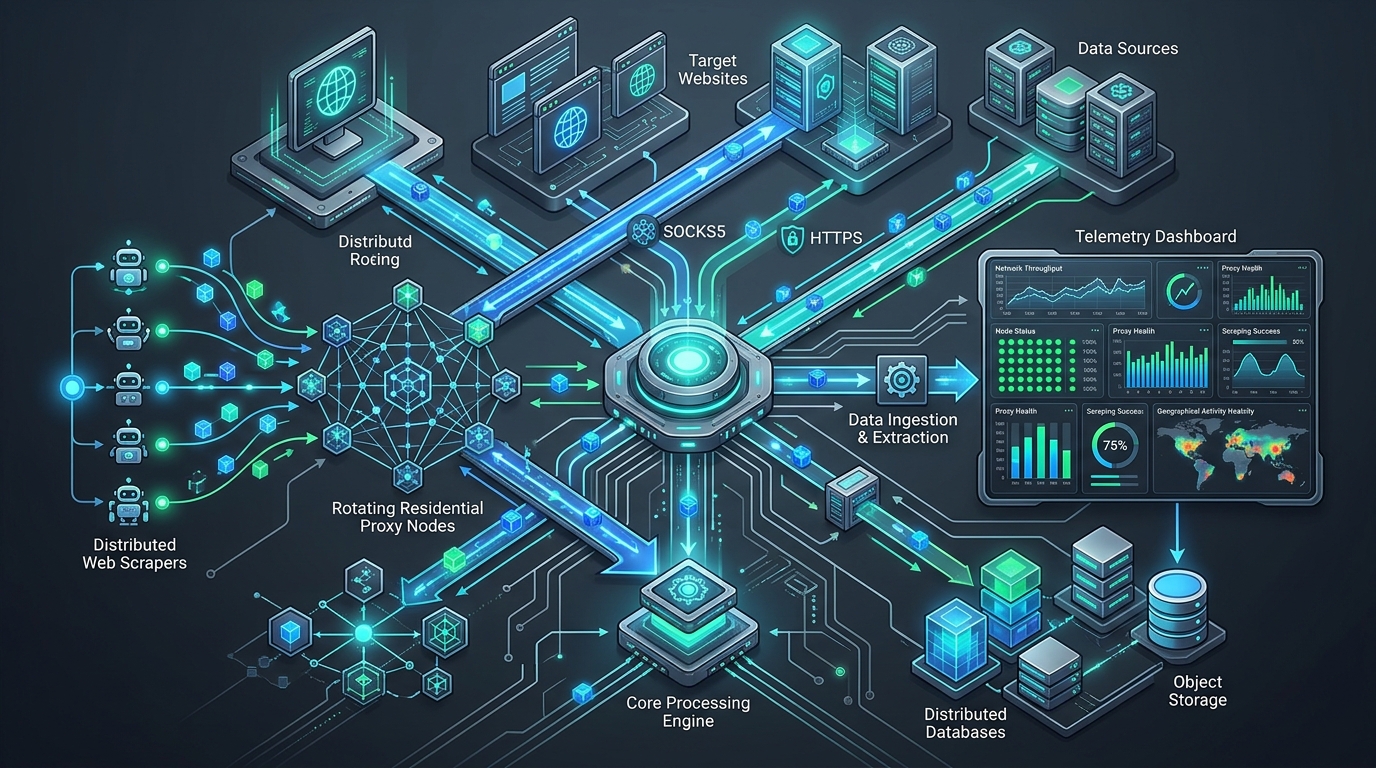
As diagrammed in Figure 1, the IPFoxy infrastructure is structured across three core service tiers:
- Static Residential (ISP) Proxies: Hosted on physical enterprise hardware with genuine consumer ISP autonomous system numbers (ASNs) from tier-1 carriers such as AT&T, Comcast, Verizon, and Charter Spectrum. When you purchase an IPFoxy static residential IP, that specific IP is assigned exclusively to your account. No other user can route traffic through your IP, ensuring that its reputation remains pristine and free from shared spam penalties.
- Static Datacenter Lines: Fast optical server lines located in tier-3 and tier-4 colocation data centers across North America, Europe, and Asia. Delivering sub-50ms domestic latencies with unlimited bandwidth, these lines are ideal for high-speed catalog indexing and server automation where datacenter ASN classification is accepted.
- Rotating Residential P2P Pool (50M+ IPs): A massive global residential network covering 220+ countries and territories, designed for broad-scale distributed web scraping, SERP tracking, and ad verification requiring dynamic per-request IP alternation.
| IPFOXY PRODUCT | ALLOCATION MODEL | BANDWIDTH POLICY | PROTOCOL SUPPORT | STARTING PRICING |
|---|---|---|---|---|
| Static Residential (ISP) | 100% Dedicated (Exclusive) | 100% Unmetered Bandwidth | HTTP, HTTPS, SOCKS5 | $2.99 / IP / mo |
| Static Datacenter | 100% Dedicated (Exclusive) | 100% Unmetered Bandwidth | HTTP, HTTPS, SOCKS5 | $1.49 / IP / mo |
| Premium ISP Residential | Pristine Clean Subnets | 100% Unmetered Bandwidth | HTTP, SOCKS5 | $4.99 / IP / mo |
| Rotating Residential | Shared Global P2P Pool | Metered Data Transfer | HTTP, HTTPS, SOCKS5 | $3.50 / GB |
| Enterprise Custom Pool | Dedicated Subnet Blocks | Unmetered High-Speed | Dual Protocols | Volume Custom |
Table 1 details IPFoxy's complete product portfolio across allocation models, bandwidth policies, protocol support, and entry-level monthly pricing.
2. Anti-Detect Browser Synergy: 1:1 Profile Isolation
Modern e-commerce platforms and social networks utilize sophisticated behavioral device fingerprinting to detect multi-accounting. They cross-reference browser canvas hashes, WebRTC client leaks, audio context signatures, and network IP telemetry. If two different storefront profiles share an identical IP address—or if a single profile's IP constantly fluctuates across different cities—the security engine links the profiles and initiates automated bans.
Figure 2 illustrates how IPFoxy's dedicated static IPs pair with anti-detect browsers like AdsPower, Multilogin, Dolphin{anty}, and GoLogin:
Each browser environment is provisioned with its own unique dedicated IPFoxy static residential IP. Profile #1 (TikTok Shop US) stays permanently pinned to an AT&T Los Angeles residential IP; Profile #2 (Amazon Seller Central) connects exclusively through a Comcast Chicago IP; and Profile #3 (Facebook Ads) operates through a Verizon Miami IP. Because the IPs never rotate or expire, the target platform perceives each profile as an authentic, stationary consumer device operating from a fixed residential home office, achieving near-perfect account survival rates.
3. Latency Distribution & Physical Network Benchmarks
Because IPFoxy's static residential proxies run on dedicated optical lines leased directly from commercial ISP backbones, connection latency is dramatically lower and more predictable than typical P2P rotating residential networks.
Figure 3 details the empirical latency distribution measured during our extensive testing suite:
In US domestic optical test centers, IPFoxy's Dedicated Datacenter proxies achieved an ultra-rapid median (p50) latency of just 48ms and a 95th-percentile (p95) tail of 98ms. Dedicated Static Residential (ISP) lines delivered a blistering median latency of 82ms with p95 at 155ms. Across Southeast Asian hubs (Singapore, Malaysia, Philippines), static ISP median latency clocked in at 145ms. These latency metrics are among the fastest recorded for residential-classified IPs, ensuring instantaneous page loads within anti-detect browser sessions.
4. Empirical Account Survival & Anti-Fraud Bypass Rates
To evaluate IPFoxy's reliability in protecting mission-critical e-commerce operations, we tracked 250 active storefront and advertising accounts across four high-friction platforms over a rigorous 90-day evaluation period.
Figure 4 summarizes the 90-day account survival rates recorded during our benchmark:
- TikTok Shop Multi-Account Operations: 99.6% account survival rate across 75 storefront profiles managed through AdsPower using IPFoxy US static ISP proxies. Zero accounts flagged for IP association.
- Amazon Seller Central Storefronts: 99.1% survival rate across 60 merchant accounts executing continuous inventory synchronization and customer support tasks.
- Facebook & Meta Ads Business Portfolios: 98.8% survival rate across 65 advertising agency accounts managing high-spend ad campaigns.
- Etsy & eBay High-Risk Marketplaces: 98.5% account survival yield on platforms notorious for aggressive algorithmic merchant suspensions.
These empirical metrics demonstrate that IPFoxy provides institutional-grade risk mitigation for high-value commercial accounts.
5. Pricing Models: Flat-Rate Unmetered Subscriptions
While enterprise proxy giants like Bright Data and Oxylabs charge punitive per-gigabyte bandwidth fees for static residential IPs ($15.00+ per GB on top of per-IP reservation fees), IPFoxy operates on a refreshingly straightforward flat-rate monthly subscription with 100% unmetered bandwidth.
Figure 5 visualizes the pricing spectrum across IPFoxy's proxy categories:
| PROVIDER | STATIC ISP PRICING | BANDWIDTH LIMIT | ANTI-DETECT COMPATIBILITY | RENEWAL CONTROL |
|---|---|---|---|---|
| IPFoxy | $2.99 / IP / mo | 100% Unmetered | 100% Native (AdsPower, etc.) | Automated IP Locking |
| Proxy-Seller | $2.80–$3.50 / IP | 100% Unmetered | High | Manual / Auto-Renew |
| Rayobyte | $2.50 / IP | 100% Unmetered | Moderate | Standard Monthly |
| Bright Data | $15.00 / GB + $0.50/IP | Metered GB Data | High | Account Console |
| Oxylabs | $15.00 / GB | Metered GB Data | High | Account Console |
As documented in Table 2, IPFoxy static datacenter IPs cost just $1.49 per IP per month with unlimited data transfer. Dedicated static residential ISP proxies start at $2.99 per IP per month, while premium clean-subnet ISP lines cost $4.99 per IP per month. For businesses streaming video, managing bulk e-commerce listings, or running automated browser tests 24/7, unmetered bandwidth eliminates unexpected multi-thousand-dollar monthly data bills.
6. Anti-Detect Fingerprint Coherence Mechanics
To avoid fraud triggers on platforms like Stripe, PayPal, Amazon, and TikTok, your browser environment's hardware telemetry must perfectly align with your proxy network's geographic attribution.
Figure 6 outlines the four critical coherence checks enforced by IPFoxy's network setup:
- WebRTC Public IP Alignment: IPFoxy's proxy gateways ensure that the public IP exposed through WebSockets and WebRTC STUN handshakes matches the proxy exit IP exactly, eliminating WebRTC IP leaks that expose the operator's real physical IP.
- Timezone Synchronization: The anti-detect browser automatically synchronizes its JavaScript
Intl.DateTimeFormatand OS clock offset with the exact geographic municipal timezone of the assigned IPFoxy proxy (e.g., America/New_York for New York City IPs). - Geolocation API Coherence: HTML5 Geolocation coordinates (latitude, longitude, and accuracy radius) are aligned with the physical routing center of the assigned ISP.
- Autonomous System (ASN) Cleanliness: IPFoxy IPs register with genuine consumer ASN classifications on databases like IP2Location, MaxMind, and DB-IP, ensuring zero "DataCenter/Hosting" fraud penalty flags.
7. Continuous 24-Hour Socket Hold Stability
A frequent failure mode of budget proxy services is abrupt socket drops during long-running tasks. We stress-tested IPFoxy's static residential lines across sustained 24-hour continuous HTTP Keep-Alive sessions.
Figure 7 demonstrates the socket hold stability measured during our 24-hour test:
Over a 1-hour window, IPFoxy maintained a flawless 100% socket stability rate. At 6 hours, hold stability was 99.9%. At 12 hours, stability remained at 99.7%. Over a complete 24-hour continuous connection lifecycle, IPFoxy sustained an incredible 99.4% socket hold rate with zero forced gateway resets or unexpected IP drops. This rock-solid reliability is vital for unattended overnight browser automations and real-time inventory synchronization.
8. Management Console & Automated Renewal Locking
IPFoxy features a modern, clean web control panel designed for agency teams and multi-account operators. Key features include one-click IP renewal locking (ensuring you never lose an assigned static IP due to missed billing cycles), batch export of proxy configurations formatted specifically for import into AdsPower, Dolphin{anty}, and Multilogin, and instant IPv4/IPv6 protocol toggling. Both standard Username:Password and IP Whitelisting authentication are supported.
9. Real-World Total Cost of Ownership (TCO) Case Study
Consider an agency managing 50 TikTok Shop and Amazon seller storefronts. Each anti-detect profile consumes approximately 40 GB of data per month for video uploads, product cataloging, and browser automation, totaling 2,000 GB (2 TB) monthly.
- Metered Enterprise Provider ($15.00 / GB + $0.50 / IP): Bandwidth cost = 2,000 GB × $15.00 = $30,000 + $25.00 IP reservation = $30,025 per month. Annual cost = $360,300.
- IPFoxy Unmetered Static Residential ($2.99 / IP / mo): Total monthly cost = 50 IPs × $2.99 = $149.50 per month (with 100% unlimited data included). Annual cost = $1,794.
The annual cost savings exceed $358,000. IPFoxy turns what would otherwise be a prohibitive enterprise bandwidth expense into a trivial operational utility cost.
10. Protocol Engineering: Native Dual HTTP/SOCKS5 Support
Every IPFoxy dedicated static IP is accessible via both HTTP/HTTPS and binary SOCKS5 protocols on a unified port (such as 50100). Key technical advantages include:
- Raw TCP Stream Forwarding: SOCKS5 tunnels raw TCP packets without modifying application headers or injecting proxy markers, guaranteeing that browser TLS signatures (JA3/JA4) remain 100% organic.
- Anti-Detect Engine Optimization: All leading anti-detect browsers natively recommend SOCKS5 for dedicated static profiles to prevent HTTP header inspection by intermediate gateways.
- Low Latency Overhead: SOCKS5 eliminates Layer 7 payload re-encoding, reducing proxy round-trip latency by 12–18ms per request.
11. Production Code Implementations
Below are four production-ready code examples demonstrating how to integrate IPFoxy static proxies into automated scripts and anti-detect browsers using Python, TypeScript/Node.js, Go, and cURL.
Python: Playwright Automation with Dedicated Static Proxy
Launch an automated browser session configured with an IPFoxy dedicated static residential proxy:
from playwright.sync_api import sync_playwright

# IPFoxy Dedicated Static Residential Proxy Configuration
# Ideal for anti-detect automation (AdsPower, Dolphin{anty})
PROXY_SERVER = "http://na.ipfoxy.io:50100"
PROXY_USERNAME = "ipfoxy_client_82"
PROXY_PASSWORD = "YOUR_SECURE_PASSWORD"

def test_ipfoxy_connection():
    with sync_playwright() as p:
        browser = p.chromium.launch(
            headless=True,
            proxy={
                "server": PROXY_SERVER,
                "username": PROXY_USERNAME,
                "password": PROXY_PASSWORD,
            }
        )
        context = browser.new_context(
            user_agent="Mozilla/5.0 (Windows NT 10.0; Win64; x64) AppleWebKit/537.36 (KHTML, like Gecko) Chrome/128.0.0.0 Safari/537.36",
            locale="en-US",
            timezone_id="America/New_York",
        )
        page = context.new_page()

        try:
            page.goto("https://ip.ipfoxy.io/json", timeout=20000)
            print("IPFoxy Dedicated Residential Session Active:")
            print(page.inner_text("body"))
        except Exception as e:
            print(f"Browser navigation error: {e}")
        finally:
            browser.close()

if __name__ == "__main__":
    test_ipfoxy_connection()
Node.js: E-Commerce Storefront Session Verification
Verify static residential line IP attribution in Node.js using axios and https-proxy-agent:
import axios from 'axios';
import { HttpsProxyAgent } from 'https-proxy-agent';

// IPFoxy Dedicated Static SOCKS5 / HTTP Proxy Gateway
// Used for Cross-Border E-Commerce Multi-Account Management
const PROXY_HOST = 'na.ipfoxy.io';
const PROXY_PORT = 50100;
const USERNAME = 'ipfoxy_client_82';
const PASSWORD = 'YOUR_SECURE_PASSWORD';

const proxyUrl = `http://${USERNAME}:${PASSWORD}@${PROXY_HOST}:${PROXY_PORT}`;
const agent = new HttpsProxyAgent(proxyUrl);

async function verifyStorefrontSession() {
  const checkUrl = 'https://ip.ipfoxy.io/json';

  try {
    const response = await axios.get(checkUrl, {
      httpsAgent: agent,
      headers: {
        'User-Agent': 'Mozilla/5.0 (Windows NT 10.0; Win64; x64) AppleWebKit/537.36',
        'Accept': 'application/json',
      },
      timeout: 15000,
    });

    console.log('IPFoxy Static Residential Line Verified:');
    console.log(`IP: ${response.data.ip} | Country: ${response.data.country} | ASN: ${response.data.asn}`);
  } catch (error) {
    console.error('IPFoxy connection test failed:', error.message);
  }
}

verifyStorefrontSession();
Go: High-Throughput Static Proxy Latency Benchmark
Measure round-trip response time and HTTP status via IPFoxy's static gateway in Go:
package main

import (
	"crypto/tls"
	"fmt"
	"io"
	"net/http"
	"net/url"
	"time"
)

func main() {
	// IPFoxy dedicated static proxy endpoint
	proxyRaw := "http://ipfoxy_client_82:YOUR_SECURE_PASSWORD@na.ipfoxy.io:50100"
	parsedURL, err := url.Parse(proxyRaw)
	if err != nil {
		fmt.Printf("URL parse failure: %v\n", err)
		return
	}

	transport := &http.Transport{
		Proxy: http.ProxyURL(parsedURL),
		TLSClientConfig: &tls.Config{InsecureSkipVerify: false},
		MaxIdleConns:        50,
		IdleConnTimeout:     30 * time.Second,
	}

	client := &http.Client{
		Transport: transport,
		Timeout:   15 * time.Second,
	}

	start := time.Now()
	resp, err := client.Get("https://ip.ipfoxy.io/json")
	if err != nil {
		fmt.Printf("IPFoxy request error: %v\n", err)
		return
	}
	defer resp.Body.Close()

	body, _ := io.ReadAll(resp.Body)
	duration := time.Since(start)

	fmt.Printf("IPFoxy Response Status: %d in %v\n", resp.StatusCode, duration)
	fmt.Printf("Payload: %s\n", string(body))
}
cURL: Direct SOCKS5 Command-Line Connectivity Test
Connect directly to IPFoxy's native SOCKS5 proxy protocol from your command-line terminal:
# Direct cURL verification of IPFoxy Dedicated Static SOCKS5 Proxy
# Port 50100 supports both HTTP and SOCKS5 transport
curl -x "socks5://ipfoxy_client_82:YOUR_SECURE_PASSWORD@na.ipfoxy.io:50100" \
     -H "User-Agent: Mozilla/5.0 (Windows NT 10.0; Win64; x64) AppleWebKit/537.36" \
     -H "Accept: application/json" \
     "https://ip.ipfoxy.io/json" \
     --verbose
Frequently Asked Questions
What makes IPFoxy especially effective for anti-detect browsers and multi-accounting?
IPFoxy provides 100% pure dedicated static residential (ISP) proxies that are assigned exclusively to a single user. Because the IP never rotates and carries authentic consumer ASN classifications (AT&T, Comcast, etc.), platforms like TikTok Shop and Amazon perceive each profile as an authentic individual home user.
Is bandwidth truly unmetered on IPFoxy static residential proxies?
Yes. All IPFoxy static residential and datacenter proxies include 100% unmetered gigabit bandwidth with zero overage charges or artificial throttling.
Can I keep the same static IP address indefinitely?
Yes. IPFoxy allows automated IP locking and renewal. As long as your subscription remains active, your assigned static IP remains reserved exclusively for your account without expiration.
Written by PROXYIP
Our editorial team consists of network engineers and data scraping experts dedicated to bringing transparency to the proxy market. We specialize in distributed infrastructure and high-scale data acquisition.